Yes, you can live in a skoolie or school bus conversion full time and many do. It is so common in fact, when you go to find a new insurance policy, they will often ask you if you are living part-time or full-time at your vehicle so this is not an uncommon thing. Also, a number of services, like mail forwarding services and campgrounds, exist for and in support of those living a full time in their motorhomes.
Depending on your location, you may need to make special modifications to winterize your vehicle, and general maintenance will always arise to make sure your home is livable, whether stationary or mobile mobile, such as roof and window maintenance.
There are a lot of unknowns surrounding a DIY school bus conversion, primarily as it relates to the changing of a commercial vehicle to a non-commercial or residential one. A common question I see is “How fast does a skoolie drive?” and “Are skoolies subject to commercial school bus speed maximums?”
My goal in this blog is to help answer those frequently asked questions, dispel myths, and provide resources to help you do your own research.
Table of Contents
How fast does a skoolie drive?
A school bus conversion does not travel quickly or brake slowly. From personal experience, our cruising speed is 45 miles per hour within the city and 60 to 65 miles per hour on the interstate on a flat surface.
Our bus could go faster since the governor (speed limiter) was removed, but there just aren’t many opportunities or a desire to go faster on smaller roads.
More often than not, we kept our skoolie speed at the above-stated ranges to be considerate of others, unless the posted speed was less than that! Many smaller vehicles don’t understand how to drive around big rigs and we had to be vigilant of them.
What is a school bus governor?
In the case of a school bus, a governor is a device that limits the speed that the vehicle can travel. If your vehicle accelerates past the maximum speed, this speed limiter can turn off the engine forcing deceleration or sound an alarm informing the driver to reduce the speed.
Before the governor was removed in our 2002 Thomas School Bus, if we increased our speed over 65 mph, the bus would beep then turn off, and we would have to pull off to the side of the road to restart.
Maximum Commercial School Bus Speeds
Commercial school bus speed maximums are mandated by a national organization and may be further elaborated at the state level, usually by the State Board of Education or the Transportation Department. Below are some examples of this:
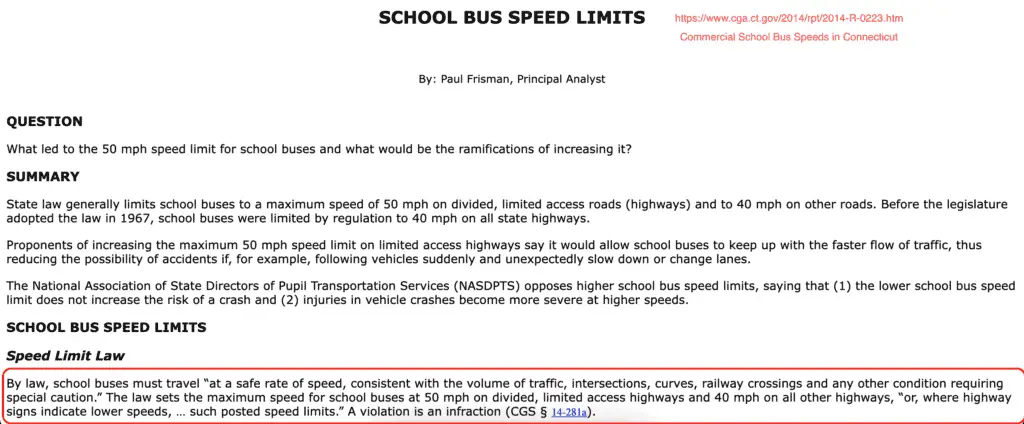
Connecticut: 50 mph on the highway, 40 mph on other roads
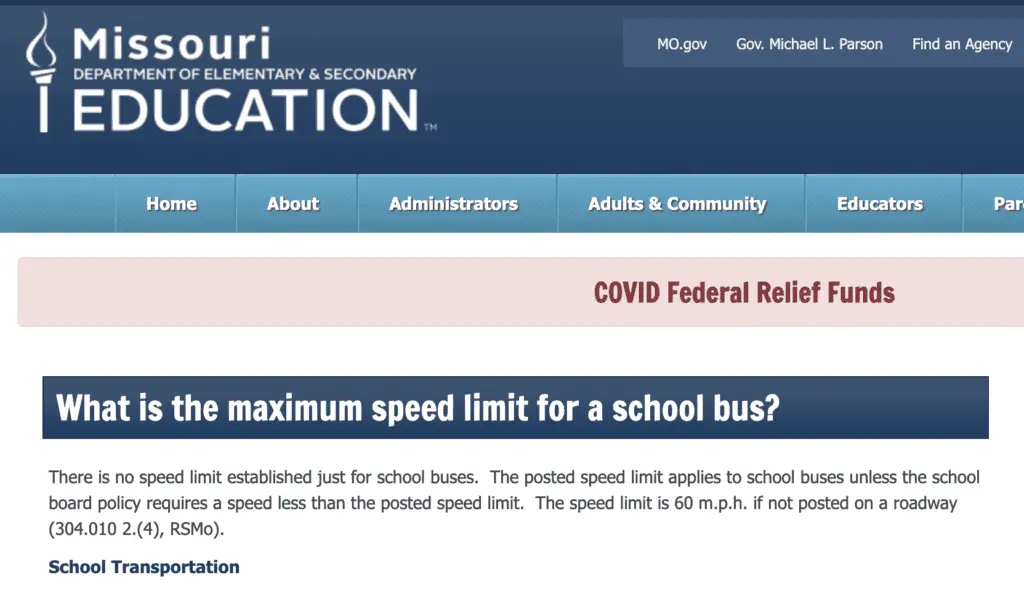
Missouri: 60 mph if not posted – follow the posted speed otherwise.
FAQs on How fast does a skoolie drive?
Are skoolies subject to commercial school bus speed maximums?
From a logical sense, if your vehicle is no longer a commercial vehicle for the purposes of transporting people (as a commercial school bus’ purpose is), then the national school bus speed standards no longer need to be followed. Furthermore, the mechanics that govern a commercial school bus speed can be removed.
Additionally, these commercial school bus speed standards are not drastically lower than stated normal vehicle speeds. Just avoid speeding, y’all!
There may be some gray area in what defines a commercial school bus versus a school bus conversion, especially if the bus hasn’t been built out as a motorhome yet (like the school bus seats are still intact) or retitled as a motorhome. You can always consult an attorney as I am not one, and this is not legal advice.
Can the school bus governor be removed?
Yes, a school bus governor can be removed, and it often is when converting a commercial bus into a motorhome. You can either remove it yourself or pay a knowledgeable diesel mechanic to remove it for you, like we did.
According to posts in forums, the public majority feels that an older vehicle without an electronic system makes the governor removal possible for the owner to do. However, if the bus is a newer model, then a mechanic may be necessary because they will have the software and tools necessary to remove it and reset the bus’ mechanical brain.
Resources to Remove a Skoolie Governor
Check out these videos on how to remove your skoolie governor.
There are a lot of unknowns surrounding a DIY school bus conversion, primarily as it relates to the changing of a commercial vehicle to a non-commercial or residential one.
My family built out our skoolie in 2020-2021 and then we traveled in our rig for 6 months full-time across the east coast of the USA. We learned so much along the way and met so many people.
If you’re at the beginning states of your skoolie journey, check out these blogs:
Just like living in a stationary home, the need to do laundry will always arise. Fortunately, there are a number of cost-effective and reasonable options available. Below are listed some of the services in order of least to most expensive.
Laundromats are readily available and often have loads of machines available, especially if you are there during off-peak hours during the weekdays.
Cost of self service laundromat
I have seen laundry cost between $1.00 to $1.50 per machine, depending on the store.
Most commonly, these facilities are coin operated so have some cash on hand. If you only have bills, there is usually a coin changer in the same room or you can go to the front desk to make change.
Paying by credit card is becoming more common, but it is still hit or miss.
Campground laundry facility
Many campgrounds we stayed out, big and small, offered this service because it really is a necessity. When booking, you can ask customer service or the booking agent if this amenity is available.
If there are limited machines available, I recommend doing laundry in off-peak hours, like early in the morning (6a-10a) and evenings (6p to 10p) and avoiding the weekends.
Expect each cycle to take 30 minutes to 60 minutes (drying usually takes the longest).
Cost of campground laundry service
I have seen laundry cost between $1.00 to $1.50 per machine, depending on the park or campground.
Most commonly, these facilities are coin operated so have some cash on hand. If you only have bills, there is usually a coin changer in the same room or you can go to the front desk to make change.
Laundry etiquette when using group laundry facilities
As a common courtesy, if there are few machines available and a queue, don’t be rude and leave your laundry blocking someone from doing their laundry when yours is done. Otherwise, you may find your laundry pulled out and you lose your place in line!
Laundromat (wash and fold service)
We exclusively use laundromats to do our laundry when living in our school bus conversion. Specifically, we use the wash and fold service which means that we drop off our laundry to the laundromat, pay a flat fee based on the weight of the clothes, and a staff member will perform all the laundry duties (wash, dry and fold!).
Cost of wash and fold laundry service
Usually this service costs about $40 ($50 with tip) for our family of five doing laundry once a week with one large laundry bag. Since we pay by weight of the laundry, that is roughly $2-$3 per pound of laundry.
The fee typically includes the cost of the detergent, however you can bring your own if you have sensitivities.
You can usually pay by credit card for this service too, which is nice if you don’t often carry cash.
Large and bulky items: You will pay individually, not by weight, for large items like duvets and comforters – somewhere between $10-20, depending open location and size. For example, a twin duvet ($14) will cost less than a king comforter ($22).
The service takes about 2 hours from drop off to pick up, which is a perfect amount of time to go grocery shopping and make lunch while someone else washes and folds the laundry. As a mom of three and wife, this feels like the ultimate luxury for an otherwise very routine life!
Walk-ins are accepted, and sometimes there are time delays if they are under staffed.
Additionally, more laundry doesn’t mean more wait time since there are frequently many commercial machines available throughout a store location.
We purposefully did not build a place for a washer & dryer in our skoolie, instead we relied on laundromat services and on friends and family we visited. We don’t regret it!
How to find laundromats that offer wash-and-fold services when traveling
I would venture to say that 99% of the commercial laundromats you can walk into offer a wash and fold service, even if it is not posted. We must have used at least 50 laundromats on our 6-month skoolie adventure, and only one of the stops that we went to did not offer this service.
We keep our eyes open when going to the grocery store and the areas around it. Many laundromats are found in strip plazas near grocery stores, and they are frequently clean, friendly and quiet.
Portable washing machine
There are so many great portable washing machines on the market these days, designed for smaller living spaces. These would be a great option for a couple or single person, but very tedious for a family.
If I had a choice, I would pick this energy-efficient portable washing machine with dryer from The Home Depot.
Cons: There are additional water usage, electricity usage and space considerations to think of.
Washing machine & dryer combination unit
These combination units are fairly common outside of the USA. I first saw one in Germany and what a great concept for a small space.
Cons: There are additional water usage, electricity usage and space considerations to think of.
Individual washing machine & dryer
I’ve seen a few rigs carrying residential full-size and RV-size washing machines and dryers on board. I love the idea.
I really liked the looked of this ~$1,400 stacking unit and have used it in my non-moving home as well.
Cons: There are additional water usage, electricity usage and space considerations to think of.
Conclusion
Truly, I have never regretted using group laundry facilities at campgrounds or wash-and-fold laundry services when traveling on the road full time. In fact, I wish I could use the service when not on the road because it is so nice to have someone else wash, dry and fold your laundry for you. The only trick is getting it put away at that point, which is really achievable and necessary when living tiny.
You can weigh your skoolie easily at most commercial gas stations, like Flying Js, along the interstates in commercial vehicle weigh stations and CAT Scale locations. Knowing where to go to weigh your school bus conversion is important for registration purposes and before driving through some states or districts.
Some gas stations that cater to big trucks like Flying Js offer scales so big rigs can check their weigh on each axle. You simply pull up, make sure your front and back tires are on the scales and basically push the call button. They may also ask for a bus or rig number, so make one up if you don’t have one! We use our old bus number (415) for fun. After that, you pull off the scales and park, then go inside to pay.
Interstate Weigh Stations
There are department of transportation (DOT) weigh stations on the side of the interstates. These are designed for truckers going through. We were told not to mess with those because they are for commercial use and not really for personal use; however, they are readily available.
CAT Scale
CAT Scale is a business specializing in scales for weighing commercial vehicles and there are over 2,075 available in the USA. CAT Scale stands for Commercial Automated Truck Scale, and they are the top professional weigh scale in the country.
The cost is about $20 to weigh a skoolie at a commercial gas station or interstate weigh station.
How much does a 40 foot school bus conversion weigh?
Our skoolie is 37 feet long and weighs roughly 24,000 pounds. We have 6 solar panels, LP gas, full-size fridge, oven, A/C and carry up to 200 pounds of water (gray & fresh).
Why should you weigh your skoolie?
You may need to weigh your skoolie in order to register and title it as a motorhome in your state, to know how much it weighs after the school bus conversion is complete, and to comply with road, bridge and interstate rules in some states.
Read this blog if you need to weigh your skoolie for the purposes of registering it in the state of Florida. It takes a deep dive on how to register and title your skoolie as a motorhome in Florida.
Conclusion
This blog describes how to weigh your skoolie easily at most commercial gas stations, like Flying Js, along the interstates in commercial vehicle weigh stations, and nearby CAT Scale locations, and how much it costs to do so.
Thanks for following our journey. – Ingrid & the HildeFam
Registering your skoolie and updating your school bus title from a bus to motorhome is such a profound step in the bus conversion process! This blog walks you through the truly simple steps to get it done in Florida in about 10 minutes at your local DMV or tax office.
How to register a school bus as a motorhome in Florida
Registering a school bus in Florida is simple. An important thing to note is that registering your school bus will not automatically update your title type from bus to motorhome so pay attention to the list below.
School bus conversions are sometimes unknown at your local DMV or tax authority. When speaking to the staff make sure to communicate that this is a motorhome (or will be), not a transport vehicle. If they just don’t see to get it, ask for a manager.
You can also print the supporting references within this article to bring with you to your appointment.
To register your school bus in Florida, fill out and bring the following to your DMV or tax authority:
For registration:
Florida Driver’s license (or other official documentation)
See the official instructions on the Florida Highway Safety and Motor Vehicle website for initial vehicle registration.
How to title a school bus as a motorhome in Florida
Holding the title of “motorhome” instead of “bus” really legitimizes your school bus conversion, and to re-title your skoolie to a motorhome is stupidly easy in Florida!
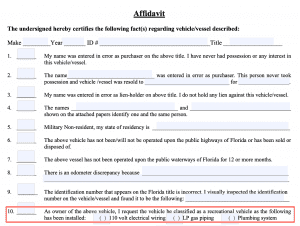
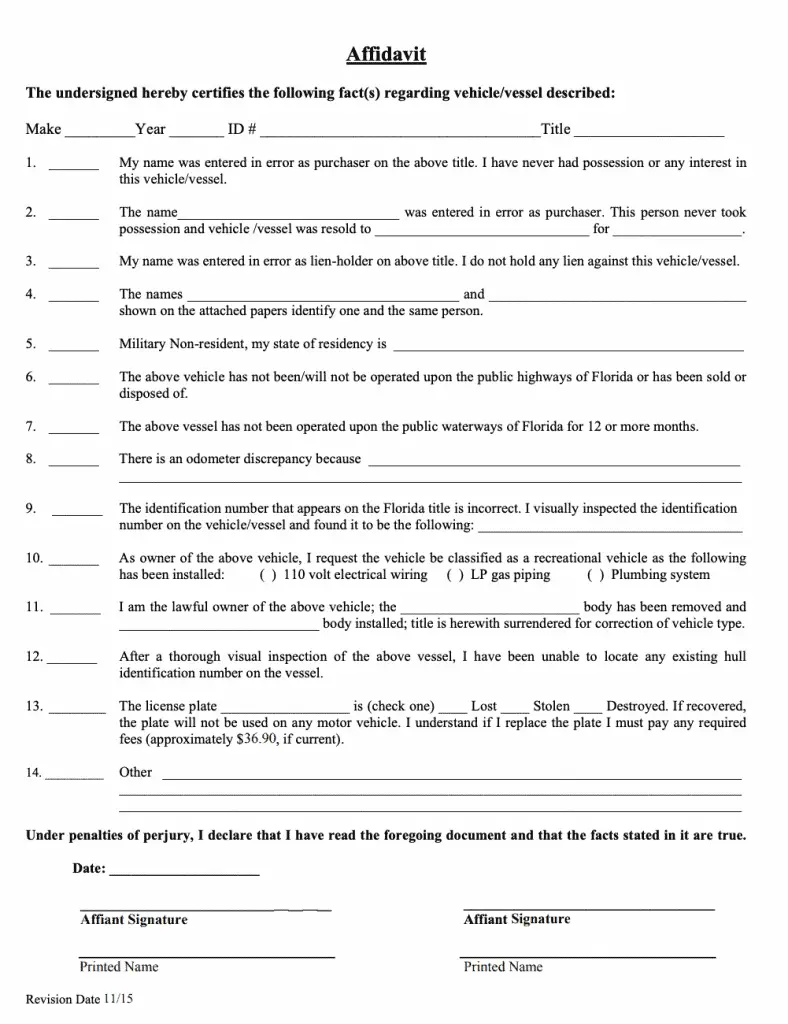
Either at the time that you register your school bus in Florida or at a later date, you fill out the General Affidavit for Motor Vehicles, which calls for a personalattestation that you have installed at least one of three items in your school bus conversion:
110 volt electrical wiring
LP gas piping
Plumbing system
Do you need to install 110 volt wiring, LP gas piping and plumbing in your school bus in order to title it as a motorhome in Florida?
Yes; however, no inspection is needed. You are only obligated to install one of the three, though most commonly you hear of people installing electrical and plumbing, as a basic necessity. Depending on your rig design, LP gas can be beneficial. When we filled out the general affidavit form, we selected all three boxes since we installed all three items in our school bus conversion.
As the owner of the above vehicle, I request the vehicle be classified as a recreational vehicle as the following has been installed: -110 volt electrical wiring -LP gas piping -Plumbing system
It’s important to note that you do not needan inspection to change your title from bus to motorhome in Florida. You provide a personal attestation only on the General Affidavit and that is that!
Though the general affidavit is available online and directly linked in this blog, I’ve read of others that wrote that attestation on a piece of paper and submitted it to their DMV or tax authority.
How much should I expect to pay to register my skoolie in Florida?
When you initially register a motor vehicle in Florida, you are required to pay some fees like the initial registration fee, administrative fees and costs associated for license plates. Expect to pay around $400, depending on where you live.
We paid around $350-400 and that aligned with what we researched on several forums.
Make sure that they only charge you for having a school bus or recreational vehicle (over 4,500 pounds) since that fees are $41.00 and $47.50, respectively, compared to a heavy truck (20,000-26,000 pounds) starts at $251!
Can I re-title a school bus to a motorhome anytime in Florida?
Yes. If a bus is titled as a bus in another state or in Florida, you can register your school bus in Florida as a “bus” first and then “motorhome” later if you don’t want to do it at the time you initially register your vehicle. Below are two scenarios that explain the choices in further detail.
Scenario 1 – do it at the time of initial registration
If your end goal is to title your bus as a motorhome, just register and title it as a motorhome from a school bus at the time of registration to save yourself the headache of doing it later.
No inspection is needed to confirm the requirements are met on the general affidavit for motor vehicles form. You only need a personal attestation that the motorhome requirements have been met.
Scenario 2 – register your bus first and then update the title to motorhome later
You can definitely keep your bus type on the title the same when you register it initially in Florida (think “bus” type in Tennessee to “bus” type in Florida), and register it as a motorhome later, like when your conversion is complete and you’ve installed one of the three requirements needed to title your school bus as a motorhome.
Is vehicle insurance needed to register a school bus conversion in Florida?
Yes, you absolutely need automobile insurance to register any vehicle in Florida, especially a school bus conversion or skoolie. You will also need to maintain that vehicle insurance after registration in order to legally operate the vehicle. The minimum requirements in Florida for skoolie insurance are to have:
Do you need an inspection to title your skoolie as a motorhome in Florida?
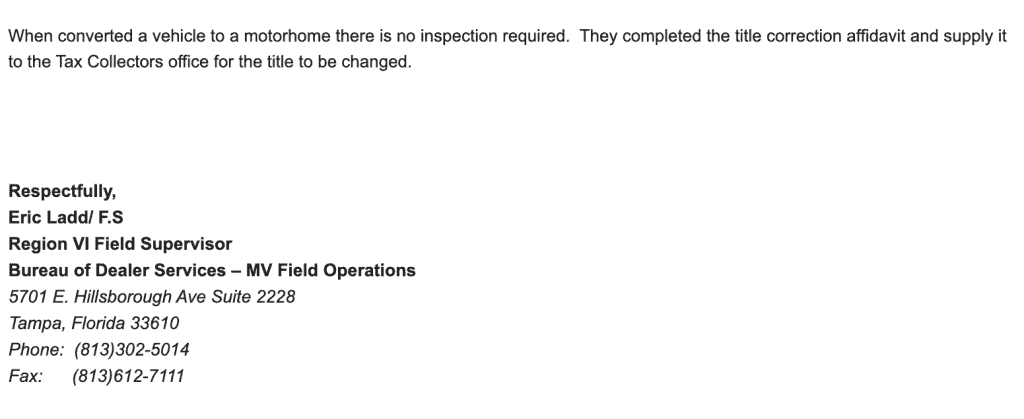
No. You do not need an inspection to title your skoolie motorhome in Florida. There is sometimes confusion between a motorhome (skoolie) and a mobile home (or manufactured home). A skoolie is a motorhome. It is not a mobile home and does not need an inspection!
See the below screenshot of email correspondence between my husband and a supervisor with the FHSMV on skoolie motorhomes.
Do you need to paint your skoolie to title it as a motorhome in Florida?
No! You do not need to paint your skoolie in order to title it as a motorhome in Florida. If your skoolie is already registered in Florida as a “bus” and you are updating the title to a “motorhome,” you need to select one of three choices on the General Affidavit for Motor Vehicle form.
Do I need to weigh my school bus conversion in order to register it in Florida?
No; however, it depends on the DMV that you visit – sometimes they require it and sometimes they don’t. In our situation, we were not required to have weighed our school bus conversion but others were told they needed to weigh their bus.
Do I need to alter the title on my school bus conversion if it is already titled as a motorhome when registering it in Florida?
Nope! If your skoolie is already titled as a motorhome then you don’t need to alter the title from bus to motorhome. You simply register your vehicle as normal and pay any associated fees.
What is a skoolie classified as?
A skoolie, otherwise known as a school bus conversion, is classified as motorhome or recreational vehicle, depending on the state and its rules. Due to the growing popularity of skoolies, they are becoming more widely recognized as a motorhome than in recent years. Though there may be similarities to a class A, class B or class C motorhome, a school bus conversion is a modified vehicle and different rig completely.
Will the general affidavit for motor vehicles allow me to retitle my school bus conversion into a motorhome in Florida?
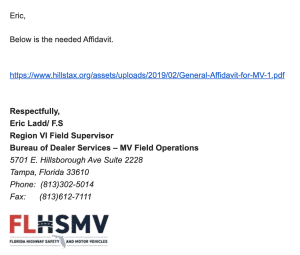
Yes! According to a field supervisor at the FHSMV department and our personal experience registering our skoolie, you only personally attest on the general affidavit that you have installed one of the three items (110V electrical, plumbing or LP propane gas pipe) in your rig in order to title your skoolie as a motorhome.
See the below screenshot from said supervisor as additional support.
If you are curious if you need a CDL to drive your skoolie in Florida, read this blog which dives deep on that topic.
Conclusion
This blog will guide you easily to register your skoolie and re-title it from a “bus” to a motorhome in the state of Florida, while also answering those frequently asked questions that arise along the way. Leave a comment if you found this blog helpful or share it with someone that it would help!