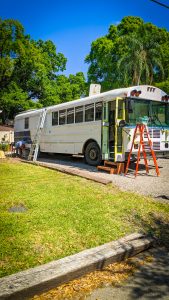
I list out below a few helpful questions to ask upon booking and our personal experiences, state by state, during our travels along the east coast of the United States between May to October 2021.
When we researched how we were going to travel in our skoolie (school bus conversion), we read a lot of forums and Facebook posts stating all the trouble that they had finding places to park, getting skoolie insurance in Florida, getting titled as a motorhome, etc.
We haven’t had difficulty in these areas so I’m creating a Skoolie series to dispel the rumors and talk about it. I hope it helps others!
Table of Contents
Common Reasons Why Skoolies Aren’t Allowed in RV Parks
Unfortunately, there will always be private RV campgrounds that run their businesses as they see fit, even if it doesn’t make sense to a skoolie owner or blatantly prejudices against the community. If you’re curious what some of those reasons may be, read the Shocking Reasons Skoolies Aren’t Allowed in RV Parks.
We stayed at the Florida RV parks at the height of summer and in a popular tourist destination, the Florida Keys. We had no problem booking a reservation (other than booking last minute!).
Questions to ask when booking
Like I mentioned, all the parks we stayed at allowed our skoolie. The only issue we ever ran into was length restrictions – specifically, Acadia National Park in Maine restricted length to under 35 feet (I believe) and we were 37 feet.
Though disappointing that we couldn’t park inside the park, there were a significant number of other private RV parks we could stay at (& with shuttle service!).
We also recommend longer booking periods, rather than paying by day, because you get a discounted rate for weekly and monthly stays.
What is the maximum size rig you allow?
Do you have water hook-ups?
Do you have electric hook-ups?
Do you have laundry services?
Do you offer a Good Sam discount?
Options to staying in RV parks
Don’t despair if you ever do get turned down. Other than the embarrassment or anxiety related to being “broken up with,” skoolies tend to be built as resilient rigs. Ours was, anyway.
Boondocking is a solid option
We built our “land yacht” with the intention of allowing us to be off-grid and redundancies in case one electrical or heating source failed.
We added 6 solar panels to our roof, which allowed us to power everything except the air conditioning. We added propane as our primary heat source. We also installed 100 gallon fresh water & 100 gallon gray water tanks, so we didn’t have to refill as frequently.
You can camp for free overnight in Wal-Mart, Lowe’s, and Home Depots. Honestly, most commercial restaurants or parking lots tend to be cool with it. You can check with security ahead of time – they don’t really mind especially if you’re nice on the front end.
We frequently would get food at Buffalo Wild Wings and then park overnight. Thanks to the managers there!
Harvest Hosts & Boondockers Welcome
Harvest Hosts has now purchased Boondockers Welcome, so they are one and the same. We loved these services because they were more affordable or free with a purchase at a business (like a restaurant or bar).
We found many of our campsites like in North Florida and in a sunflower field in South Georgia using Harvest Hosts.
Harvest Hosts is website that brings together hosts that are RV & Skoolie-friendly to spend 1 night at their home or place of business.
To get 15% off your membership with Harvest Hosts, use our link to register. In return, we do get $15 for referring you. Will it be worth it? We think so.
Thanks for following along with our journey and RVing adventures. – Ingrid & the HildeFam
We have quickly and easily insured our school bus conversion twice in Florida with no issues. The first time we insured our decommissioned school bus was the day before we bought her at auction, with all the seats and school bus markings. Next, we changed providers after we titled her as a motorhome and received better rates.
We read many articles and forums describing the difficulty some people had getting insurance on their skoolie or school bus conversion, and that just isn’t the case if you know who to speak with.
Insure your skoolie with an independent insurance agent
My biggest recommendation is to work with an independent insurance agent who understands school bus conversions.
We worked with two independent insurance agents, Marie Carney & Kelly Newsome, on different occasions to find us the best rates across all the automobile insurance providers in Florida.
The huge benefit to working with an independent insurance agent is she is not restricted to working with one insurance company. This saved us a lot of time because she did the research on which insurance providers would insure a school bus conversion, whether the conversion has not started or if it is fully complete.
The added benefit of working with an independent agent is you may also be able to bundle your car, motorhome and home policies together. We did this with our skoolie & car, which saved us money and just the headache of paying different providers.
Insurance agents that insure Skoolies in Florida
Marie Carney, Vystar Insurance Agency
Direct 904-594-5464; Brightway Service 888-254-5014
Insurance companies that insure school bus conversions
What insurance providers actually insure decommissioned school bus conversions and skoolie motorhomes?
Here are a list of insurance companies that I’ve come across that may insure a school bus conversion. These providers may vary state to state, and the list is not specific to Florida.
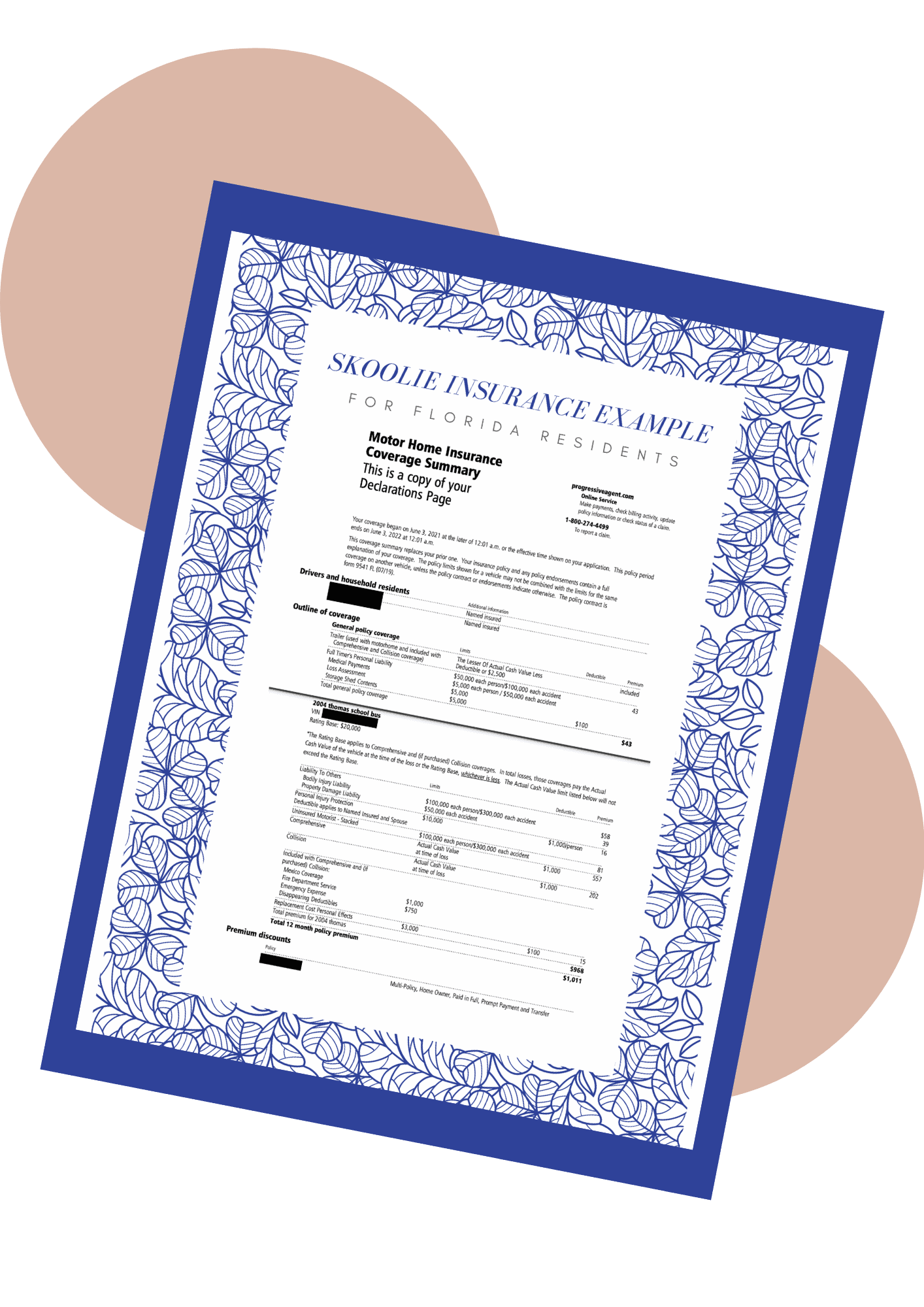
This is who we’ve insured our skoolie for the past two years. Our independent insurance agent bound a policy with Progressive Insurance. The terms were reasonable and our detailed below.
This is a breakdown of our personal school bus conversion insurance policy with Progressive.
What questions did our insurance agent ask before insuring our skoolie in Florida?
What is the cost & rating base on skoolie insurance in Florida?
Total annual policy amount: $1,011
Rating base: $20,000
We paid the annual policy up front – we didn’t have the option to split the payments into smaller periods with this provider. We went with minimum coverage on the policy.
Are you living full time or part time in your school bus conversion?
We were planning to or already living full time in our policy, and the insurance wanted to make a distinction for this on our policy.
What are the coverage & liability thresholds to insure a skoolie?
Our policy covers:
personal liability like medical payments, loss assessments and storage shed contents
What evidence did we provide our insurance agent to show we were a motorhome?
We sent our agent:
Our Florida title and registration
Provided her with our VIN number
Since we are titled as a motorhome in the state of Florida, the process to insure our skoolie was the same as insuring a “normal” motorhome.
Progressive, at the time we bound, actually had a drop down option for school bus conversion.
This may come in handy if you do modifications like a roof raise on your bus tiny home.
FAQs on Binding Insurance on a Skoolie in Florida
Can I insure my school bus conversion if I am not yet titled as a motorhome?
The short answer is yes. We purchased our decommissioned school bus in Tennessee and we received a temporary Florida insurance policy with Allstate Insurance, which allowed the insuring of a vehicle that wasn’t titled as a motorhome.
The cost to insure our school bus was reasonable though more expensive than after we completed the conversion and titled it as a motorhome.
How do you retitle a decommissioned school bus as a motorhome in Florida?
The process to update our school bus title from “bus” to a “motorhome” was really simple in Florida. Read this blog on how we did it and the forms we used to do it in about 10 minutes.
Does a skoolie insurance policy cover personal possessions?
It depends on if you elect personal property coverage on the skoolie insurance policy or purchase a separate policy for personal property in your rig.
Check your current school bus conversion insurance declaration page to determine if there is personal property coverage on your policy. If you don’t have coverage, then you can contact your insurance agent to create a policy, like a renter’s insurance policy, that will cover your belongings and personal property like appliances in case of loss.
Can I obtain a motorhome coverage on my skoolie if it isn’t titled as a motorhome?
No. To obtain motorhome or RV coverage, you must have your school bus conversion titled as a motorhome.
If your decommissioned school bus is still being converted into a motorhome, you can and should have insurance on it. Check with an independent insurance agent that is knowledgeable about RVs and skoolies. I’ve referenced a few above.
Does my school bus conversion need to be inspected before getting insurance?
It depends state-to-state, honestly. Personally, we’ve insured our skoolie twice, once before the conversion was complete and it was titled as a motorhome with Allstate and then after with Progressive, and we never had to have it inspected in Florida.
How much does school bus conversion insurance cost?
We pay just over $1,000 for an annual motorhome school bus conversion policy with Progressive in the state of Florida (2021-2022). Our skoolie is titled as a motorhome in Florida.
We were previously insured in 2020-2021 with Allstate before our decommissioned school bus was even built out. That annual policy cost was about $1,200.
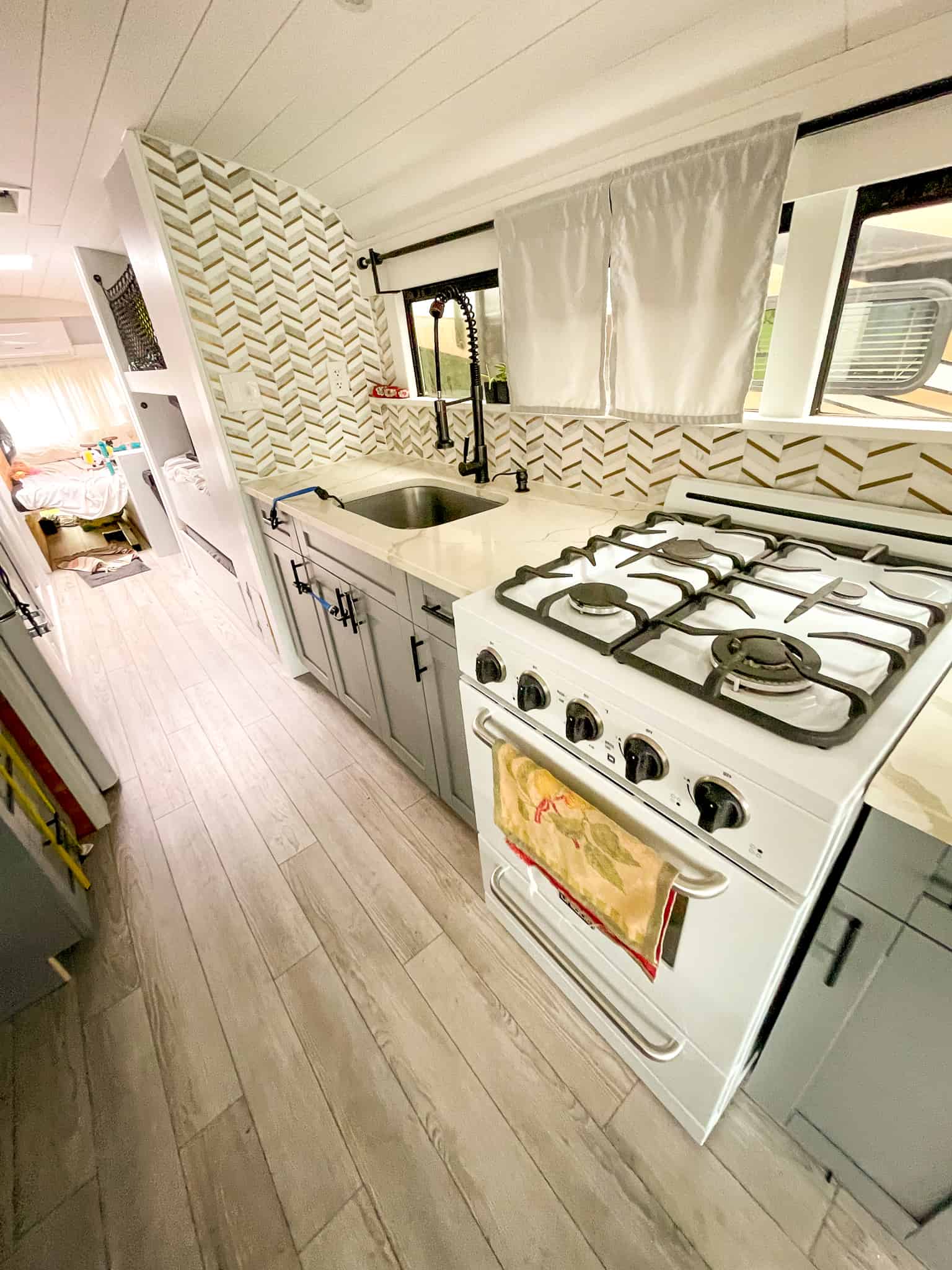
Designing our skoolie small kitchen was no small task. Having strong design in a tiny home kitchen is so important! I share the 10 design choices we made in our skoolie small kitchen that we’re obsessed with.
10 Skoolie Small Kitchen Design Ideas
12V Fridge
Breakfast bar seating with storage
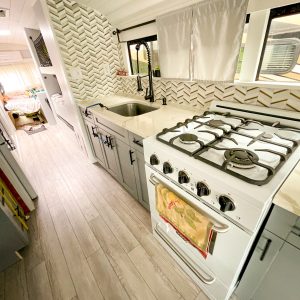
Chef-style pull-down kitchen faucet
Foldable drying rack
Propane range with cooktop and oven
Quartzite counters
Storage containers for dry goods
Undermount single basin sink
Vertical cabinet with soft-close drawers
In-line water filtration
12V Fridge
We designed our skoolie to be completely off-grid with our main power source coming from solar energy. As such, we needed appliances that were as energy-efficient as possible and designed for mobile application (RV or marine).
When performing our energy audit, we determined that most of our energy pull would be from large house-hold appliances (refrigerator) and heating & cooling sources (air-conditioning).
We purchased a 12V 10 cubic foot refrigerator from Unique, a Canadian brand that specializes in manufacturing appliances for off-grid and mobile application. Unique also sells a 110V version at about 1/2 the price of the 12V. Both fridges will be more energy-efficient when compared to your normal household refrigerator.
Breakfast bar seating with storage
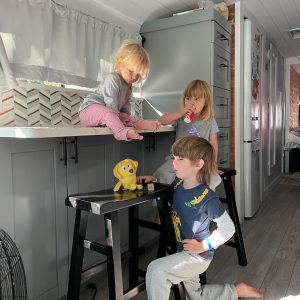
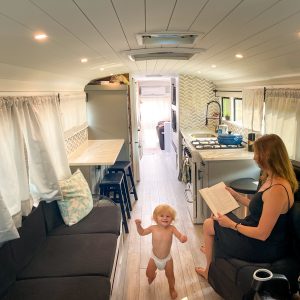
When you live tiny, it’s imperative that you have multi-use spaces. Our breakfast bar fits 2 wide bar stools with room for a third. Under the counter is cabinet storage for our dry goods and the kids’ snacks. We share meals around it, make art projects, complete office work, and just chill around this space.
Adding the breakfast bar was probably the best design choice we made for our tiny home.
Chef-style pull-down kitchen faucet
I mentioned in our “12 Hacks for Living in a Skoolie”blog that our faucet was an amazing design choice. When we’ve just come from the beach, we can swivel the faucet around and pull the sprayer out of the kitchen window to hose off sandy items or use it as an outdoor shower. Because of it’s high arch, we can also clean tall items in the sink like pots or children!
Foldable drying rack
We purchased up a roll-up drying rack that goes over the kitchen sink or over a towel on the counter. It is such a space saver and folds away easily under the sink when not in use. When drying everything on a towel on the counter, mildew grows quickly because there isn’t airflow. This compact drying rack solved that issue for us.
We purchased ours at Home Depot or Lowe’s.
Propane range with cooktop and oven
We purchased the white 24″ 4-burner propane gas range with oven, cooktop & broiler by Unique. We love how well it cooks food and that it was made for off-grid and mobile application. This range is from the same brand, Unique, as the fridge so they have a matching retro look that we enjoy.
Quartzite counters
Choosing quartz or quartzite countertops for our skoolie felt like a splurge; however, it really wasn’t that bad. Because of the small space, we were able to score a deal by purchasing a remnant from a larger job. That piece, including the kitchen sink, installation and labor, came out to about $1,400.
We love that it is easy to clean, stands up to children and holds up well in a mobile application.
Storage containers for dry goods
We purchased plastic storage containers from IKEA for all dry goods in our tiny home. I mentioned in “5 Easy Steps to Live Intentionally with Less in a Skoolie”blog that we try to limit packaging coming into the bus. These containers have been a great solution to that problem and they double as food storage contains for large meals that go into the fridge.
We recommend buying plastic or metal containers – avoid glass, even tempered glass, because items do fall out of cabinets and can break!
Undermount single basin sink
We love having a single basin sink for a small living space. It’s easy to fit all the dirty dishes (or kids) into one deep sink, and it also holds things like our large cast iron skillet when driving (so it doesn’t fall off the counter!).
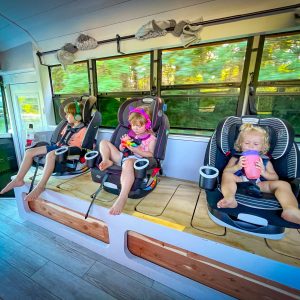
Madeleine, Finley & Landon relaxing in our skoolie.
Having the undermount sink is a nice feature to keep the counters clean and avoid the inevitable build-up of gunk around the rim of a kitchen sink. Everything can be pushed into the sink easily.
Vertical cabinet with soft-close drawers
Utilizing vertical space in a tiny home is key in a strong design. Rather than installing upper cabinets, which would have required us to lose that feeling of openness in the living space, we opted for a vertical cabinet with pull-out drawers instead. They are also soft-close, which is so lovely in a busy household.
In-line water filtration
We have two water filters in our skoolie. One is an in-line filter that screws on to the hose for water coming into the bus. This filters out any particles or sediment. Under the kitchen sink, we installed another filter that further purifies the water in the bus and makes it drinkable.
We prefer the in-line water filters because they are out-of-sight and don’t require us to move them when traveling. Countertop water systems like the Berkey require regular maintenance (refilling and cleaning) and storage when driving.
Do you have a skoolie small kitchen?
I hope you enjoyed our 10 most-loved design choices in skoolie small kitchen. I would love to get your input in the comment section if you would put any into your tiny home on wheels.
Thanks for following our journey. – Ingrid & the HildeFam
12 Hacks for Living in a Skoolie | Destination Unknown
We’ve come up with twelve ways to improve living in your skoolie or other small space. From organization to food, we share the tips that have helped improve our skoolie travel.
Seeing sunlight & starry skies with a skylight
Installing a pull-down faucet that can double as an outdoor shower
Having a dedicated wet space
Cleaning your compost toilet weekly
Treating your gray tank
Installing a water filtration system outside & inside
Getting outside at least once a day
Using your space intentionally
Removing packaging before it comes into the bus
Purging unnecessary items frequently
Perform weekly engine maintenance
Run your AC or heat source weekly to keep moisture levels down
Seeing sunlight & starry skies with a skylight
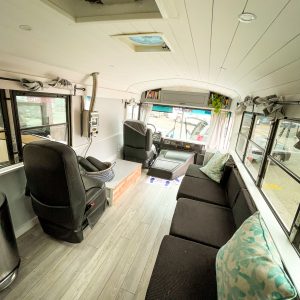
Our skylight is toward the back of the bus, in the captain’s quarters. We love this skylight because it brings in so much natural light and we don’t have to open up blinds or sunlight screens during the day. At night, we get to look up at the stars from the comfort of home.
Installing a pull-down faucet that can double as an outdoor shower
This is the skooliest skoolie hack! We installed a pull-down faucet in our kitchen. It has been so handy to have it when we come back from a day at the beach. We can swivel it around and pull the handle outside of the window to rinse off gear or ourselves. It has two settings: stream and spray.
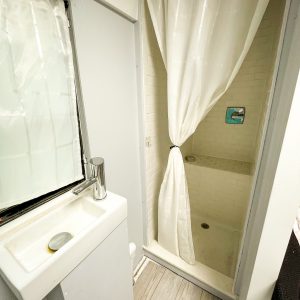
We love being able to use our shower to store gear, scooters and our outdoor rug when they’ve gotten wet outside. It is so lovely to have a dedicated wet space where things can drain and we don’t have to worry about water escaping.
Cleaning your compost toilet weekly
Our best practice is to dump the waste in the bag and clean the bucket & urine diverter with soap and water at least once a week. Our compost toilet is comprised of a 5-gallon bucket with a garbage bag and a urine diverter going to our gray tank, located under the bus exterior.
When we first started living in our skoolie, I dreaded this part of the bus; however, we’ve gotten the hang of how much coconut coir we need to cover the waste in the bucket and tossing frequently has become a part of our normal cleaning routine.
After using the urine diverter, we make sure to spray it with a mixture of vinegar, water with a few drops of essential oils. Poopuri spray is great to keep on hand too because the bottles are so discrete.
Treating your gray tank
We treat the waste in our skoolie‘s gray tank with a chemical treatment monthly. We don’t really have any issues with odor in the bus since we installed back-flow attachments in our plumbing system; however, it’s nice to have a less odorous smell when we drain our tank. You can find environmentally-friendly treatments at most RV shops or online.
We prefer to drain our gray tank weekly. Since we have a 100 gallon tank, it can take up to 30 minutes to drain. Instead, we like to drain weekly as part of a normal cleaning routine and that cuts down on time to drain the tank.
Installing a water filtration system outside & inside
Keeping clean, filtered water on-demand is important to us. When filling our 100 gallon fresh water tank, we have an in-line filter, which reduces sediment and some bacteria.
At the kitchen sink, we have a second filtration system to filter out bacteria and more deposits. This gives us clean drinking water. Before we installed this, we were purchasing loads of plastic water jugs, and that takes up so much space in a tiny place. We’ve found this system to be so convenient and low-maintenance.
Fresh air is really important to us, so we try and get out for walks every single day. Even if it’s just for an hour, getting fresh air is essential! Even when the weather is bad, we do this.
Living in a tiny space, you just need to get out of it to literally stretch your legs. When we dream of this lifestyle, a key thing was for us not to spend as much time indoors and give us the opportunity to explore with our family.
We have a built-in shoe caddy so shoes come off immediately. Coats are kept at the front of the bus in a basket behind the driver’s seat.
We installed outlets with USB & USB-C ports so we can charge electronics easily without a “dongle.”
We have hooks in each room so nothing lands on the floor.
We built a custom cabinet above the captain’s quarters for clothing storage and diapers.
The children’s bunk beds have a storage compartment for clothing and another space for toys.
We truly enjoy having a place for everything, and everything in its place. Things don’t get misplaced and nothing falls out of place when driving.
Removing packaging before it comes into the bus
Living in a skoolie means you can just head to the stores when you need something; however, the amount of packaging that comes with any shopping haul is immense for a small space. We plan ahead and it drastically lessens the amount of packaging before it ever enters our skoolie.
Bagging groceries directly into our cart (no plastic or paper bags)
Removing things from their boxes, like cereal boxes around the plastic bags
Repackaging things like dried beans into storage containers that fit our storage space
Purging unnecessary items frequently
Purging as part of a normal cleaning routine happens seasonally. We go through our belongings and keep what we need and what we’re going to use often.
When we travel, we feel it’s important to not overwhelm your space. If it doesn’t have a dedicated space or the item no longer serves us, we remove it from the space.
Perform weekly engine maintenance
Like any automobile, performing routine maintenance and giving your skoolie some TLC helps it last longer and perform better.
We do this by:
Checking the fluid levels before we drive
Performing regular brake checks as we drive
Run your AC or heat source weekly to keep moisture levels down
When the exterior temperature differs greatly from the interior temperature, moisture builds up. If that moisture has no where to go and the interior space doesn’t dry out, mold and mildew can grow. We start to see this first along window sills.
We combat this by running our AC or other heating source weekly, especially during the winter months and during the rainy season. In the summers, we frequently have our windows open so we are able to keep air flow going.
What hacks have you created for living full time in your tiny home on wheels? Are 12 hacks for living in a skoolie too much or too little?
Living with less is a way of life that many people are choosing for themselves these days. When you live in a skoolie, that choice can be tricky to accomplish. If you are looking to Live Intentionally with Less in a Skoolie or RV, then follow these 5 steps!
Avoid single use items & packaging
Reassess areas prone to clutter frequently
Make a place for everything, and everything in its place
Build a capsule wardrobe
Buy concentrate and dried food items
Avoid single use items & packaging
Single use items are just that – one time.
If you need to use a plastic bag, try using it as many times as possible.
When you purchase groceries, have them put the groceries directly into the cart instead of bagging them.
Remove cardboard boxes around foods like cereal to reduce the waste inside your tiny home later.
Instead of buying paper towels, use dish towels and reusable paper towels.
Reassess areas prone to clutter frequently
Purge your closet and pantry regularly so nothing has room to build up and expire. If I decided I didn’t like the cut or style of a piece of clothing, I just got rid of it – why keep something that doesn’t flatter you?
Do you have a junk drawer? Be brutal on that space.
Do you have a habit of collecting paper mail or receipts? Scan them into your phone with GeniusApp (free PDF scanner) and toss the paper. Log onto every account and request paperless statements.
Make a place for everything, and everything in its place
Clutter stresses our family out, even more so when living in a small space! We make a habit of putting things away right after we used them, like instead of putting the milk on the counter when you’re done (because someone else will want some), we put it straight in the fridge until someone wants some.
We have a designated area for shoes as you come in the door. Coats and bags go into a designated basket behind the driver’s seat or on a hook on the wall. Dirty laundry goes straight into the hamper.
On days when the clutter builds up, we take 10 minutes to clean up our space. Sometimes this happens a few times a day, but we all participate and it goes by quickly.
Buy concentrate and dried food items
Try shopping for foods that are shelf-stable and do not need to be refrigerated. One of the biggest generators of trash in our skoolie was due to milk and milk alternative jugs. It felt like right after we went shopping, our trash can would be overflowing in a few hours.
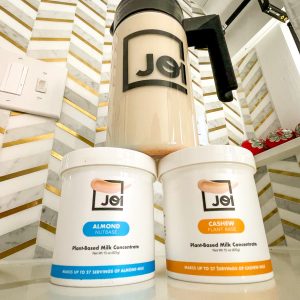
JOI Plank Milk Concentrate
Ingrid loves oat milk, so she stumbled across a shelf-stable option that she has fallen in love with.JOI Plant Milk Concentrate is such a wonderful example of shelf-stable food choices. The small jar can make over 100 pitchers of plant-based milk, without any of the packaging. It’s so tasty too because you can make it how you want.
When you do shop for fresh foods like fruits and vegetables make sure to properly store them in the crisper drawers in your fridge! That way they will not go bad prematurely. Battling fruit flies isn’t fun!
Choosing to living intentionally in a Skoolie
The one thing to think about with intentional living – is intentional planning and design for what you want your home to look like and how your home will serve you while you live in it. If you are intentional about what things and items will be in your home, it can go a long way.
There is a certain beauty and skill with living with less; however, there are headaches that come with it. It can definitely be overwhelming thinking of how you “have to get rid of ___” because there isn’t space in your tiny home.
You really have to flip your mindset instead to be “I can design my home to tailor to my lifestyle today.”
Ingrid Poole
In my opinion, living intentionally with less in a skoolie has opened up more opportunity for travel and reduced my mental stress load. When we left our skoolie to move to Sweden on a week’s notice after Eric broke his leg, we checked two bags (included) and had our personal items. It was so easy to pack because we were already living with so little. Read that blog here.
My mental stress was less because I didn’t have a huge space to clean up every night; on laundry days, we would do “wash & fold” (a luxury) so laundry came back to us folded. I would spend 10+ hours a week on domestic labor when we lived in a traditional home!
Thanks for following our journey. – Ingrid & the HildeFam