Destination Unknown

Category: Features and tips

Blogs in this category include features on and tips about our skoolie as well as resources and products used.

  • 12 Hacks for Living in a Skoolie

    12 Hacks for Living in a Skoolie

    12 Hacks for Living in a Skoolie | Destination Unknown

    We’ve come up with twelve ways to improve living in your skoolie or other small space. From organization to food, we share the tips that have helped improve our skoolie travel.

    1. Seeing sunlight & starry skies with a skylight
    2. Installing a pull-down faucet that can double as an outdoor shower
    3. Having a dedicated wet space
    4. Cleaning your compost toilet weekly
    5. Treating your gray tank
    6. Installing a water filtration system outside & inside
    7. Getting outside at least once a day
    8. Using your space intentionally
    9. Removing packaging before it comes into the bus
    10. Purging unnecessary items frequently
    11. Perform weekly engine maintenance
    12. Run your AC or heat source weekly to keep moisture levels down
    Seeing sunlight & starry skies with a skylight

    Our skylight is toward the back of the bus, in the captain’s quarters. We love this skylight because it brings in so much natural light and we don’t have to open up blinds or sunlight screens during the day. At night, we get to look up at the stars from the comfort of home.

    Installing a pull-down faucet that can double as an outdoor shower

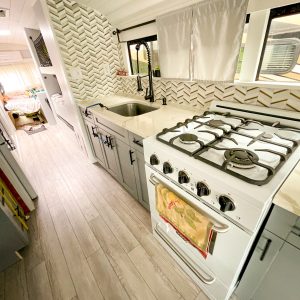
    This is the skooliest skoolie hack! We installed a pull-down faucet in our kitchen. It has been so handy to have it when we come back from a day at the beach. We can swivel it around and pull the handle outside of the window to rinse off gear or ourselves. It has two settings: stream and spray.

    See a detailed list of products we purchased for our skoolie transformation here!

    Having a dedicated wet space

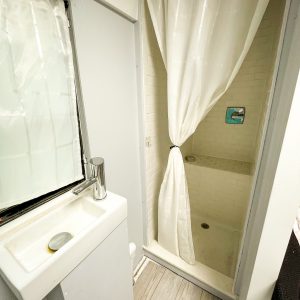
    We love being able to use our shower to store gear, scooters and our outdoor rug when they’ve gotten wet outside. It is so lovely to have a dedicated wet space where things can drain and we don’t have to worry about water escaping.
    Cleaning your compost toilet weekly

    Our best practice is to dump the waste in the bag and clean the bucket & urine diverter with soap and water at least once a week. Our compost toilet is comprised of a 5-gallon bucket with a garbage bag and a urine diverter going to our gray tank, located under the bus exterior.

    When we first started living in our skoolie, I dreaded this part of the bus; however, we’ve gotten the hang of how much coconut coir we need to cover the waste in the bucket and tossing frequently has become a part of our normal cleaning routine.

    After using the urine diverter, we make sure to spray it with a mixture of vinegar, water with a few drops of essential oils. Poopuri spray is great to keep on hand too because the bottles are so discrete.

    Treating your gray tank

    We treat the waste in our skoolie‘s gray tank with a chemical treatment monthly. We don’t really have any issues with odor in the bus since we installed back-flow attachments in our plumbing system; however, it’s nice to have a less odorous smell when we drain our tank. You can find environmentally-friendly treatments at most RV shops or online.

    We prefer to drain our gray tank weekly. Since we have a 100 gallon tank, it can take up to 30 minutes to drain. Instead, we like to drain weekly as part of a normal cleaning routine and that cuts down on time to drain the tank.

    Read this blog to see how we determined what size gray water tank we needed for our family size.

    Installing a water filtration system outside & inside

    Keeping clean, filtered water on-demand is important to us. When filling our 100 gallon fresh water tank, we have an in-line filter, which reduces sediment and some bacteria.

    At the kitchen sink, we have a second filtration system to filter out bacteria and more deposits. This gives us clean drinking water. Before we installed this, we were purchasing loads of plastic water jugs, and that takes up so much space in a tiny place. We’ve found this system to be so convenient and low-maintenance.

    See a detailed list of products we purchased for our skoolie transformation here!
    Getting outside at least once a day

    Fresh air is really important to us, so we try and get out for walks every single day. Even if it’s just for an hour, getting fresh air is essential! Even when the weather is bad, we do this.

    Living in a tiny space, you just need to get out of it to literally stretch your legs. When we dream of this lifestyle, a key thing was for us not to spend as much time indoors and give us the opportunity to explore with our family.

    Using your space intentionally

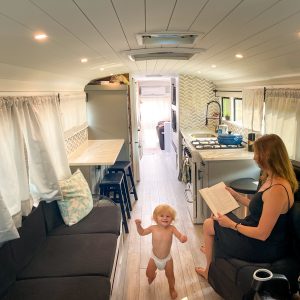
    We designed our home to use our tiny space intentionally. For example:

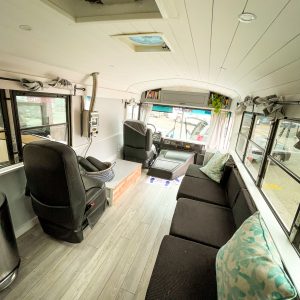
    • We have a built-in shoe caddy so shoes come off immediately. Coats are kept at the front of the bus in a basket behind the driver’s seat.
    • We installed outlets with USB & USB-C ports so we can charge electronics easily without a “dongle.”
    • We have hooks in each room so nothing lands on the floor.
    • We built a custom cabinet above the captain’s quarters for clothing storage and diapers.
    • The children’s bunk beds have a storage compartment for clothing and another space for toys.

    We truly enjoy having a place for everything, and everything in its place. Things don’t get misplaced and nothing falls out of place when driving.

    Removing packaging before it comes into the bus

    Living in a skoolie means you can just head to the stores when you need something; however, the amount of packaging that comes with any shopping haul is immense for a small space. We plan ahead and it drastically lessens the amount of packaging before it ever enters our skoolie.

    We do this by:

    • Purchasing dried or concentrate items, like JOI Plant Milk concentrate
    • Bagging groceries directly into our cart (no plastic or paper bags)
    • Removing things from their boxes, like cereal boxes around the plastic bags
    • Repackaging things like dried beans into storage containers that fit our storage space

    Purging unnecessary items frequently

    Purging as part of a normal cleaning routine happens seasonally. We go through our belongings and keep what we need and what we’re going to use often.

    When we travel, we feel it’s important to not overwhelm your space. If it doesn’t have a dedicated space or the item no longer serves us, we remove it from the space.

    Perform weekly engine maintenance

    Like any automobile, performing routine maintenance and giving your skoolie some TLC helps it last longer and perform better.

    We do this by:

    • Checking the fluid levels before we drive
    • Performing regular brake checks as we drive

    Run your AC or heat source weekly to keep moisture levels down

    When the exterior temperature differs greatly from the interior temperature, moisture builds up. If that moisture has no where to go and the interior space doesn’t dry out, mold and mildew can grow. We start to see this first along window sills.

    We combat this by running our AC or other heating source weekly, especially during the winter months and during the rainy season. In the summers, we frequently have our windows open so we are able to keep air flow going.


    What hacks have you created for living full time in your tiny home on wheels? Are 12 hacks for living in a skoolie too much or too little?

    Watch our full skoolie tour!

    Thanks for following our journey. – Ingrid & the HildeFam
  • 5 Easy Steps to Live Intentionally with Less in a Skoolie

    5 Easy Steps to Live Intentionally with Less in a Skoolie

    Live intentionally with less in a Skoolie

    Living with less is a way of life that many people are choosing for themselves these days. When you live in a skoolie, that choice can be tricky to accomplish. If you are looking to Live Intentionally with Less in a Skoolie or RV, then follow these 5 steps!

    1. Avoid single use items & packaging
    2. Reassess areas prone to clutter frequently
    3. Make a place for everything, and everything in its place
    4. Build a capsule wardrobe
    5. Buy concentrate and dried food items

    Avoid single use items & packaging

    Single use items are just that – one time.

    • If you need to use a plastic bag, try using it as many times as possible.
    • When you purchase groceries, have them put the groceries directly into the cart instead of bagging them.
    • Remove cardboard boxes around foods like cereal to reduce the waste inside your tiny home later.
    • Instead of buying paper towels, use dish towels and reusable paper towels.

    Reassess areas prone to clutter frequently

    Purge your closet and pantry regularly so nothing has room to build up and expire. If I decided I didn’t like the cut or style of a piece of clothing, I just got rid of it – why keep something that doesn’t flatter you?

    Do you have a junk drawer? Be brutal on that space.

    Do you have a habit of collecting paper mail or receipts? Scan them into your phone with GeniusApp (free PDF scanner) and toss the paper. Log onto every account and request paperless statements.

    Make a place for everything, and everything in its place

    Clutter stresses our family out, even more so when living in a small space! We make a habit of putting things away right after we used them, like instead of putting the milk on the counter when you’re done (because someone else will want some), we put it straight in the fridge until someone wants some.

    We have a designated area for shoes as you come in the door. Coats and bags go into a designated basket behind the driver’s seat or on a hook on the wall. Dirty laundry goes straight into the hamper.

    On days when the clutter builds up, we take 10 minutes to clean up our space. Sometimes this happens a few times a day, but we all participate and it goes by quickly.

    Buy concentrate and dried food items

    Try shopping for foods that are shelf-stable and do not need to be refrigerated. One of the biggest generators of trash in our skoolie was due to milk and milk alternative jugs. It felt like right after we went shopping, our trash can would be overflowing in a few hours.

    JOI Plank Milk Concentrate

    Ingrid loves oat milk, so she stumbled across a shelf-stable option that she has fallen in love with. JOI Plant Milk Concentrate is such a wonderful example of shelf-stable food choices. The small jar can make over 100 pitchers of plant-based milk, without any of the packaging. It’s so tasty too because you can make it how you want.

    Get 10% off your first order with the code: Destination Unknown on JOI’s website.

    Fresh Fruits & Veggies

    When you do shop for fresh foods like fruits and vegetables make sure to properly store them in the crisper drawers in your fridge! That way they will not go bad prematurely. Battling fruit flies isn’t fun!

    Choosing to living intentionally in a Skoolie

    The one thing to think about with intentional living – is intentional planning and design for what you want your home to look like and how your home will serve you while you live in it. If you are intentional about what things and items will be in your home, it can go a long way.

    There is a certain beauty and skill with living with less; however, there are headaches that come with it. It can definitely be overwhelming thinking of how you “have to get rid of ___” because there isn’t space in your tiny home.

    You really have to flip your mindset instead to be “I can design my home to tailor to my lifestyle today.”

    Ingrid Poole

    In my opinion, living intentionally with less in a skoolie has opened up more opportunity for travel and reduced my mental stress load. When we left our skoolie to move to Sweden on a week’s notice after Eric broke his leg, we checked two bags (included) and had our personal items. It was so easy to pack because we were already living with so little. Read that blog here.

    My mental stress was less because I didn’t have a huge space to clean up every night; on laundry days, we would do “wash & fold” (a luxury) so laundry came back to us folded. I would spend 10+ hours a week on domestic labor when we lived in a traditional home!

    Thanks for following our journey. – Ingrid & the HildeFam

  • Good Day Tampa Bay Fox 13 News Interview

    Good Day Tampa Bay Fox 13 News Interview

    Hildebrand family interview with Good Day Tampa Bay with Fox 13 News

    Our family had a lot of fun being interviewed by Good Day Tampa Bay with Fox 13 News in March 2021.

    Jason with the station came by the house and asked us questions like why we decided to convert a retired school bus into a recreational vehicle for our family of five (to travel affordably), where we were going first (Mile Marker 0 in Key West, baby!), and how long we will be on the road for in North America (2021-2022 is the current plan!).

    Interview posted on March 28, 2021

    If you like this content, then check out our blog on why we bought a school bus.

    Thanks for following our journey – Ingrid, Eric, Landon, Finley & Madeleine

  • Why we bought a retired school bus

    Why we bought a retired school bus

    In this blog, we discuss the major reasons why we bought a retired school bus to convert into our dream tiny home on wheels for our family of five during a global pandemic.

    Table of Contents

    This blog talks about what first got us hooked on the idea of doing a school bus conversion. If you want to see the end result of 7 months of work and how much we put into the HildeBus, then read this blog.

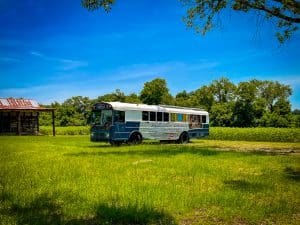
    Skoolie parked in a sunflower field in Pitts, Georgia

    Deciding against buying an RV

    In September 2020, my husband and I sat in the parking lot of a used RV lot to discuss the pros & cons of the dated RV that we toured. This RV offered state-of-the-art technology and finishes from 2005, and formerly retailed at the hefty price tag of $200,000. Now, 15 years older and 1 foreclosure sale later, the salesman was trying to pass this “land yacht” on to us for only $20,000. What a steal, right? We were crazy not to take it, right?


    As we sat in the car, checkbook laid out beside us, I did an online search for how to safely secure children into an RV while moving. As it turns out, there are sadly few passenger & child safety restraints required for RVs.

    Many states require children to be secured while driving a passenger vehicle; however, what are the rules for an RV?

    1. What are the seatbelts secured to in an RV? The comparatively (to a school bus) lesser strength vehicle frame.
    2. Are child seat latches built into RVs? They usually must be retrofitted if you need more than one car seat.
    3. How many seatbelts are available [we have 3 kids in carseats], or are any seatbelts available? Usually no additional passenger seat belts other than the captain chair, accompanying passenger and (optional) jump seat.
    4. Are RVs crash-rated? If you’ve ever seen RV crashes compared to school bus crashes, it’s easy to see which one fares much better in an accident.

    The answers we found didn’t make us feel confident about our family’s safety while driving in a traditional RV.

    Why we converted a school bus

    Later that night, my husband woke me up to tell me hear him out. At 2am in the morning, that’s the last thing I intended to do, but he sounded so hopeful.

    Why don’t we buy a school bus and convert it into an RV? They are made for transporting children and made of steel.

    Eric Hildebrand

    We researched and it turns out that purchasing a retired school bus “was a thing.” There is an entire sect of the tiny home community that own converted school buses — lovingly called “Skoolies.” Once we went down the rabbit hole of safety, costs, and ease of construction. We were hooked on building a school bus conversion.


    School buses are safe and solid construction

    School buses are made for protecting children in case of impact. School buses are made of metal: typically, a steel frame & ribs, aluminum sheet metal body. A “traditional” RV or other motorhome is usually constructed on a steel frame, framed with wood and wrapped with a fiberglass shell.

    As such, the quality of construction of a school bus is far superior to that of a Class A RV. A simple google search will show you which vehicle or motorhome fares better in an accident.

    A motorhome is not recommended to carry passengers while driving, besides those passengers found in the cockpit (driver & passenger seats with seatbelts).


    Bidding on a retired school bus

    Fast forward to one week later , we were bidding on our first school bus at government auction.

    We purchased our bus for about $4,250. We estimated the renovation will cost $25,000 in repairs and vehicle maintenance over a six month period. We will install solar panels on the roof, and a composting toilet.

    My husband will do the work predominantly on his own. He has no construction background. YouTube will be his teacher. I will help out when I can.

    Update: We spent between $45,000 to $50,000 on our renovation and repairs. Check at the breakdown of our skoolie features and upgrades in this blog.

    Moving through the pandemic

    2020 took a toll on all of us, but made us stronger as a family because we were forced to be around each other all the time. With job security and other factors being a concern in this strange world, what better way to stay close to your loved ones (literally in 280 sq.ft.), save money, and see the world?

    We’re going to change our lives for the better in 2021 and document the entire journey.

    THIS JOURNEY is our life by design.

    You can find our YouTube Channel “Destination Unknown” below. Thanks for watching & reading why we bought a school bus. – Ingrid & the HildeFam