Destination Unknown

Tag: skoolie conversion

  • Should you hire a professional to convert a bus?

    Should you hire a professional to convert a bus?

    It is up to you! You have the option to hire no one, outsource some work to professionals or outsource the entire bus conversion to professionals. The concept of a tiny mobile dwelling is simple,; however, it is important to know your limits and when to ask for help, especially when safety is concerned. A knowledgeable professional like an electrician or plumber can help you out immensely during those inevitable times of uncertainty, and can give a level of surety surrounding an otherwise DIY project.

    If you really want to learn that particular skill, ask the professional if its okay to look over their shoulder and ask questions. 


    If you’ve started your school bus conversion and aren’t sure of what products to buy, then check out our skoolie supplies and shopping list essentials blog.


    Option #1: Hire No One

    We have some friends, William and Shelly, that converted their bus completely on their own. William also helps others convert their retired school buses into mobile dwellings, like he did for another friend, Karine.

    Unsure of where to begin? Check out our guide to buying a used school bus for conversion.

    Option #2: Outsource some work to professionals

    This is the path we chose! When we converted our school bus, we started at level zero! My husband did the 95% of the build-out himself on a tight 7 month deadline. Towards the end of the project, a dear friend and carpenter helped us with the finishes and those jobs that are faster done with two people like framing our front door and helping run the propane gas lines.

    We hired local electrical and plumbing professionals review our work at the rough-in and finishing stages so we felt comfortable and safe. We also had AC professionals connect our coolant lines since that requires special tools.

    After we were on the road, another carpenter help us with some more carpentry finishes and storage solutions, his friend sprayed the interior and ceiling paint so we had a smooth and professional finish, and Eric’s old skydiving buddy installed a sick vinyl wrap on the exterior.

    If you are looking into a roof raise for your rig, check out this blog where I list out some professionals and resources for this service.

    Option #3: Outsource the entire bus conversion to professionals

    Skilled labor costs more so expect to pay a flat fee for daily labor ($200/day) or hourly ($40/hr or more), depending on your location. We were out of Florida and did our conversion from 2020-2021.

    Below are recommendations when finding someone to do the work:

    • Have they built a skoolie for themselves or others before?
    • Find someone with a proven track record for excellence (request past client recommendations, search on forums like Facebook groups and on YouTube)
    • Obtain at least two detailed quotes with timeframes for completion
    • Make sure everything is in writing
    • Break up payments for big milestones (for example: retainer, demolition, build-out, completion)

    How to Find Skoolie Builders

    If you’ve decided that you want to hire a reputable professional to help you convert your school bus into a stunning mobile dwelling or assist you with fully custom mobile conversion, then check out our skoolie builder directory with 20+ builders across the USA and even one in Canada.


    Frequently Asked Questions
    What is a pro bus conversion?

    A professional bus conversion or a pro bus conversion is a vehicle build-out and modification that is performed by a professional tradesman. A professional will have a portfolio of completed projects and should offer past client reviews as a support of their work.

    A pro bus conversion is not done by someone who does this recreationally or as a DIY project (a “non professional bus conversion”).

    Can I convert a bus to a camper?

    Yes! You will learn so much doing it and you will be frustrated with the project at times but you will have made something with your own two hands that you can live and travel and live your dreams. You can make a school bus conversion as simple or as complex as you need for your travel lifestyle. You can also outsource some parts of the project or the entire bus conversion to a professional.

    Not only that, but you can also insure your skoolie and register it as a motorhome (Florida-specific).


    Learn more

    If you found this blog helpful, leave a comment below or share it with a friend! Consider joining our mailing list below and get notified when we publish new content on skoolie living and travel tips!
  • Can you live in a skoolie full time?

    Can you live in a skoolie full time?

    Yes, you can live in a skoolie or school bus conversion full time and many do. It is so common in fact, when you go to find a new insurance policy, they will often ask you if you are living part-time or full-time at your vehicle so this is not an uncommon thing. Also, a number of services, like mail forwarding services and campgrounds, exist for and in support of those living a full time in their motorhomes.

    Depending on your location, you may need to make special modifications to winterize your vehicle, and general maintenance will always arise to make sure your home is livable, whether stationary or mobile mobile, such as roof and window maintenance.

  • How fast does a skoolie drive?

    How fast does a skoolie drive?

    There are a lot of unknowns surrounding a DIY school bus conversion, primarily as it relates to the changing of a commercial vehicle to a non-commercial or residential one. A common question I see is “How fast does a skoolie drive?” and “Are skoolies subject to commercial school bus speed maximums?”

    My goal in this blog is to help answer those frequently asked questions, dispel myths, and provide resources to help you do your own research.

    Table of Contents


    How fast does a skoolie drive?

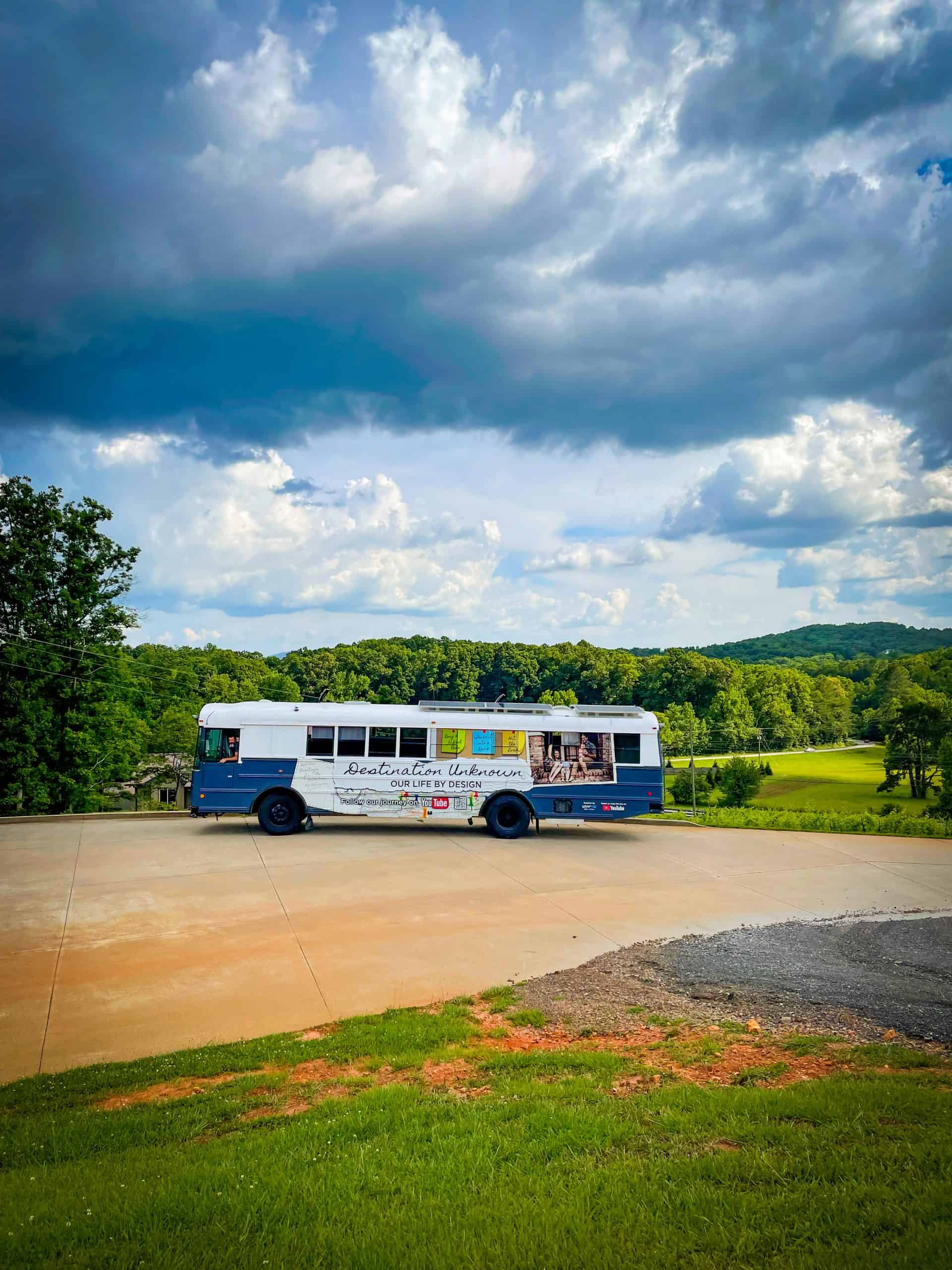
    A school bus conversion does not travel quickly or brake slowly. From personal experience, our cruising speed is 45 miles per hour within the city and 60 to 65 miles per hour on the interstate on a flat surface.

    Our bus could go faster since the governor (speed limiter) was removed, but there just aren’t many opportunities or a desire to go faster on smaller roads.

    More often than not, we kept our skoolie speed at the above-stated ranges to be considerate of others, unless the posted speed was less than that! Many smaller vehicles don’t understand how to drive around big rigs and we had to be vigilant of them.

    What is a school bus governor?

    In the case of a school bus, a governor is a device that limits the speed that the vehicle can travel. If your vehicle accelerates past the maximum speed, this speed limiter can turn off the engine forcing deceleration or sound an alarm informing the driver to reduce the speed.

    Before the governor was removed in our 2002 Thomas School Bus, if we increased our speed over 65 mph, the bus would beep then turn off, and we would have to pull off to the side of the road to restart.

    Maximum Commercial School Bus Speeds

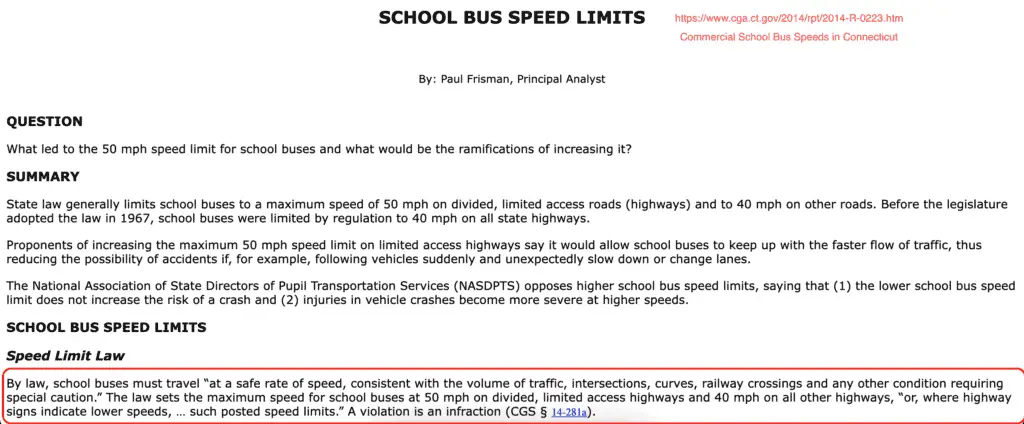
    Commercial school bus speed maximums are mandated by a national organization and may be further elaborated at the state level, usually by the State Board of Education or the Transportation Department. Below are some examples of this:

    • Connecticut: 50 mph on the highway, 40 mph on other roads
    • Missouri: 60 mph if not posted – follow the posted speed otherwise.

    FAQs on How fast does a skoolie drive?

    Are skoolies subject to commercial school bus speed maximums?

    From a logical sense, if your vehicle is no longer a commercial vehicle for the purposes of transporting people (as a commercial school bus’ purpose is), then the national school bus speed standards no longer need to be followed. Furthermore, the mechanics that govern a commercial school bus speed can be removed.

    Additionally, these commercial school bus speed standards are not drastically lower than stated normal vehicle speeds. Just avoid speeding, y’all!

    There may be some gray area in what defines a commercial school bus versus a school bus conversion, especially if the bus hasn’t been built out as a motorhome yet (like the school bus seats are still intact) or retitled as a motorhome. You can always consult an attorney as I am not one, and this is not legal advice.

    Can the school bus governor be removed?

    Yes, a school bus governor can be removed, and it often is when converting a commercial bus into a motorhome. You can either remove it yourself or pay a knowledgeable diesel mechanic to remove it for you, like we did.

    According to posts in forums, the public majority feels that an older vehicle without an electronic system makes the governor removal possible for the owner to do. However, if the bus is a newer model, then a mechanic may be necessary because they will have the software and tools necessary to remove it and reset the bus’ mechanical brain.

    Resources to Remove a Skoolie Governor

    Check out these videos on how to remove your skoolie governor.

    Conclusion to “How fast does a skoolie drive?”

    There are a lot of unknowns surrounding a DIY school bus conversion, primarily as it relates to the changing of a commercial vehicle to a non-commercial or residential one.

    My family built out our skoolie in 2020-2021 and then we traveled in our rig for 6 months full-time across the east coast of the USA. We learned so much along the way and met so many people.

    If you’re at the beginning states of your skoolie journey, check out these blogs:

  • How to do laundry if you live in skoolie or RV

    How to do laundry if you live in skoolie or RV

    Just like living in a stationary home, the need to do laundry will always arise. Fortunately, there are a number of cost-effective and reasonable options available. Below are listed some of the services in order of least to most expensive.


    Laundromat (self service)

    Laundromats are readily available and often have loads of machines available, especially if you are there during off-peak hours during the weekdays.

    Cost of self service laundromat

    I have seen laundry cost between $1.00 to $1.50 per machine, depending on the store.

    Most commonly, these facilities are coin operated so have some cash on hand. If you only have bills, there is usually a coin changer in the same room or you can go to the front desk to make change.

    Paying by credit card is becoming more common, but it is still hit or miss.

    Campground laundry facility

    Many campgrounds we stayed out, big and small, offered this service because it really is a necessity. When booking, you can ask customer service or the booking agent if this amenity is available.

    If there are limited machines available, I recommend doing laundry in off-peak hours, like early in the morning (6a-10a) and evenings (6p to 10p) and avoiding the weekends.

    Expect each cycle to take 30 minutes to 60 minutes (drying usually takes the longest).

    Cost of campground laundry service

    I have seen laundry cost between $1.00 to $1.50 per machine, depending on the park or campground.

    Most commonly, these facilities are coin operated so have some cash on hand. If you only have bills, there is usually a coin changer in the same room or you can go to the front desk to make change.

    Laundry etiquette when using group laundry facilities

    As a common courtesy, if there are few machines available and a queue, don’t be rude and leave your laundry blocking someone from doing their laundry when yours is done. Otherwise, you may find your laundry pulled out and you lose your place in line!

    Laundromat (wash and fold service)

    We exclusively use laundromats to do our laundry when living in our school bus conversion. Specifically, we use the wash and fold service which means that we drop off our laundry to the laundromat, pay a flat fee based on the weight of the clothes, and a staff member will perform all the laundry duties (wash, dry and fold!).

    Cost of wash and fold laundry service

    Usually this service costs about $40 ($50 with tip) for our family of five doing laundry once a week with one large laundry bag. Since we pay by weight of the laundry, that is roughly $2-$3 per pound of laundry.

    The fee typically includes the cost of the detergent, however you can bring your own if you have sensitivities.

    You can usually pay by credit card for this service too, which is nice if you don’t often carry cash.

    Large and bulky items: You will pay individually, not by weight, for large items like duvets and comforters – somewhere between $10-20, depending open location and size. For example, a twin duvet ($14) will cost less than a king comforter ($22).

    The service takes about 2 hours from drop off to pick up, which is a perfect amount of time to go grocery shopping and make lunch while someone else washes and folds the laundry. As a mom of three and wife, this feels like the ultimate luxury for an otherwise very routine life!

    Walk-ins are accepted, and sometimes there are time delays if they are under staffed.

    Additionally, more laundry doesn’t mean more wait time since there are frequently many commercial machines available throughout a store location.

    We purposefully did not build a place for a washer & dryer in our skoolie, instead we relied on laundromat services and on friends and family we visited. We don’t regret it!


    How to find laundromats that offer wash-and-fold services when traveling

    I would venture to say that 99% of the commercial laundromats you can walk into offer a wash and fold service, even if it is not posted. We must have used at least 50 laundromats on our 6-month skoolie adventure, and only one of the stops that we went to did not offer this service.

    We keep our eyes open when going to the grocery store and the areas around it. Many laundromats are found in strip plazas near grocery stores, and they are frequently clean, friendly and quiet. 


    Portable washing machine

    There are so many great portable washing machines on the market these days, designed for smaller living spaces. These would be a great option for a couple or single person, but very tedious for a family.

    If I had a choice, I would pick this energy-efficient portable washing machine with dryer from The Home Depot.

    Cons: There are additional water usage, electricity usage and space considerations to think of.


    Washing machine & dryer combination unit

    These combination units are fairly common outside of the USA. I first saw one in Germany and what a great concept for a small space.

    You can pick up an all-in-one ventless washing machine and dryer for around $900 after taxes at The Home Depot.

    Cons: There are additional water usage, electricity usage and space considerations to think of.


    Individual washing machine & dryer

    I’ve seen a few rigs carrying residential full-size and RV-size washing machines and dryers on board. I love the idea.

    I really liked the looked of this ~$1,400 stacking unit and have used it in my non-moving home as well.

    Cons: There are additional water usage, electricity usage and space considerations to think of.


    Conclusion

    Truly, I have never regretted using group laundry facilities at campgrounds or wash-and-fold laundry services when traveling on the road full time. In fact, I wish I could use the service when not on the road because it is so nice to have someone else wash, dry and fold your laundry for you. The only trick is getting it put away at that point, which is really achievable and necessary when living tiny.


    If you want to read similar content, check out the 12 Hacks for Living in a Skoolie blog.


    Thanks for following our journey! – Ingrid & the HildeFam

  • Where can I weigh my skoolie motorhome quickly?

    Where can I weigh my skoolie motorhome quickly?

    You can weigh your skoolie easily at most commercial gas stations, like Flying Js, along the interstates in commercial vehicle weigh stations and CAT Scale locations. Knowing where to go to weigh your school bus conversion is important for registration purposes and before driving through some states or districts.


    Where can I weigh my skoolie motorhome?

    Commercial Gas Stations

    Some gas stations that cater to big trucks like Flying Js offer scales so big rigs can check their weigh on each axle. You simply pull up, make sure your front and back tires are on the scales and basically push the call button. They may also ask for a bus or rig number, so make one up if you don’t have one! We use our old bus number (415) for fun. After that, you pull off the scales and park, then go inside to pay. 

    Interstate Weigh Stations

    There are department of transportation (DOT) weigh stations on the side of the interstates. These are designed for truckers going through. We were told not to mess with those because they are for commercial use and not really for personal use; however, they are readily available.

    CAT Scale

    CAT Scale is a business specializing in scales for weighing commercial vehicles and there are over 2,075 available in the USA. CAT Scale stands for Commercial Automated Truck Scale, and they are the top professional weigh scale in the country.

    Locate a CAT Scale

    How much does it cost to weigh a skoolie?

    The cost is about $20 to weigh a skoolie at a commercial gas station or interstate weigh station.

    How much does a 40 foot school bus conversion weigh?

    Our skoolie is 37 feet long and weighs roughly 24,000 pounds. We have 6 solar panels, LP gas, full-size fridge, oven, A/C and carry up to 200 pounds of water (gray & fresh).

    Why should you weigh your skoolie?

    You may need to weigh your skoolie in order to register and title it as a motorhome in your state, to know how much it weighs after the school bus conversion is complete, and to comply with road, bridge and interstate rules in some states.


    Read this blog if you need to weigh your skoolie for the purposes of registering it in the state of Florida. It takes a deep dive on how to register and title your skoolie as a motorhome in Florida.

    Conclusion

    This blog describes how to weigh your skoolie easily at most commercial gas stations, like Flying Js, along the interstates in commercial vehicle weigh stations, and nearby CAT Scale locations, and how much it costs to do so.

    Thanks for following our journey. – Ingrid & the HildeFam