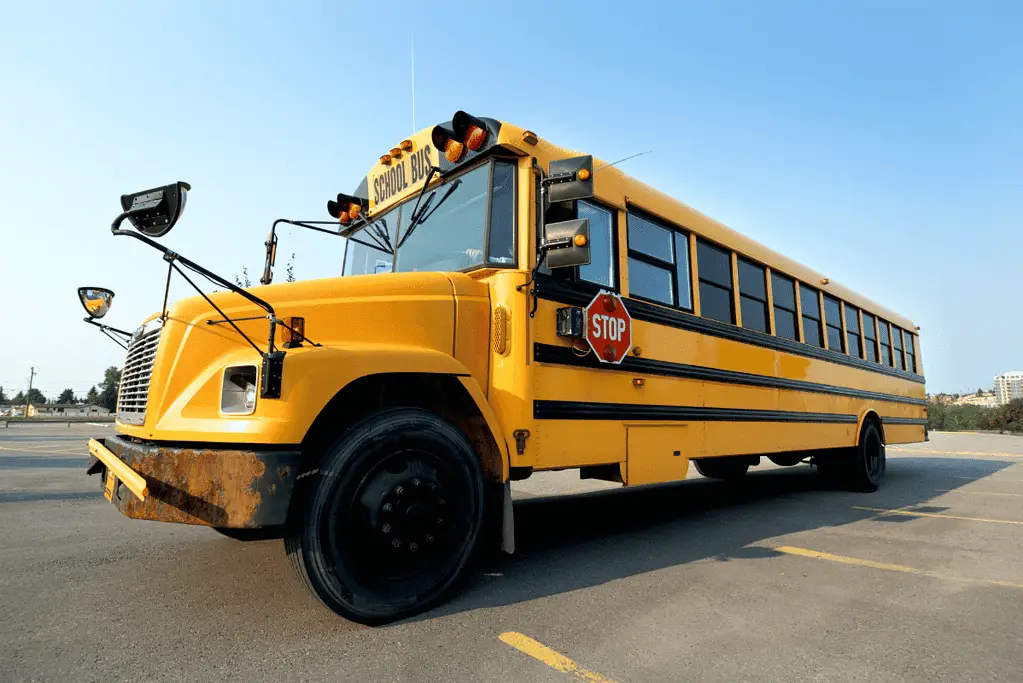
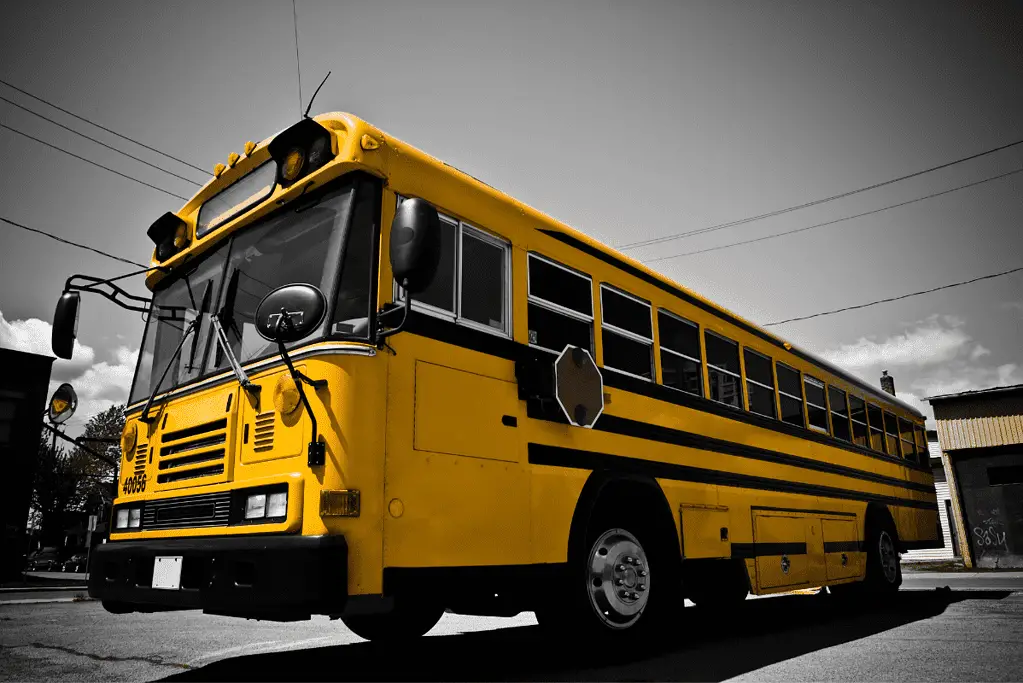
You’re not alone. A common question I see on skoolie forums from new and veteran skoolie owners is how to get insurance on your school bus conversion in a specific state, whether it’s still titled as a commercial vehicle or as a motorhome. So, I decided to do create a state-by-state Skoolie Insurance Directory of North America!
I spent 10+ hours scouring skoolie forums and websites for personal recommendations from the skoolie community and reaching out to insurance agents across North America.
My goal is that the Skoolie Insurance Directory will be a growing and reliable resource that provides helpful information to the school bus conversion community.
We have insured our skoolie twice; once when it was titled as a commercial passenger vehicle and again after re-titling the bus into a motorhome in Florida. We purchased our bus from a school board in Tennesee then transported it to back to Florida with a gap insurance policy.
What is included in the Skoolie Insurance Directory?
The directory is an easy-to-access resource filled with independent and commercial insurance agents from independent insurance brokerages and the usual commercial agencies across North America. Additionally, this resource will still be helpful, whether your bus is still registered as a commercial passenger or you’ve successfully converted the title to a motorhome. Finally, the information provided is listed state-by-state so you can quickly locate the best insurance provider for your place of residence.
The directory provides the:
State
Agent name and contact information
Insurance company
Type of vehicle being insured (RV, commercial passenger vehicle / bus)
If you’re having difficulty finding an insurance policy for your school bus conversion when calling the main line from big chains like Progressive and State Farm, then I highly recommend working with an independent agent, specifically one recommended in the Skoolie Insurance Directory or a local brokerage.
Oftentimes, when you’re working with someone in your community, they have a desire to help a neighbor and (most importantly) can shop across multiple insurance providers rather than just one. That saves you a whole bunch of time. Read my experience obtaining insurance on our skoolie RV in Florida here, including an example of our policy.
Can I get insurance on my school bus if it’s titled as a commercial vehicle?
Yes. A retired school bus is originally a commercial passenger vehicle. During it’s time of operating, it had an insurance policy and it can still obtain one, even after the bus is retired.
If you are in the process of retitling and/or rebuilding your school bus conversion, then work with your insurance provider to bind a commercial vehicle policy.
Another option is to find a short-term policy (aka. “gap”) policy to carry during the time that you’re renovating your rig. A gap policy can also be helpful if you purchase the bus out-of-state from your home location and you will transport it across state lines. Consult with your insurance agent on the best policy for you.
Can I get insurance on my school bus if it’s titled as a motorhome?
Yes. A retired school bus that has been re-titled as a motorhome or RV can obtain insurance. Different states and insurance providers have different requirements for what it takes to bind a motorhome policy. Nonetheless, there are several options available to you. Read this blog on how we easily insured our school bus RV in Florida.
Should I tell the Insurance Company that I own a Skoolie?
Yes, tell the insurance company that you own a skoolie. Firstly, once you provide the make, model and title, it is immediately obvious that you own a current or former commercial vehicle. Your goal in getting insurance is to insure your tiny home on wheels as either a commercial vehicle (if not titled as a motorhome) or as a motorhome (if it has been retitled as such).
Instead, work with a recommended insurance agent who can search for policies across multiple insurance providers and will come to bat for you with the underwriters.
For a list of recommended state-by-state skoolie insurance providers, download the Skoolie Insurance Directory.
Conclusion to Skoolie Insurance Directory of North America
I hope that this directory of Skoolie Insurance Providers in North America gives you peace of mind as you transition to bus life or try and scout our new providers for a better rate.
If you like this post, then you may be interested in these other related posts:
Disclosure: Some of the links in this article may be affiliate links, which can provide compensation to me at no cost to you if you decide to purchase a paid plan. Thank you, if you do. As an Amazon Associate I earn from qualifying purchases. This site is not intended to provide financial advice and is for entertainment only. Read our affiliate disclosure in our privacy policy.
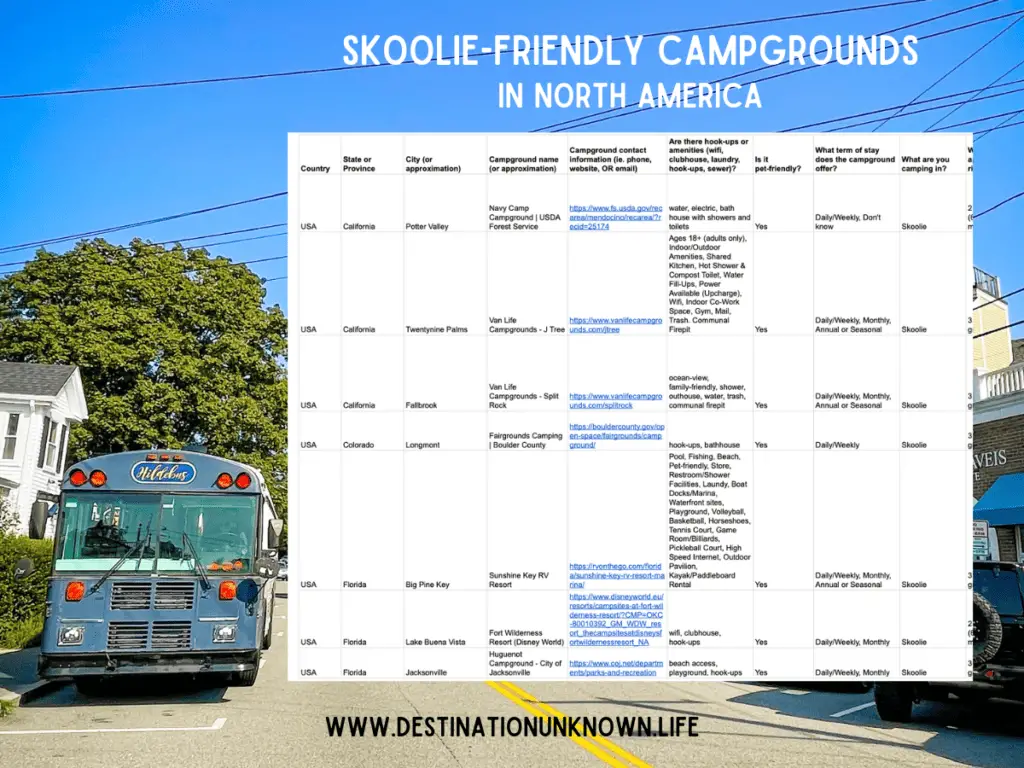
You’re not alone. A common question I see on skoolie forums from new and veteran skoolie owners is where to find skoolie-friendly campgrounds during their travels. To create this directory, I spent over ten hours scouring skoolie forums and websites for personal recommendations from the skoolie community and four months of direct outreach to campground managers in the USA and Canada. Additionally, there are helpful features like an interactive Google Map and tips for free or wild camping, including in populated areas.
Paid Download
My goal is that the Skoolie-Friendly Campground Directory will be a growing and reliable resource that provides helpful information to the school bus conversion community. We’ve got 287+ campgrounds and increasing!
Free Download
Don’t despair if you are looking for a free alternative. Check out the simpler free version of the full-version. This is actually the guide that started it all, and includes about 95+ campgrounds in the USA that allow skoolies to camp.
To add your favorite skoolie-friendly campgrounds to the list, email me at hello@destinationunknown.life with the details.
What is included in the skoolie-friendly campground directory?
The directory of skoolie-friendly campgrounds in North America reflects input from our community on which campgrounds they’ve camped at and recommend as being accepting of school bus conversions, and input from privately owned and operated campgrounds and RV park owners. Campgrounds can be found in all 50 American states and 10 Canadian provinces. Sounds pretty nice, eh?
The campgrounds include privately owned campgrounds, RV parks, RV resorts, tiny home communities, private land, and even some highly-rated public parks in the United States of America and Canada. These campgrounds require payment and are not free campgrounds; however, I include a guide at the back of the e-book that offers tips on how to free and wild camp.
The directory provides the:
State, city, name, and contact information of the campground
Answers commonly asked questions like:
Is the campground pet-friendly?
What are the campground amenities (full hook-ups like water, dog park, playground, wifi, etc)?
In order to add your campground to the directory, you’ll be presented with 12 simple questions about the campground and why you liked it.
If you have difficulty with the form, please feel free to email Ingrid instead at Hello@DestinationUnknown.Life with the information.
Skoolie-Friendly Campgrounds FAQs
Does KOA allow skoolies?
Yes. Skoolies may be allowed to park at some KOAs but not all. Each KOA-affiliated campground is privately owned and operated, meaning that each business has its own rules and regulations.
You can eliminate some of the guesswork when searching by looking in the skoolie-friendly campgrounds directory of North America. In it, you’ll find over 287+ campgrounds, RV parks, and tiny home communities that welcome skoolies.
KOA stands for Kamping of America, and it’s company that maintains affiliate listings of privately owned campgrounds in North America.
Where can I find skoolie-friendly campgrounds near me?
Locating skoolie-friendly campgrounds is becoming easier because of the number of available resources. Using the skoolie-friendly campgrounds directory of North America, you’re able to find over 287+ campgrounds, RV parks, and tiny home communities that welcome skoolies.
There are also a number of membership programs, like Harvest Hosts or Thousand Trails, where you pay an annual fee thus giving you access to to the short-term sites on their platform. Finally, you can locate thousands of free camping sites using sites like BLM lands, USDA, and much more.
Where can I find long-term skoolie parking?
Common ways to find long-term skoolie parking is by contacting RV and mobile home parks, tiny home communities, friends and family with land, and boat yards.
You can eliminate some of the guesswork when searching by looking in the skoolie-friendly campgrounds directory of North America. In it, you’ll find over 287+ campgrounds, RV parks, and tiny home communities that welcome skoolies, some of which offer long-term skoolie parking.
Can I park my skoolie in an RV resort?
Yes. Skoolies may be allowed to park at some RV resorts but not all. Each RV resort is privately owned and operated, meaning that each business has its own rules and regulations.
You can eliminate some of the guesswork when searching by looking in the skoolie-friendly campgrounds directory of North America. In it, you’ll find over 287+ campgrounds, RV parks, and tiny home communities that welcome skoolie conversions.
Yes. National parks are very skoolie-friendly camping destinations for short-term stays. With that being said, national parks often have length restrictions for bus builds so check your size on their website before booking.
Yes. State parks are very skoolie-friendly camping destinations for short-term stays. With that being said, state parks may have some restrictions to camp overnight depending on things like length and animals, so check on their website before booking.
Maybe. It depends on if the city park is equipped for overnight camping. The amenities available in city parks vary from town to town, state to state. If a city park does offer overnight camping, remember to check for restrictions on common restrictions such as length.
Conclusion to Skoolie-Friendly Campgrounds in North America
I hope that the Skoolie-Friendly Campgrounds Directory for North America gives you some peace of mind when traveling in your skoolie conversion. We have a lovely community of independent thinkers, DIYers, and travel enthusiasts who deserve to easily locate skoolie-friendly campgrounds wherever they roam.
My goal is that the directory will be a growing and reliable resource that provides helpful information to the school bus conversion community.
I hope in the near future that more campgrounds will be added to this list so that the days of hunkering down for an overnight or two in Wal-Mart parking lots and refilling your water tanks at questionable truck stops are fewer and far between… unless that’s your vibe. 🙂
To add your favorite skoolie-friendly campgrounds to the list, use this form or email me at hello@destinationunknown.life with the details.
If you are looking for more in-depth reviews of some of our favorite RV parks, peep them here:
Disclosure: Some of the links in this article may be affiliate links, which can provide compensation to me at no cost to you if you decide to purchase a paid plan. Thank you, if you do. As an Amazon Associate I earn from qualifying purchases. This site is not intended to provide financial advice and is for entertainment only. Read our affiliate disclosure in our privacy policy.
RV parks everywhere have different requirements, and some are more finicky than others. From the totally chill to the downright snobby, there is a lot of variation in what you may come across on your skoolie journey. Keep reading for the 8 shocking reasons why skoolies aren’t allowed in RV parks (Reason #6 may surprise you!).
Below, I’ve listed some of the most common reasons I have personally read or discussed with other school bus conversion owners when searching for RV campgrounds.
Much of this information is available on RV campground websites, in the “Rules and Regulations” section; however, I often recommend calling a campground in advance because websites can contain outdated information.
Table of Contents
Our Skoolie Journey and Staying in RV Campgrounds
We built our school bus conversion out over 8 months during the pandemic, then hit the road full-time with our family of five. We traveled for 6 months along the East Coast, visiting 12 states along the way.
During our adventure, we stayed in RV campgrounds in several states, and had positive experiences in all of them, despite the RV park horror stories you hear directed towards the skoolie community.
What are some reasons why skoolies aren’t allowed in RV Parks?
While the list as to why skoolies or school bus conversions may not be allowed in RV campgrounds could be endless, I’ve put together a list of the most common reasons why skoolies are denied entry to stay at an RV park.
Not a Self-Contained RV
Everyone poops. If your skoolie doesn’t have showers and plumbing for waste disposal, a campground may have concerns about how you dispose of your waste or may not have the infrastructure in place with public bathhouses (bathrooms, showers) for you to use during your stay.
Length
If you have a huge rig, like over 29 feet, then you may have difficulty finding campgrounds that can accommodate your size even if they accept alternative RVs.
The DIY nature of a school bus conversion is admittedly a concern for RV park owners and certainly a common fear of newbie skoolie-builders.
If you are building your rig yourself, I recommend spending a little extra money to have a professional electrician inspect your entire system and draft a certificate of inspection stating that it’s in working order.
Age
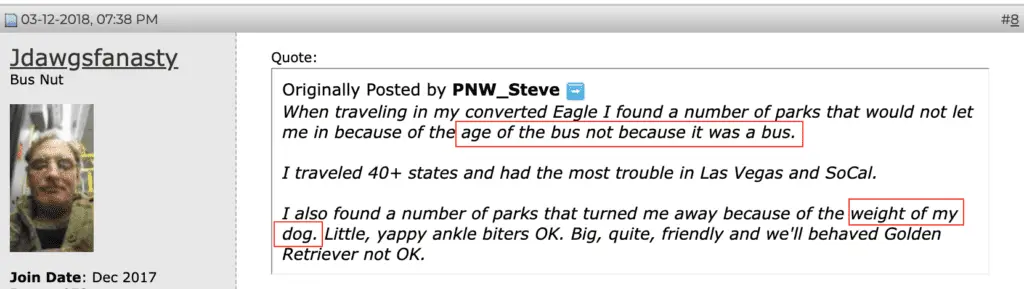
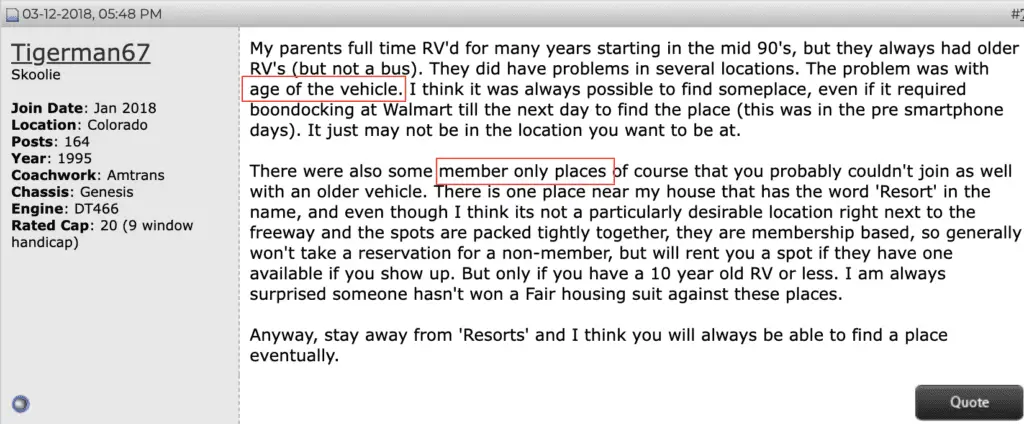
If your rig is over 10 years old, then some campgrounds may cite age as a reason to deny you. In those cases, it may be helpful to show a vehicle inspection showing that your rig is in tip-top shape.
Snobbery
Some campgrounds are downright snobby and won’t let you in if you don’t fit into the rest of the community. In those cases, just move along because you probably don’t want to stay there anyway.
Pet Restrictions
Traveling with pets is very common in the RV community; however, if you’re traveling with an uncommon housepet like a pot-bellied pig, then a campground may take issue with allowing farm animals on their property!
More commonly, for more traditional pets like dogs, you may find there are breed restrictions, weight or size restrictions, and vaccination requirements that could affect your pet’s ability to camp in the park.
Bad Paint Job
This is definitely a case of judging a book by its cover, but that is how the cookie crumbles sometimes. This point is closely related to the snobbery point above; however, it is a commonly cited cause I see in forums and Facebook groups as to why a skoolie is turned away from an RV resort or campground.
Membership Only Resorts
Some RV resorts offer memberships, meaning that it’s members pay fees to be apart of the community. This can result in situations like paid members having more pull in who camps in the resort, being given priority camp sites and first availability, or it affects the length of time non-members can camp.
Why Skoolies Aren’t Allowed in RV Parks FAQs
What can I do if an RV park won’t let my skoolie stay at the campground?
The best answer is to leave and find other accommodation. Unfortunately, a business can refuse service for a number of reasons, even if that reason is simply that you are driving a skoolie.
Fortunately, there are far more campgrounds out there that do accept school bus conversions and other alternative recreational vehicles, and being turned away is less common than you may think (though it doesn’t feel great when it happens to you!). Check out this list of skoolie-friendly campgrounds in North America.
Can I camp at an RV park with my dog?
Probably. Nearly all campgrounds allow dogs, but they may have breed restrictions, weight restrictions, or vaccination requirements (like an updated rabies vaccination).
The resorts aren’t checking what’s inside your vehicle; however, if you’re carrying a barnyard animal that needs walks and may surprise the neighbors, expect to have some questions.
It is common within the RV community to travel with pets, especially dogs. Dogs provide their owner with security, and support, and act as a deterrent against burglars.
How do I know if my Skoolie Will Be Allowed to Park at an RV Park?
The best way to know if your skoolie will be allowed to camp at an RV park is to review the “rules and regulations” on their company website to first see if there are any glaringly obvious disclaimers against “alternative vehicles.”
Next, you’re going to pick up the phone and call the camp office to chat one-on-one with the office manager. I have often found that what is stated on a website and what is allowed may differ, so speaking with a real person will save you hours of headaches. You can also offer to text or email a photo of your rig and any supporting documents to help, if additional support is needed.
Can I park my Skoolie at a National Park?
Yes, the National Parks in the United States don’t care if you drive a skoolie. The national parks have length restrictions, so you may not be eligible to park if your bus exceeds the requirements.
Unfortunately, length restrictions are one of the most common reasons why skoolies aren’t allowed in RV parks.
Are There Free, Skoolie-Friendly RV Campgrounds?
Yes. Some of our best memories in our skoolie were spent at free campgrounds or staying with friends and family. One of the easiest ways to find free campgrounds that are skoolie-friendly are through platforms like Harvest Hosts and Boondockers Welcome and on BLM-managed land. BLM stands for the Bureau of Land Management of the United States of America.
The best part of these free, skoolie-friendly campgrounds is they had no requirements to camp!
For overnight stays, most rigs are welcome at commercial warehouse spaces like Wal-Mart, Love’s Gas Stations, and Home Depot.
Did the Reasons Why Skoolies Aren’t Allowed in RV Parks Surprise You?
Having been a part of the skoolie community for several years, I feel like I’ve heard it all. I’m curious though what you thought of the reasons why skoolies aren’t allowed in RV Parks. Let me know in the comments.
As mentioned, we had an overwhelmingly positive experience when we stayed in RV parks in our skoolie. Honestly, this was a preferred method of camping for our family because the parks provided safety and fun for younger kids (limited traffic and loads of amenities like playgrounds and walking paths).
If you liked this post, then I recommend reading the following:
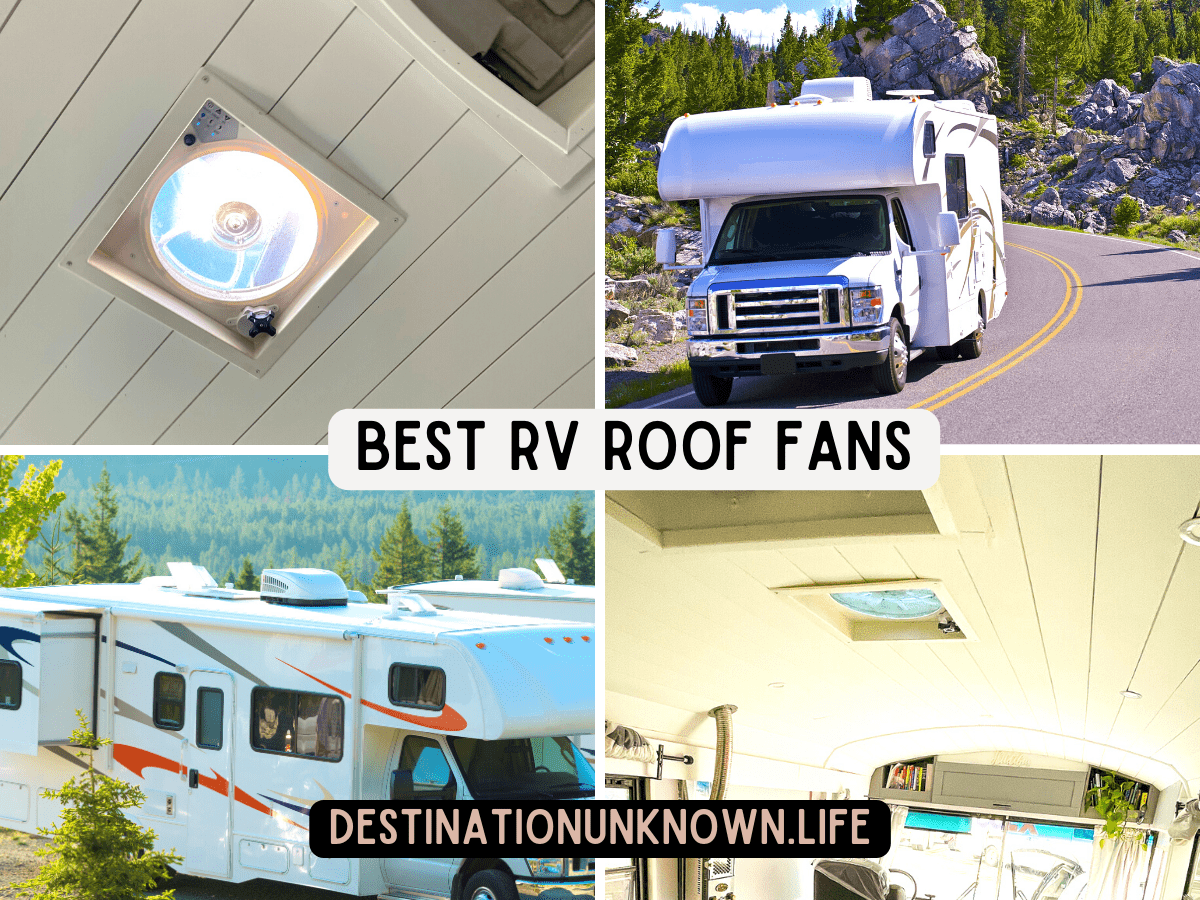
Installing an RV roof fan is an excellent and low-energy way to keep your interior comfortable and free from moisture.
In this article, I dive deep into why you need a RV roof fan, what to consider when shopping for one, and some of the best options available on the market, including what we installed in our rig.
Our family converted a retired school bus into our dream tiny home on wheels during the pandemic. We learned so much about building a skoolie along the way, and this blog is dedicated to sharing that knowledge with this community.
Yes! The primary reason for an RV roof fan or vent is to help to remove moisture from the interior of your RV. This is important because excessive moisture can lead to mold and mildew growth, which can be harmful to your health.
Interior moisture is created most often by your literal existence inside the home. After all, the CO2 from your breath, sweat from your body, cooking, and shower steam have to go somewhere!
Additionally, a RV roof fan or vent can provide lighting, remove odors, and help cool a warm interior by circulating air.
As a note, you may not have a need for a RV roof fan or vent if you do plan to run your air conditioner all the time since that will extract moisture as it cools; however, the likelihood of always running an AC is not 100% in many people’s home on wheels.
Personally, we installed a mini-split and two roof fans though our bus is quite large.
This Roof Fan is most similar to what we installed in our school bus conversion – our exact model is no longer available online. We liked that it offered a rain shield, variable speeds, bug screen, lighting, and a remote control to operate the fan.
If you’re looking for a great RV roof fan with lighting, the Hike Crew 14” RV Roof Vent Fan with LED Light is a fantastic option.
The fan comes with a 12V motor and three-speed options for intake and exhaust, which helps to keep your RV comfortable and fresh. The LED lighting is trimmed around the entire frame, which is the most I’ve seen on an roof fan. For someone with limited space or budget for lighting, this is a huge win.
This fan has a compact design makes it perfect for smaller RVs, and comes with a remote control – great for the vertically challenged or when you don’t feel like getting up from the couch.
The fan is reversible so it has the ability to cycle air inside or vent stale air and condensation outside.
The RVLOVENT 12V RV Roof Fan Vent is an excellent choice for those who prefer an easy-to-operate fan with manual controls. There’s no worry of losing a remote or the extra ambient lighting. You simply open and close the vent by turning the knob, though this could be a deterrent for someone with limited mobility.
The fan is reversible so it has the ability to cycle air inside or vent stale air and condensation outside.
The simpler design makes it an affordable option to the Hike Crew fan.
This fan is the perfect option for smaller rigs that want a small-profile exhaust fan. It has only a 6″ diameter, making it one of the tiniest fans on the market, it’s manually operated, discrete, and affordable.
If you’re looking for a reversible fan that cools, this isn’t it. It only sucks out the air of the vehicle.
If you’re looking for a simple RV roof vent that doesn’t have any fancy features, the Camco RV Roof Vent Kit is a great option. This vent comes with a standard 14″ x 14″ opening, and it’s made from high-quality materials that are built to last.
The vent is easy to install, and it comes with all the necessary hardware, so you won’t have to make any additional purchases. The vent’s interior dimensions are 10 x 10 x 4.5 inches, and it weighs just 2.87 pounds, making it very lightweight.
What products are needed to install a RV roof fan?
In addition to the fan kit, you’ll need something to cut an opening in your roof like this multi-purpose angle grinder, self-leveling lap sealant, putty, a scraping tool to remove the old product (if you’re replacing an old fan), and acetone to clean the hole before installation.
What should you consider when shopping for an RV roof fan?
Before purchasing a RV roof fan, there are several factors you should consider like size, price, electrical wiring, and features.
Dimensions
Make sure you measure the size of your RV roof opening to ensure that the fan you purchase fits properly. Most RV roof fans and vents are designed to fit a standard 14” x 14” opening, but there are some exceptions. The actual dimensions of the unit will be larger than the 14”x14” hole.
Price
RV roof fans and vents come in a range of prices, so it’s important to set a budget before you start shopping. You can buy new manually-operated roof fans starting around $125 on Amazon.
Consider how much energy the fan will use, especially if you plan to use it frequently. With that being said, most of these fans use relatively little energy when in use compared to their household counterpart.
Features
Consider additional features like an auto-close function, reverse direction, multi-speed, a remote control, color choices, and integrated lighting.
How do RV vent fans work?
RV vent fans work by drawing air in from the outside and expelling it through the roof vent. This helps to circulate the air inside the RV, which can help to keep the interior temperature comfortable and fresh.
Can you add a fan to an RV roof vent?
Yes, you can add a fan to an RV roof vent; however, for the cost, you may as well buy an RV roof fan kit that has everything you need right there. Manual operated roof fan kits start as low as $130 and can be bought online with fast shipping (see a product example here).
The vast majority of RV roof fans and vents come in 14” by 14”. While there are exceptions to the rule, a quick search on the internet will confirm this. There are a few small exhaust fans (single direction), like this 6″ dome fan.
Yes, roof vent fans are definitely worth it. They help to keep the air inside your RV fresh and comfortable, which can be especially important if you’re traveling in hot or humid climates.
What colors do RV roof vent covers come in?
RV roof vent covers come in a variety of colors, including white, black, cream or beige, and smoke gray. By far, the most common colors are white and black.
Conclusion
Let me know in the comments which RV roof fan you installed in your RV or why you didn’t install one at all.
An RV roof fan or vent is an essential accessory for any RV owner. It helps to regulate the temperature inside the RV and remove excess moisture. When shopping for an RV roof fan, it’s important to consider factors such as dimensions, price, wired or wireless options, energy usage, durability and quality, and features such as auto-close, remote control, and lighting.
Overall, an RV roof fan or vent is a worthy investment that can make your RV life more comfortable and enjoyable.
Related Content
If you are looking for other RV product reviews, then check out these:
Disclosure: Some of the links in this article may be affiliate links, which can provide compensation to me at no cost to you if you decide to purchase a paid plan. Thank you, if you do. As an Amazon Associate I earn from qualifying purchases. This site is not intended to provide financial advice and is for entertainment only. Read our affiliate disclosure in our privacy policy.
If you’re in the market for a school bus, you’ve likely come across two different designs: the flat-nose bus and the dog-nose bus. Both options have their advantages and disadvantages, and it’s important to understand the differences before making a decision. In this blog post, we’ll take a deep dive into the design, safety, comfort, and maintenance of the Flat-Nose vs. Dog-NoseBus.
I would like to note that both bus styles share small differences in the areas we will be analyzing. At the end of the day, your choice to purchase a school bus for a conversion project will be based on additional factors such as personal preference, price, and availability.
If you’re curious if you’re in the right place, then let me help you out. Our family converted a flat-nose school bus into our dream tiny home on wheels in 2020-2021. Our blog can help you if you are in the beginning stages and looking for a school bus to convert or are looking for a skoolie builder.
Comprehensive Answers to Common Skoolie Myths
We aim to bust the common myths you read about school bus conversions by providing solid resources and research from the skoolie community.
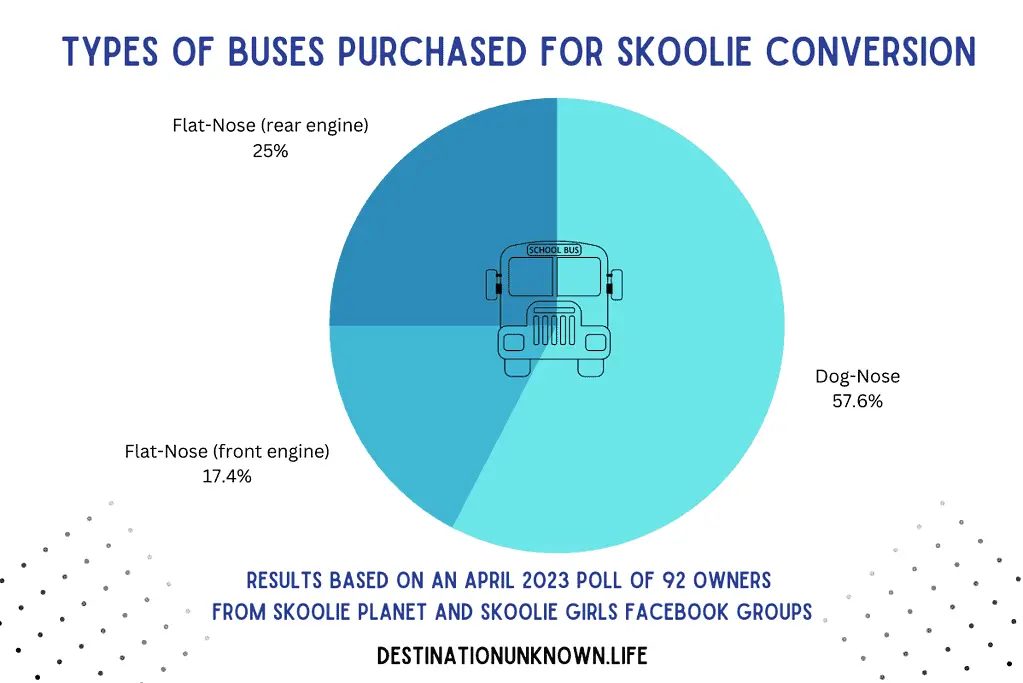
In April 2023, I polled 92 skoolie owners in the Skoolie Planet and Skoolie Girls Facebook Groups to see what type of bus they purchased for conversion:
Flat-nose with a front engine
Flat-nose with a rear engine
Dog-nose (front engine only)
The results surprised me! I expected more people to have flat-nose front engine buses since that was what I saw commonly in my state (Florida); however, the poll participants came from all over North America, thus casting a wider net.
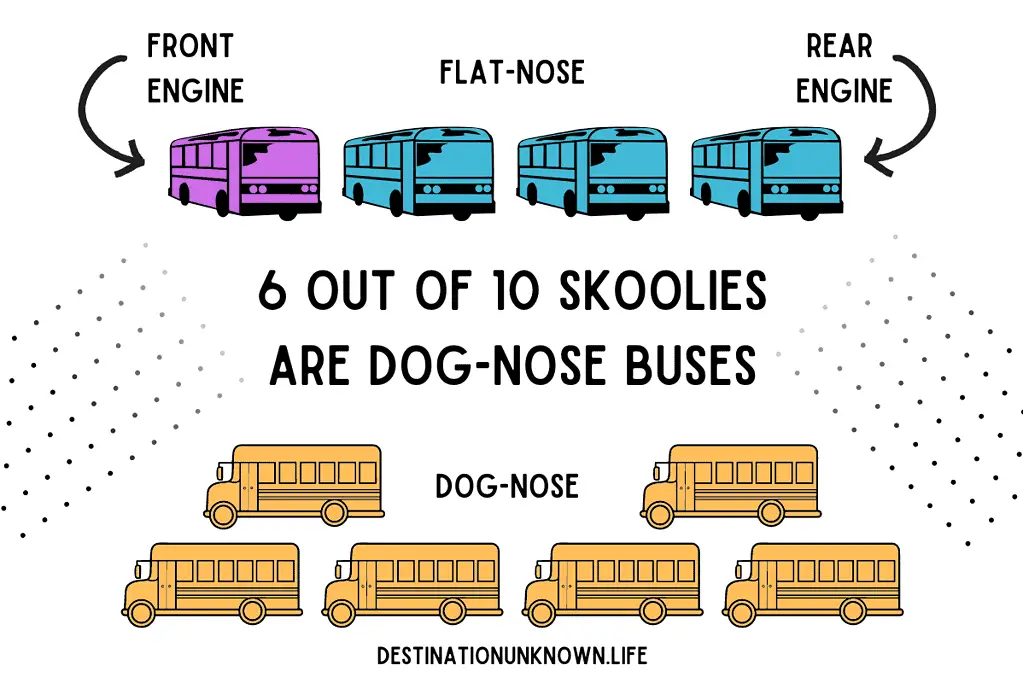
57.6% of skoolie owners purchased a dog-nose bus. The remaining 42.4% owned flat-nose buses. Of the flat-nose bus owners, 41% had front engines and 60% had rear engines!
Our Personal Experience with a Flat-Nose Bus
We purchased a flat-nose front-engine school bus and didn’t mind having the engine block in the cock-pit, though we knew no different to be honest.
When traveling or when the engine was running, it was loud since the engine block is located next to the driver’s seat, though it wasn’t a hindrance when living stationary. Our kids would happily sit or climb on it to get better views through the big front windows.
Design
Overview of design differences
The primary difference between a flat-nose bus and a dog-nose bus is the location of the engine. In a flat-nose bus (also known as a Type D bus), the engine is located inside the bus, either in the driver compartment or in the rear of the bus (aka. A pusher). In a dog-nose bus (also known as a Type C bus), the engine is located in the front of the vehicle, outside of the driver compartment. This would be the same area as standard vehicles like an SUV or car, etc.
Flat-nose bus design features
Flat-nose buses, also known as flat-front buses, offer better visibility for the driver and a smoother ride for passengers due to the engine’s location. Since they have a shorter wheelbase and “snout”, it can make them easier to maneuver in tight spaces. However, the flat-nose design can reduce the useable space in the cockpit since the engine block sits usually in the middle. If it’s in the rear, you’ll still need access to it; however, you could build an movable structure to allow access in the interior (you will also have exterior access).
Additionally, the ride is loud when in a flat-nose bus because the engine is located inside of the bus. Furthermore, the engine puts off a lot of heat, which is beneficial in the winter if you desire warmth; however, in the summer months, you’ll need to ride with the windows open if you don’t have cooling AC while driving.
Dog-nose design features
Dog-nose, also known as snub-nose, buses often have more internal storage space and a quieter ride, as the engine is located outside, farther from the passenger compartment. They also tend to have a more traditional school bus look, which some people prefer.
Safety
Overview of safety differences
Both flat-nose and dog-nose buses are designed to meet strict safety standards. However, there are some differences in how each type of bus performs in certain areas.
Flat-nose safety features
Flat-nose buses offer better visibility for the driver, which can help prevent accidents. Additionally, the engine’s location inside the driver compartment can help absorb impact in the event of a collision.
Dog-nose safety features
Dog-nose buses often have a larger crumple zone due to the engine’s location, which can help absorb impact in the event of a collision. Additionally, the engine’s location can help prevent fires from spreading to the passenger compartment.
Comfort
Overview of passenger experience
Passenger comfort is an important consideration when choosing a school bus. Both flat-nose and dog-nose buses have their advantages and disadvantages when it comes to comfort.
Flat-nose passenger experience
Front-nose buses may have a louder ride since the engine block is located inside the vehicle. The flat-nose design may make for a less spacious interior, since the engine block is either located as you come up the stairs or in the rear of the vehicle.
Dog-nose passenger experience
Dog-nose buses often have a quieter ride, as the engine is located farther from the passenger compartment. Additionally, with the engine’s external location, there is more internal space in the driver’s area.
Maintenance
Overview of maintenance differences
Maintenance is an important factor to consider when choosing a school bus. Both flat-nose and dog-nose buses have their advantages and disadvantages when it comes to maintenance. The risk of damage due to road debris would be about the same since in both cases since the engines are exposed to this.
Flat-nose maintenance considerations
Flat-nose buses have the advantage of easier access to the engine for maintenance and repairs, as it is located inside the driver compartment. However, this also means that any engine issues can potentially impact the driver’s visibility and safety.
Dog-nose maintenance considerations
Dog-nose buses have the advantage of the engine being located outside of the driver compartment, which will usually require a ladder to gain visibility.
FAQ about Flat-Nose versus Dog-Nose Buses
Are flat-nose buses better?
This is subjective and based on personal preference. Flat-nose buses offer better visibility and a smoother ride, while dog-nose buses often have more internal living space since the engine block is located outside and, therefore, a quieter ride. Both options are designed to meet strict safety standards.
What is a dog-nose bus?
A dog-nose bus (also known as a Type C or snub-nose bus) is a school bus design where the engine is located in the front of the vehicle, outside of the driver compartment.
What is a flat-nose bus?
A flat-nose bus (also known as a Type D bus) is a school bus design where the engine is located under the front hood of the vehicle, inside the driver compartment.
How long is a dog-nose bus?
The length of a dog-nose bus can vary, but they typically range from 15 to 35 feet in length.
What type of bus is best for conversion?
Both flat-nose and dog-nose buses can be suitable for conversion, depending on your needs and preferences. Flat-nose buses often offer a more modern exterior look (streamlined) and better driver visibility, while dog-nose buses may offer slightly more interior living space, vintage appeal, and a quieter ride.
Where is the engine on a flat front bus?
The engine on a flat front bus is located under the front hood of the vehicle, inside the driver compartment, or at the rear of the bus.
Conclusion
So, which type of bus is right for you? Ultimately, the decision will come down to your individual needs and preferences. If you prioritize visibility and a smooth ride, a flat-nose bus may be the best option for you. If you prefer more storage space and a quieter ride, a dog-nose bus may be the way to go. Regardless of which type of bus you choose, make sure to prioritize safety, comfort, performance, and maintenance when making your decision.