This blog goes into all the details on how to calculate how much water you’ll need to live comfortably whether you’re an individual or a big family like us. The amount of fresh water you will need to carry on board with you in your skoolie will vary depending on several factors: length of time living on board (full time or part time), number of people traveling in the bus (individual or a family) and how you will be living in your skoolie (RV parks or boondocking).
Our background
If you’re not familiar with our story, you can read it here.
We lived full-time in our skoolie, lovingly called the HildeBus, for six months during May to October in 2021. We built her out with the intention of living and adventuring full-time, and therefore our water storage supported that goal.
Water Usage
What size water tanks did we install in our skoolie for a family?
The freshwater is mounted indoors, under the bed in the captains’ quarters. The gray water tank was mounted underneath the rear of the bus, under the bathroom area.
How much water will one person use per day in a skoolie?
If you were one person living in a school bus conversion, after factoring in your 1 gallon of clean drinking water, you will use approximately 6 gallons for the household activities like dishes, cleaning and showering.
Some perspective on water usage
How much water do you use in a 3 minute shower in a skoolie?
Most water-efficient shower heads emit 1.5-2.5 gallons of water per minute. At 2 gallons of water a minute, your 3 minute shower uses 6 gallons of fresh water.
How much water do you use to do dishes?
According to the NRDC, doing dishes by hand (in a “normal home” can use up to 27 gallons of water! Though I don’t believe our water usage was anywhere near that high in our skoolie, it did contribute probably the most to our daily water usage.
How long will 100 gallons of water last in a skoolie with a family of 5?
In practice, we used about 14 gallons of fresh water a day as a family of 5 (2 adults, 3 young children). I calculated this by dividing the 100 gallon fresh water by 7 days before needing to refill, which comes out to about 14.29 gallons.
After budgeting 3.5 gallons of drinking water per person (1 gallon of drinking water per adult, 1/2 gallon of drinking water per child), the 10.5 remaining gallons of water used came from doing dishes, light cleaning and fast showers.
Note: We outsourced laundry to a laundromat, which reduced household water consumption significantly – “wash & fold” service is dream come true!Read more about laundry options in an RV here.
Skoolie water usage by family size
How often did we need to refill our 100 gallon freshwater tank?
A practical application
We enjoyed boondocking (not being tied into the power or water grid – filling our water tanks and relying on solar energy for electricity). As such, we relied on having full a water tank when planning this type of trip.
When living full-time on board as a family of five and boondocking, we needed to refill our freshwater tank about once a week.
Where did we find fresh water to fill our water tank in our skoolie?
When we lived on the road for six months full time in our skoolie, we filled our water tank up about 20 times when not tied into the grid. Most often, we found water at these sources:
When refilling our water tank at gas stations & rest stops, we look for places that have high traffic and, therefore, more people accessing it versus a station in the middle of nowhere that may have some standing well water.
Boondockers Welcome & Harvest Hosts
These affordable host sites are fantastic ways to camp and boondock affordably and safely. Prior to booking, you can see if your host site offers hookups for water and other utilities like electric and glorious wireless internet.
Campgrounds and RV parks
Campgrounds and RV parks became a “hail Mary” for us when traveling with kids. Sometimes we just desired a RV-friendly community and safe place for our kids to roam, without having to think about it all. These parks often have load of amenities and activities, especially in the summer season, and access to utilities like WiFi, electric (to power our AC), and water.
Boat Yards & Marinas
Boat yards and marinas are well-equipped for larger vehicles like RVs due to the nature of their business. They’re usually pretty accepting too if you need to fill up your water, dump your gray, and toss out your trash. We had the best experience in Georgetown, Maine, where we stayed at Back River Boat Yard for two weeks.
Disclaimer: There are a number of places to find water to fill up your skoolie water tank; however, maintain a good level of skepticism about clean drinking water. Finding water is one of the easier things to find on the road; however, make sure to filter it regardless of where you get it.
How do you filter fresh water in an RV?
We filter our fresh water in two stages:
As the water comes into the holding tank with an in-line filter attached to the water hose. We used this product from Amazon. It’s meant to last 12 months – the competitors often say 3 months.
What is the Best Skoolie On-Demand Liquid Propane (LP) Tankless Water Heater for a Family of 5?
This blog is all about sharing the best on-demand liquid propane (LP) tankless water heater that we used in our skoolie for a family of 5 living full-time on the road. We lived off-grid by boondocking for about half of the time. Also, ours is ventless!
There are a lot of guides out there giving recommendations for the “top 5 best skoolie water heaters” but no one is saying directly what they used, for how many people, if they were living full-time and how successful it was when they were boondocking.
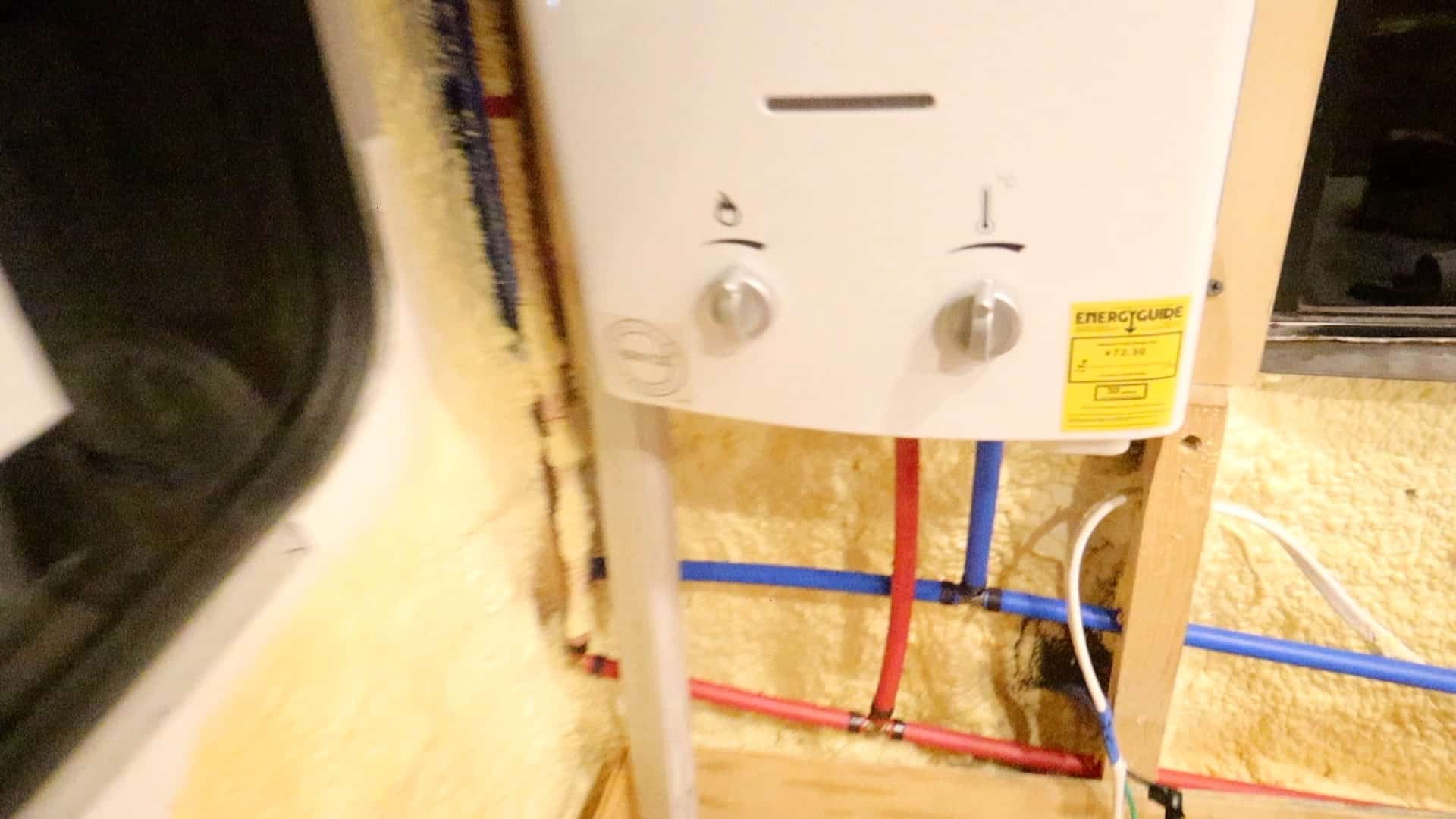
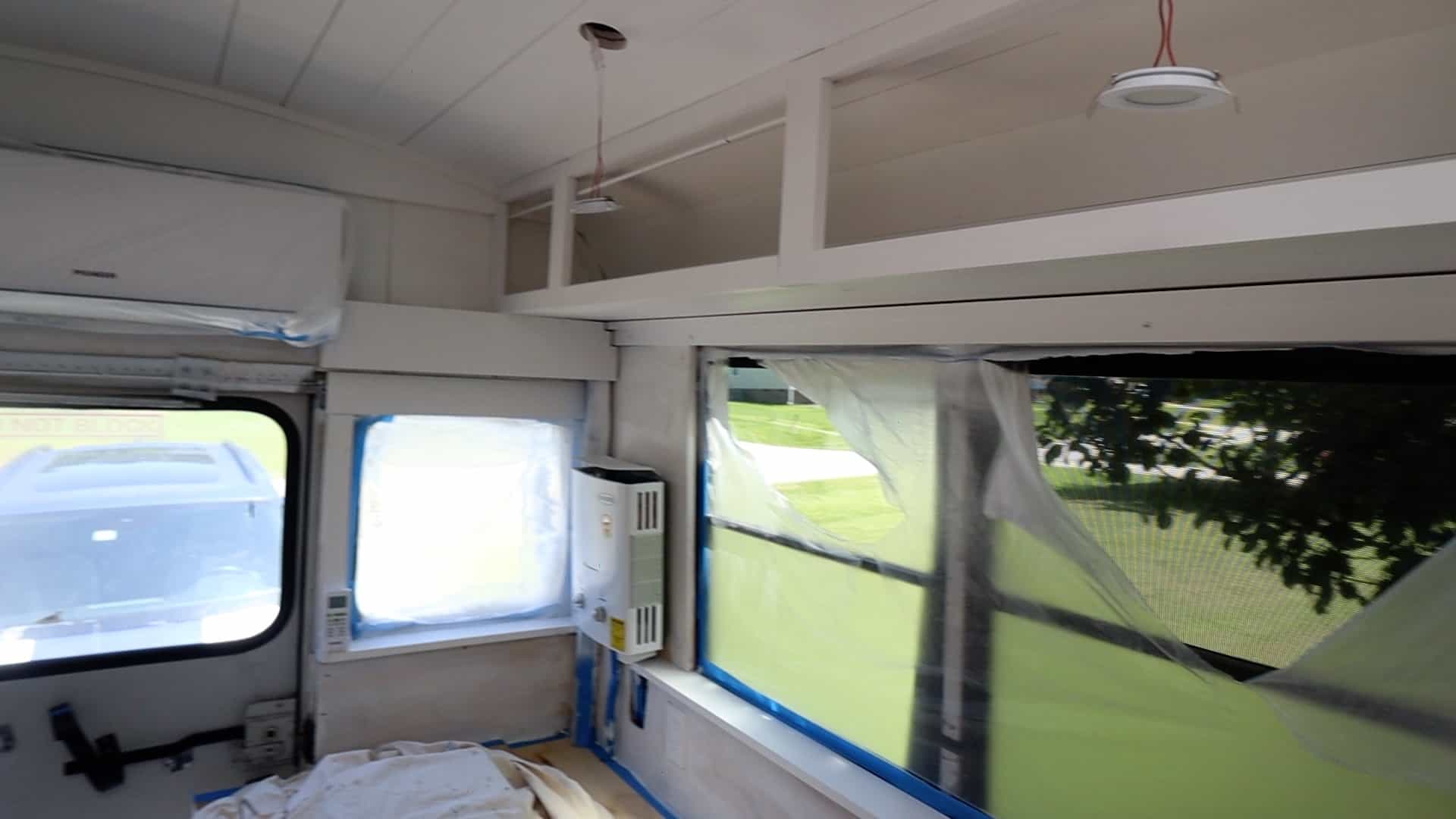
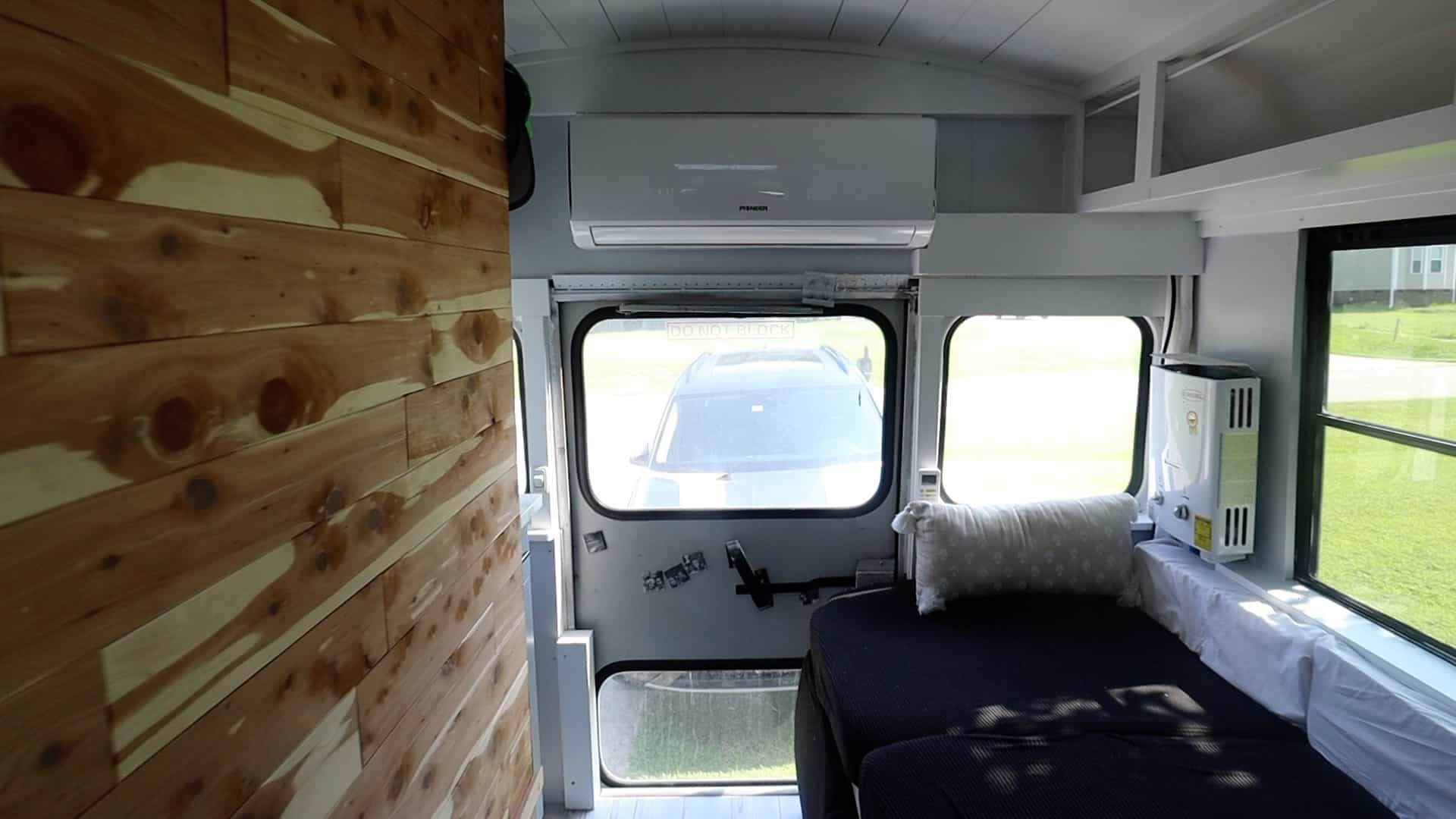
We purchased the Excel Vent-Free Tankless Propane Water Heater, Low Pressure Startup, 1.6GPM for our skoolie. You can find it here (Amazon) for about $199 with shipping before taxes .
This compact hot water heater has a number of great features and we have been happy with our purchase.
Vent free
This propane hot water heater does not require the installation of a fixed vent to release fumes out of the space. Instead, the propane gas is converted through usage in the hot water heater and the by-product vents from the top of the unit.
Low pressure start-up
Having a low pressure start-up is great if you have low flow water, like if you are relying on gravity to help your water flow. In our skoolie build, we installed a pump and accumulator, so we always had great water pressure whether we were off-grid or at a campground.
No standing pilot
The pilot light only lit when the water was heating rather than always remaining on. We enjoyed this feature because it’s just safer not to have something burning all the time that could cause a fire.
Battery-powered electronic ignition
A small battery is installed to light the ignition for the water heater pilot light. If the battery needs to be replaced, you can access the battery housing on the bottom right side of the unit.
Lightweight
This hot water heater is compact and only weighs 11 pounds. It’s mounted to the wall on a metal cleat and it was easy to install by one person.
How does the Excel Vent-Free Tankless Propane Water Heater rank?
4 out of 5 star reviews
I reviewed several websites, and the Excel Vent-Free Tankless Propane Water Heater ranks at 4 out of 5 stars. Additionally, it comes well recommended in the RV, van and school bus conversion communities for living tiny.
FAQ about skoolie tankless water heaters
How much does a tankless water heater cost?
Most tankless water heaters are between $200-$300, based on my shopping experience. The Excel Vent-Free Tankless Propane Water Heater that we used in our bus conversion was just about $200 before taxes (free shipping) when we bought it in the spring of 2021.
Do propane tankless water heaters need to be vented?
No. Not all water heaters need to be vented. There are a number of tested and trusted ventless water heaters on the market. Ventless or vent-free tankless propane water heaters are available with many positive reviews!
We wanted to avoid placing more holes in the roof and, at this stage, our solar panels and ceilings were already installed so we didn’t want to open a can of (unnecessary) worms by cutting through it all, especially since there are safe options available that make venting unneeded.
Why should you put a tankless water heater in a RV or Skoolie?
Installing a tankless water just makes sense in an RV or school bus conversion! You save so much space and it’s more energy efficient, heating the water only when you need it.
It’s compact.
The dimensions of the tankless, ventless hot water heater unit we purchased are width 11.6 inches x depth 4.46 inches x height 13.5 inches.
It’s lightweight.
Ours weighs 11 pounds!
Heats water on demand.
Traditional tank water heaters are notorious for being energy-hogs since they heat water constantly, not on-demand.
No standing pilot light.
Ventless options.
Our hot water heater is ventless so there were fewer holes that needed to be cut in our bus to install it.
Is a tankless water heater worth it in a RV or skoolie?
In our humble opinion, it’s worth every penny.
Space-saving
There is a big loss of space in a tiny home with a tank water heater. A compact water heater makes a big impact in a small space.
Energy-efficiency
Hot water heaters with tanks have the added (unnecessary) constant energy usage since they heat water even when the water is not in use. Tankless water heaters heat water on-demand, only when you need it.
Con: Not much cost savings compared to a tank hot water heater
When you compare the price of a heat-on-demand hot water heater to a tank water heater, there is not a big difference in price.
What size tankless water heater do I need for a family of 5 living full time in a skoolie?
We used water constantly while living in our skoolie – truly, our skoolie functioned like a “normal” home would and should. Grabbing a glass of (filtered) water from the sink or taking a shower were things we didn’t have to give up, especially with 100 gallons of fresh water & 100 gallons of gray water installed.
If you are geeky, the unit we purchased from Amazon had a hot water output of 1.6 gallons/minute (5.5 l/min), and we were never without hot water in our tiny home on wheels.
What are the disadvantages of a liquid propane tankless water heater?
Running out of propane
Truly, we don’t see any disadvantages other than running out of propane, which is unlikely.
Leak possibility
If you’ve installed your LP water heater according to manufacturer guidelines and/or had a professional install or review your work, the likelihood of this happening is low. Nonetheless, it is worth mentioning.
How much propane does a RV tankless water heater use?
To put it in perspective, we lived full time on the road as a family of five for six months and only had to fill up our 2-twenty gallon propane tanks twice during that time.
There is a small likelihood of a gas leak; however, if you do your due diligence during installation, leaks should not occur. Additionally, it’s recommended to install a propane gas detector (alongside a smoke and carbon dioxide detector). You can pick those up at most building stores.
How big of a propane tank do I need for a tankless water heater in a skoolie?
We installed two 20-gallon propane tanks in one of storage bins under the bus. We are a family of five that lived full-time in our skoolie tiny home for six months and we had to refill our tanks twice during that time.
How do you hook up a tankless gas water heater in a skoolie?
I’ve listed a top-level overview of the installation process below.
Review and follow manufacturer guidelines
Truly, following the manufacturer guidelines is the biggest recommendation. Fortunately, our instructions were clear and finding useful guides on YouTube were excellent when we needed it.
Secure the water heater to the wall, allowing for the appropriate head room at the top for heat escaping.
Attach the hot water lines
We used red (hot) and blue (cold) CPVC flexible pipe.
Connect the gas line
Test the gas line for leaks
Get a spray bottle with soapy water and spray all your connections. If you see any bubbles, then you need to work on the connections.
Install the battery used for the ignition
Open the battery compartment on the bottom right corner of the unit.
Hire a professional to review your work
If you are not a professional like us, we recommend having a licensed plumber and/or gas specialist take a look at your fittings after finishing your installation if you are doing it yourself.
Don’t cover the unit so it’s always able to vent and cool properly
As per manufacturer guidelines, keep the unit uncovered so it an property vent and not overheat, which can lead to fire.
Inspect quarterly for leaks and issues
If you’re installing this on a motor vehicle, then things rattle and roll constantly in transit and you may be entering different climates, which causes expansion and contraction. Check fittings quarterly for safety.
Resources for the Excel Vent-Free Tankless Propane Water Heater
We really enjoyed our on-demand, tankless, and ventless LP water heater. It met the needs of our family of five perfectly as we lived and traveled full time on the road. We were never without hot water when we needed it, and that’s really what we needed it for!
A skoolie roof raise is the process to modify the original school bus manufacturer roof height (approximately 6 feet 2 inches to 7 feet) to a desired taller height (usually between 11 inches to 16 inches taller). This can be an intermediate level DIY project or you can pay a professional.
You may be interested in raising the roof of you bus for a few reasons, like:
Personal height
Additional storage
More roomy feel
Upgrade of windows
Better floorplan options
The goal of this blog is to be a resource for someone interested in raising the roof of their bus and to guide them to make the best decision for them based on the budget, timeline, and personal height requirements they have.
Listed below is information to assist you in going the DIY route or finding a professional to assist you in your tiny home bus renovation.
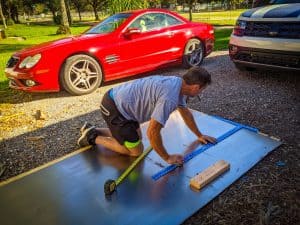
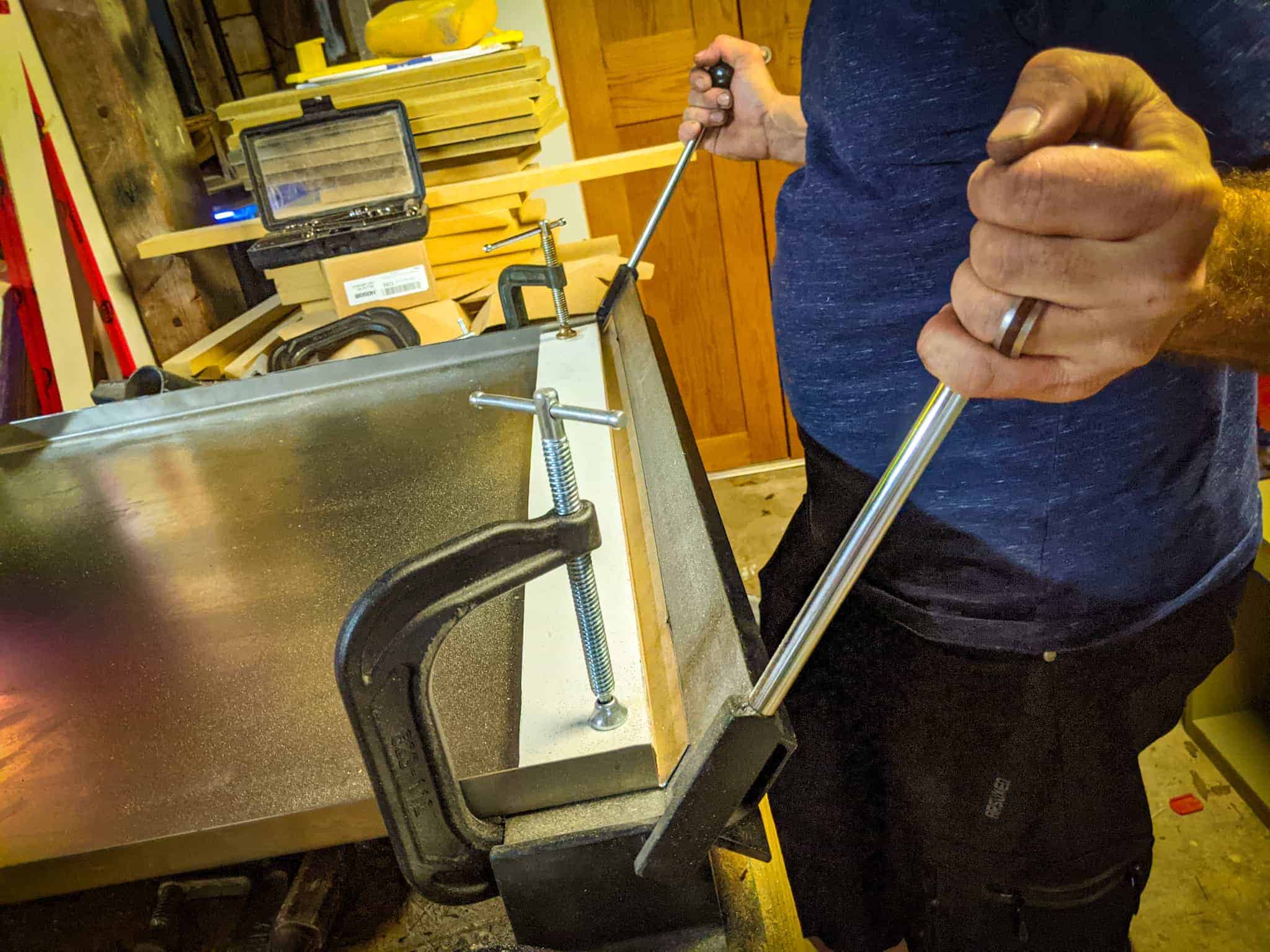
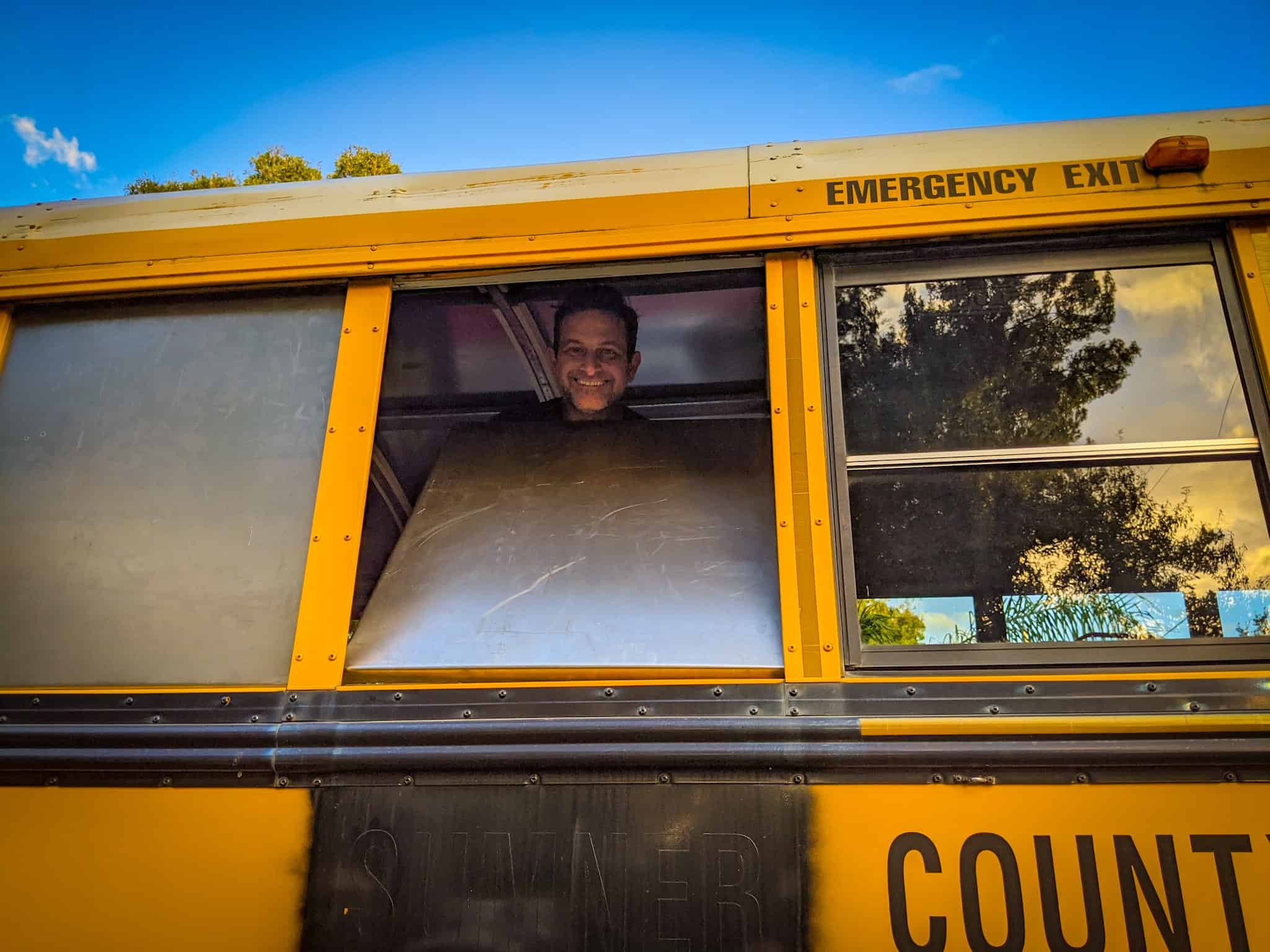
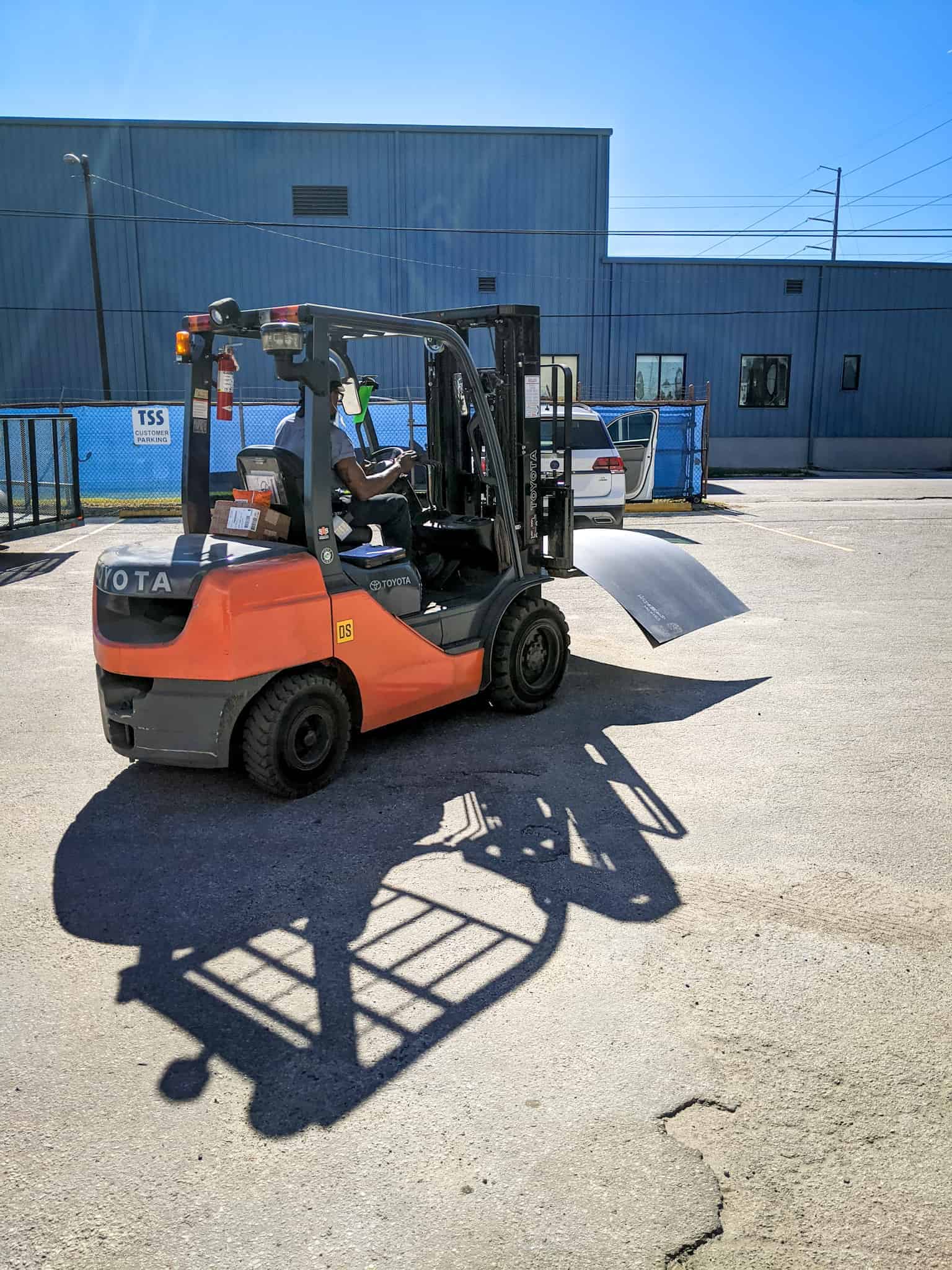
Eric measuring sheet metalEric bending sheet metalEric inserting a sheet metal frame into school bus window frame.Forklift carrying sheet metal
COVER PHOTO | What is a skoolie roof raise? | Destination Unknown
How high is an unmodified school bus roof?
The interior height in the center of the bus (the highest part of the bus) will vary from manufacturer to manufacturer, but it is typically between 6’2″ to 7′ high.
Factors that will affect the interior height of your completed school bus conversion will be any additions to the floor (like furring strips, insulation, sub-flooring, finish flooring) and to the ceiling (like insulation, furring strips and finishing pieces like shiplap).
During our build, we estimate that we lost 3 inches in the floor and 3-4 inches in the ceiling. The interior height in our skoolie is about 6’3,” without a skoolie roof raise.
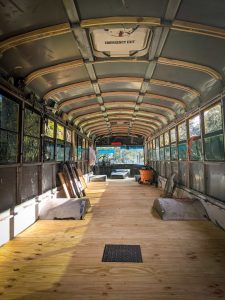
Empty school bus interior showing
How much does a skoolie roof raise cost?
Paying a professional to raise your school bus roof can cost upwards of $10,000, making it one of the most expensive upgrades you could pay for on your skoolie build.
The cost of supplies is relatively affordable, at approximately $1,000 for purchasing all new items.
If you are considering doing a roof raise yourself, then this will be the most cost effective route and your price range should be below $4,000, assuming you pay at least one person to help with labor. If you are a one-man-show, then you should only have the cost of any supplies you need.
Additional considerations and ancillary costs in raising the roof are replacing windows and to do a full or partial roof raise. You may need to remove all windows during a roof raise. In doing so, will you put them back in or upgrade for more weather tight options like RV windows or custom windows.
Cost & Materials Case Study
Check out the Skoolie Roof Raise: Cost and Materials vlog by Artsy Reclaimed where he talks in detail about his costs to perform his 16 inch skoolie roof raise, delete some bus windows and relocate a school bus door, and upgrade the old bus windows with RV windows.
What supplies will you need to do a school bus roof raise?
Simple Supplies & Materials list
Sheet metal (16 or 18 gauge) or other metal sheets
Personal protective equipment
Angle grinder
Air hammer with chisel tip
Bottle jack
All the rivets, self-tapping metal-to-metal screws or bolts
Metal or wood support posts
Gear to replace existing or upgrade new windows
Welding kit
Tin snips
Metal bender
How do you lift a school bus roof?
Simplified roof raise process
Expose the hat channels and remove the windows. You may need an air hammer to assist at this stage to remove rivets.
Cut the steel hat channels supporting the skoolie roof with an angle grinder or similar tool and temporarily support the roof on some sort of posts or pillars.
Use bottle jacks* to evenly raise the disconnected roof to your desired height.
Once your desired height is reached, you’ll weld new steel supports to bridge the gaps you created and then remove the temporary supports and jacks.
Attach new sheet metal panels to cover the gaps you created during the roof raise.
*A car jack isn’t recommended since it may raise the roof at an angle, rather than straight up.
What skill level is needed to do your own skoolie roof raise?
This activity is not for the faint of heart. This is a big bus conversion project and the entire process can be daunting for someone with an intermediate skill level… or even an expert! Your entire roof literally needs to be suspended above you and then welded back together safely.
Advanced or expert skill is recommended.
Is a school bus roof raise worth it?
It really depends on your budget and personal height requirements.
If you’re 6’8″, then the answer is a solid yes for head comfort alone; however, for those shorter than 6’2″, you could probably live without a roof raise, the price tag that comes with a skoolie roof raise, and the increased building time.
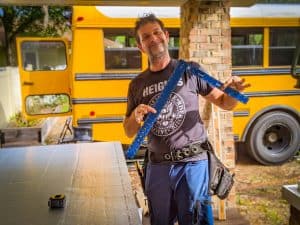
Eric holding a t-square with a skoolie behind him
My husband is 6′ and I’m 5’10.” We did not raise the roof and it has never affected the functionality of living in our bus. The only place we would have preferred a little more space would be in our children’s bunk area; however, they only sleep there so it is not a big problem (more of a preference).
Consideration items
Some other factors to consider if you raise the roof are:
The additional heating costs in cold climates due to increased square footage
Doing research prior to travel to avoid low bridges
Do the pros of a higher roof outweigh the skoolie roof raise cost?
Will you do a partial roof raise, like only in the kitchen area?
What is the maximum height so as to still accommodate additional items like solar panels or a roof deck?
Should you hire a welder to assist?
Should you pay someone to help you raise the roof?
Do you have a metal supply yard nearby? We couldn’t find sheet metal at our local Lowe’s and Home Depot.
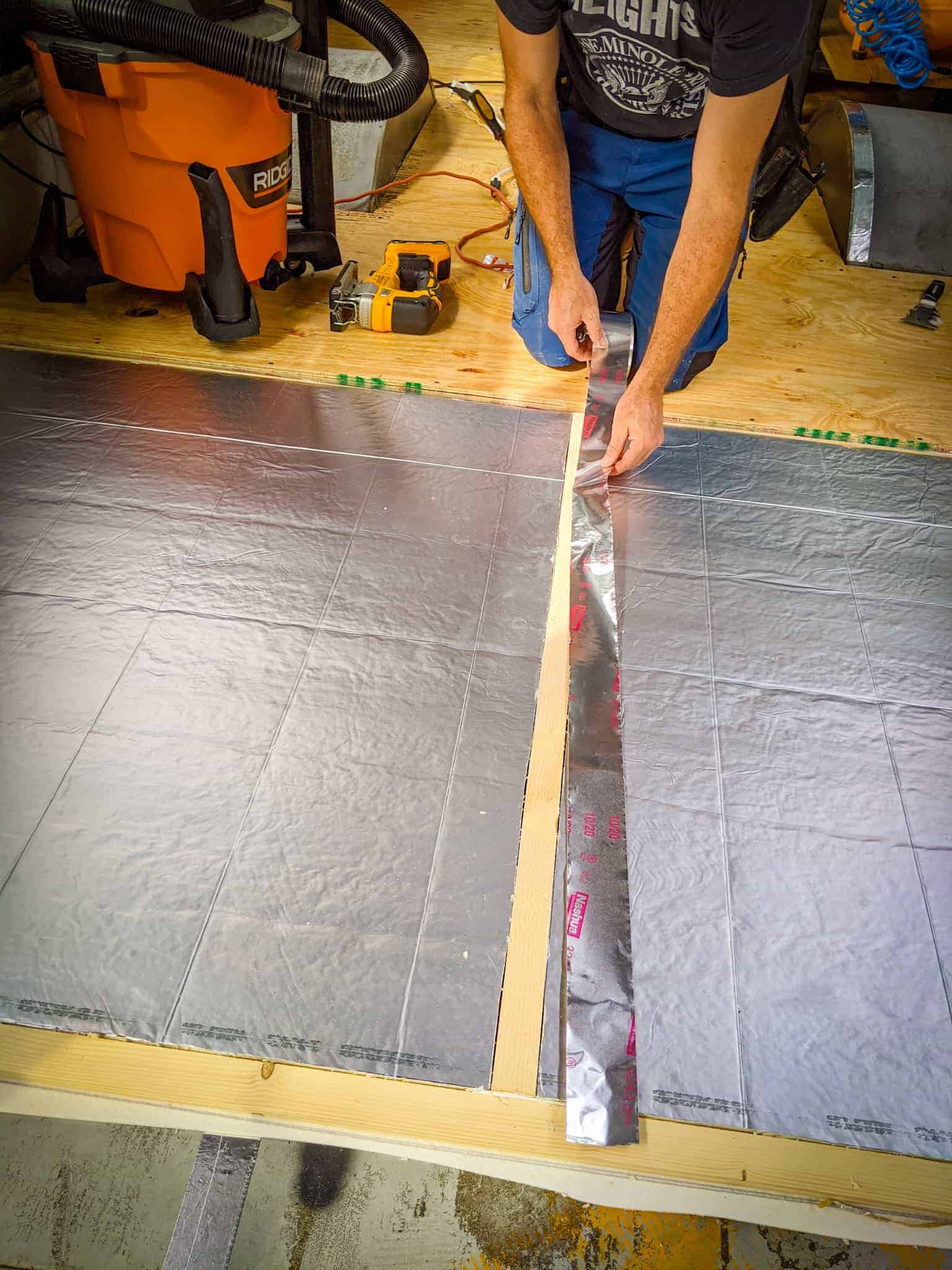
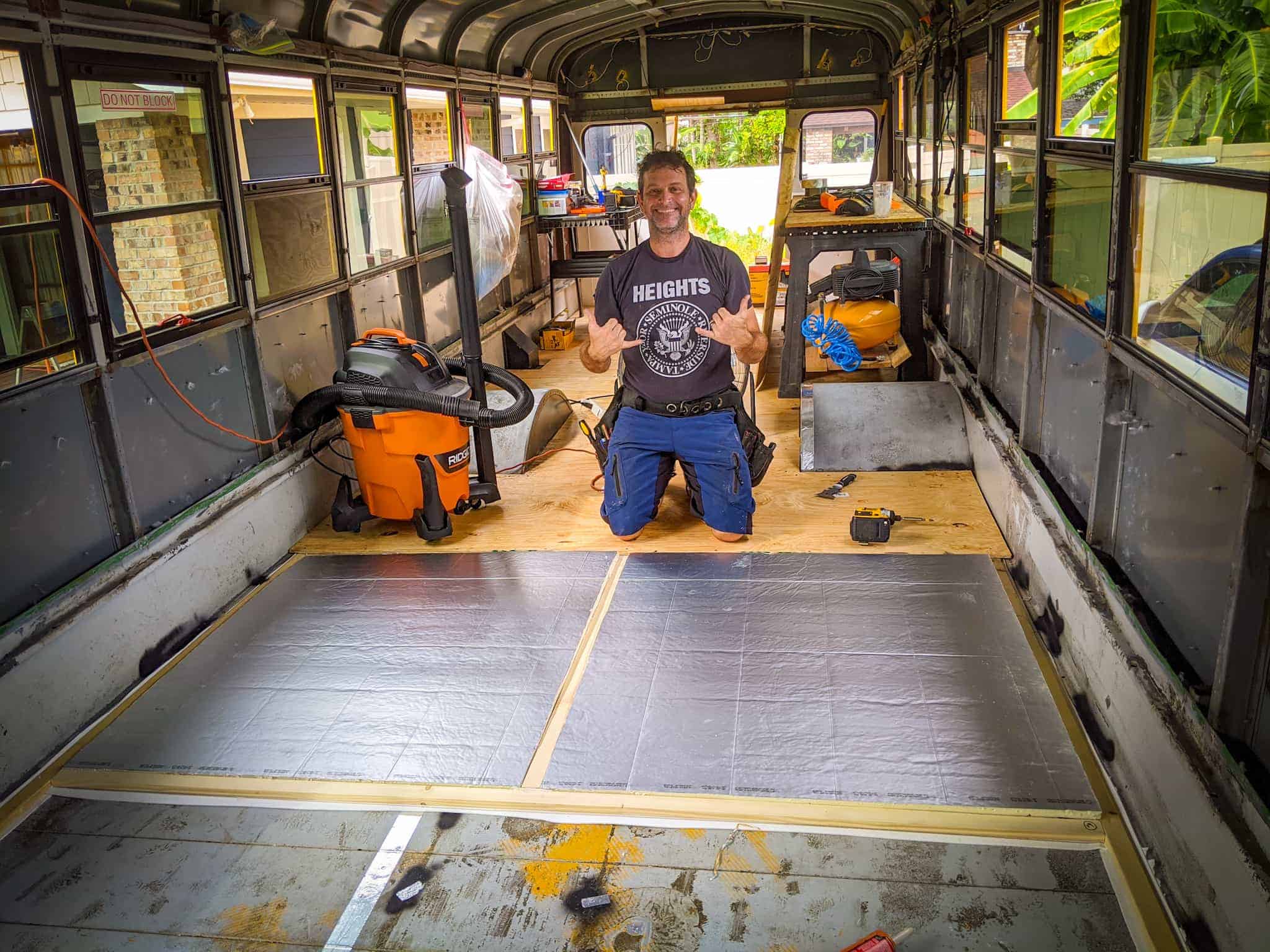
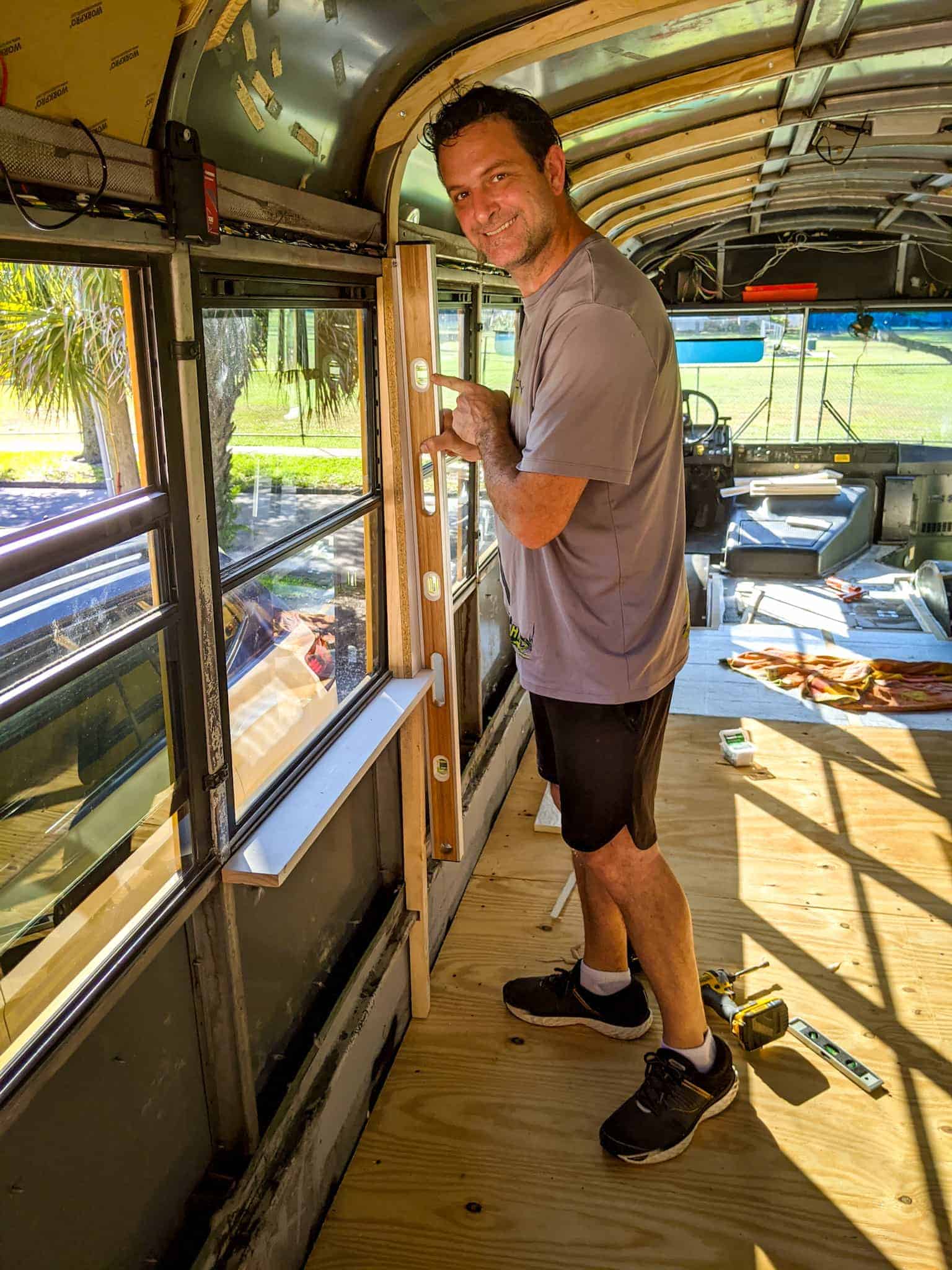
Eric installing flooring furring strips and insulation.Eric installing flooring furring strips and insulation.Eric using the level to during the wall furring strip installation.
Where can you learn to do a skoolie roof raise yourself?
It’s time to raise the roof!
There are a number of owners of school bus conversions that have done a DIY roof themselves, rather than outsource to a trained professional.
They have done a wonderful job documenting their roof raise process on their skoolie build.
Below, I’ve listed some resources that you can look into if you’re planning to do a skoolie roof raise on your own.
I would love to say that I found a kit for you. At the time of writing this blog, I have not! If you have any place that you can recommend, please let me know in the comments.
Pay a professional to do your school bus roof raise
If raising the roof yourself on your tiny home isn’t your cup of tea, there are plenty of professionals out there.
To see a full list of school bus conversion professionals, read this blog!
In my own internet research for this blog, here are a few vendor(s) I came across. I have no affiliation with these people or companies. This is simply a resource to help you save time.
If you can recommend any vendors in the comments, I would be happy to include that feedback for readers.
Roof raise vendors
Transcend Existence – He has a number of YouTube videos documenting his work on other skoolie tiny homes. It appears that he has a stationary location somewhere in the western US and may travel for some conversions depending on the scope.
To see a full list of professionals that can help you at all stages of your school bus conversion, read this blog!
Does raising the roof affect skoolie insurance eligibility?
It depends state to state. We had a lovely experience applying for insurance in Florida for our school bus conversion. In short, our insurance agent was not concerned about additional modifications done to the school bus.
Our insurance rates are very reasonable with good coverage. You can see exactly who we insured our bus with, recommendations for our area and download our exact policy in this blog.
Conclusion
I hope this blog has thoroughly answered any questions you have about what a skoolie roof raise is, costs associated with raising the roof of your bus, materials and supplies needed, resources for how to do your own DIY roof, and resources for finding and pricing out professionals.
Thanks for following us on our journey. If you’re curious about where we started, check out this blog. – Ingrid & the HildeFam
As an Amazon Associate I earn from qualifying purchases. As an affiliate of other programs, I earn from qualifying purchase. Thank you for your support.
How to buy a used school bus for a skoolie conversion
If you are like us, when you first learned about the cool things you can do with a used school bus, your imagination was flooded with visions of a custom tiny house for epic family road trips, custom tiny spaces and maybe even music festivals!
That’s why we made the “The Ultimate Skoolie Guide To Buy a Used School Bus to Convert.”
Yes, you could buy a used school bus but…like…how do you know what to look for? And if you found an old school bus, how do you know if it’s a good bus for your skoolie conversion or a money pit?
You may have already started researching online and quickly realized there are a lot of scams or misinformation out there.
We researched the heck out of buying a used school bus for a skoolie conversion, and we will share all of that information with with you.
Case study: Our personal experience
Where did we purchase our used school bus from?
We purchased a flat nose 2002 Thomas school bus at government auction through GovDeals.com, sight unseen, for $4,500 in Sept 2020 from Sumner County School Board in Gallatin, Tennessee.
We called a remote diesel mechanic to inspect the bus before we purchased it.
Watch the vlog where Eric sees our own bus for the first time.
What did we look for in our first bus?
We are a family of five with no pets and needed a full sized school bus. We wanted a strong engine for driving up hills and mountains.
The perfect bus for us ideally would look like:
Cummins diesel engine (5.9L Cummins or 8.3L Cummins)
limited surface rust
mileage under 100K preferably
no major mechanical issues with evidence of proper maintenance
no handicap access
35 feet or longer
good tread on the school bus tires
What we learned during our school bus conversion
Timelines Change
We thought we could complete our skoolie conversion in 4 months. Our skoolie life began 7 months from the time we started, and we still had a few projects left to complete when we moved in.
How much storage space do you need?
A key part in planning before you buy is determining how much storage space you will need, and not just on the interior.
Don’t forget the exterior since that is where you may be mounting things.
We got really lucky here because we had enough space underneath to mount our AC condenser and gray tank. Our bus came with 3 large storage bins already mounted, which allowed for ample storage and installation of our propane tanks.
Engine Location
We bought a flat nose bus, so our engine block sits next to the driver seat. A school bus engine puts off a lot of heat, like over 200 degrees Fahrenheit!
It is brutal in the summer without AC inside the bus, even with the windows down.
In hindsight, we would have preferred a rear mount engine or an engine mounted outside the front of the bus (also known as a “dog nose bus“).
Case study of our budget
Purchase budget
Used school bus purchase price: $4,500 in September 2020
Mechanical inspection with a mobile mechanic: $350
Build-out of our school bus conversion
High-quality finishes, 6-panel solar array, DC fridge, professional inspections, labor: $50,000
On-going maintenance
Surprise repair in May 2021 in Miami, Florida (brake line repair + new tire): $4,000
General maintenance and upgrades by Mechanic in Worcester, Massachusetts: $10,000
5-days Hotel accommodation when we couldn’t live in the bus: $1,000
Do you need construction experience to make a skoolie conversion?
My husband, Eric, took on our skoolie conversion.
He had limited to no experience in building, and relied heavily on resources online, the skoolie community, and professional recommendations.
He tried to follow RV builder code as much as possible, and scheduled professional inspections at the rough-in and final stages for plumbing, electrical and gas.
Eric spent about as much time researching before actually performing the activity, specifically around the electrical, gas installation and solar array set-up.
Poor electrical decisions can lead to fire hazards. Eric studied for at least 2 weeks on how to properly install the 12V DC and AC electrical systems and consulting with several electricians prior to ordering the supplies.
Best places to buy a used school bus for sale
Survey responses from the skoolie community
Sales vs. Source | Who did you buy your used school bus from?
I surveyed the skoolie community asking, “Who did you buy your used school bus from?” Honestly, I didn’t expect the results.
Overwhelmingly, the results and discussion in the comments section showed that many of you purchased a bus locally on Facebook marketplace!
I categorized the responses into nine source categories listed below. Within each category are seller recommendations that I will go into more detail in the next sections.
Thank you to all the participants from the Facebook groups: Skoolie Nation and Skoolie Planet, and our Instagram stories.
If I had surveyed a larger pool of people (more than 30), the results may have changed; however, I think the results are normal for a person polling people in the skoolie community for the purpose of seeing where they bought their bus from.
Auction
A benefit to using an auction site is that you may have more payment options available to you, like credit card, than a direct sale to a seller who may only take cash or certified check.
Additionally, you may find more businesses than private sellers listing buses for sale on an auction site, since the auction staff can help them list and sell their used bus fleet quickly.
One person surveyed purchased their bus on eBay. When I searched on “school bus” in the eBay search bar, I was pleasantly surprised by the selection of used school buses available, including fully converted school bus conversions for sale.
eBay is a “household name” and reputable marketplace offering great buyer protection and payment options.
This site allows government agencies to offer used goods. In fact they have tons of cheap school buses being sourced from school districts retiring their old fleets!
This site has become the national clearing house, and you can find used school buses for sale in basically of the USA.
An added benefit to purchasing through a middle man like this website is that you have some protection if the used school bus is in worse condition than stated.
Furthermore, the school districts and other government agencies selling off fleets of retired school buses have no personal interest in them. They are unlikely to hide flaws and failures on purposes to mislead a new buyer.
How to bid on buses on GovDeals.com
Click “Register” in the top right corner to create an account.
To find the used school buses, choose “Bus, Transits and Schools” on the home page.
For a more specific search, used the Advanced Search at the top of the page. Select the “Find vehicle” tab. I recommend restricting the maximum price range between $0 to $15,000 or whatever your budget allows (the default price range is $0 to $50,000), and the location to a maximum radius from your home base. If you’re in Florida, driving to Alaska for a used school bus is pretty unreasonable.
Decide on the used school bus or school buses that you want to bid on.
Register a credit card when bidding. If you win the auction, they will a deposit first and then eventually the full payment due.
Read the fine print since not every auction follows the same rules: we were allowed to inspect the vehicle before final purchase.
Some auctions carry a reserve. That simply means that if the seller doesn’t receive a high enough price (the “reserve price”) then even if you win the bid, you may not be allowed to buy the school bus. To avoid reserve auctions, you can filter those auctions out.
Expect active bidding at the end of the auction to occur, which may extend the clock. For example, if an auction is set to end at 5:00pm and bids continue coming in within 2-5 minutes of the auction’s scheduled end, then the time allowed to bid may increase by 2-5 minutes. This helps the seller receive the highest price from the most serious buyers.
When bidding closes and you win your used school bus, the feeling is a mixture of happiness, relief and anticipation of what is to come.
Make your deposit with the credit card on file.
Schedule a mobile mechanic to inspect the school bus at the fleet yard or review the mechanical records prior to complete payment.
Coordinate a time to pick up your school bus!
To locate the bus auctions, from the home page, navigate to the left side to Categories. Click “motor pool” then “school bus.”
One person surveyed got their bus here. This appears to be small auction site and there weren’t many active auctions at the time I visited. Maybe you can score a deal here if you keep checking back.
This auction site is another government surplus site that has a variety of products for sale, including used school buses.
Business
Bus charter or bus operator
Two people surveyed said they purchased their bus from a bus charter or bus operator. These would be companies that maybe operate tour groups and a 3rd-party operator that provides buses to business or individuals for a fee.
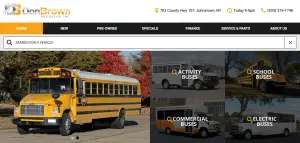
Another two people surveyed relayed the positive experience they had working with Don Brown Bus Sales out of Johnstown, New York. There is also finance, service and parts divisions.
Employer
One person surveyed purchased their bus from their boss. If your employer runs buses, ask them if they plan on retiring any of the fleet soon.
Government or Not-for-profit
Of the people surveyed that purchased from governments or not-for-profit organizations, the responses showed bus sales from the following places:
Church
School Systems, School Districts, & School Boards
YMCA
School Systems, School Districts, & School Boards
You may find luck individually contacting a school system, school district or school board directly to purchase your used school bus.
However, it is a lot easier to simply go to a reputable auction site that works with many school boards. We personally bought our used school bus from a school district using GovDeals.com.
Online marketplace
Eight people surveyed said they purchased their skoolie on an online marketplace, which was the most in our survey.
Facebook Marketplace
8 people surveyed purchased their old school buses on Facebook Marketplace.
There’s no middleman so you can negotiate with the seller individually.
Craigslist
One person surveyed said she bought her bus on Craigslist. This community-lead forum is a great source for finding your school bus conversion, if you’re willing to look.
Bus For Sale by Owner Classifieds
Below are listed a number of sites specifically referencing classified ads for nearly everything related to school bus conversion sales, like school buses for sale, bus conversions for sale, skoolies for sale, and converted bus for sale.
Be cautious when buying direct from the owner versus using a middle man or a business, like a school district, since that person has a greatly likelihood of deception because of financial interest.
Make sure that they’re selling what they claim they are selling.
Below are some helpful tips when dealing directly with a seller:
Use common sense. If the price seems too good to be true, ask yourself why that is.
Call the DMV. Check the VIN number on the bus to see if it has been reported stolen.
Ask for proof of ownership like a bill of sale or registration form.
Is it currently insured? Get a copy of the policy.
Is it registered with plates?
Is it safe to drive? Has it been in any accidents?
Are there any mechanical issues? Walkthrough the bus with the owner, if possible, and ask specific questions concerning common problem areas like surface rust, leaks, structural issues, engine issues and engine maintenance.
Has the owner recently had it serviced? Ask for records and receipts.
Will the owner allow you to have your mechanic take a look?
What method of payment do they want?
You will pay taxes at the DMV when you register the vehicle. You’ll need to include the purchase price on the Bill of Sale.
Facebook Groups
We frequently see postings of school bus conversions in a number of popular Facebook Groups. Try searching within Facebook using terms like:
Skoolie for sale
School bus conversion for sale
Skoolie Buy Sell Trade
I’ve compiled links to some of the Facebook bus groups specifically mentioning skoolie sales or bus sales in the description. Membership or joining the Facebook group may be required to see the posts.
One person surveyed said they bought their school bus conversion from Natural State Buses builder located in Bentonville, Arkansas.
According to their website, they specialize in:
Roof raises
Window & door installation
Spray foam insulation
Demo
Interior build-out
Trade
One person responded to the survey that they traded their old RV for their used bus, and I think that’s an awesome way to make a swap between like-minded people. This is also a cashless option.
Google search
When all else fails, google it! Google is a powerful search engine. It knows your location and can easily pull up local bus yards in close proximity to where you live.
Try searching on long-tail keywords like:
“School bus for sale near me”
“Old school bus sales”
“Used school bus auction”
“Retired school bus dealer”
“Buy school bus”
“Cheap school bus”
“Converted school bus”
“Used buses”
“Buy a school bus”
Safe & Strong Construction
There are a lot of things to consider when buying an old school bus. However, there is one thing you shouldn’t have to worry about, and that’s whether the bus you are looking at buying is safe or not.
School buses are built to be extremely safe.
School bus manufacturers must follow strict safety regulations because these vehicles transport children.
I go into detail on why we purchased a retired school bus instead of an RV because of the quality of construction in this blog.
What sizes do school buses come in?
We can break the types of school buses into three sizes:
A full sized bus is greater than 30 feet long, with the maximum length reaching around 45 feet. These are the most common buses you see.
Since long buses are a dime a dozen, the sales price compared to that of a short bus may be less.
These size buses are best suited for four or more occupants, though reasonably under 6-8 people living on board.
Mid sized school bus
Mid sized school buses will fall somewhere between 20 feet to 30 feet. This size school bus is like Goldilock’s porridge: not too big, not too small, but just right. It provides enough interior space while not taking up too much space at say a parking lot.
This size bus can accommodate two to four occupants living on board. Any more than that, and you may wish you had a longer bus.
Short school bus
A short bus is less than 20 feet. They are less common to find, but are a great option if you’re a single person or couple that don’t need as much space or wants to be more invisible in public.
Short buses may be the perfect size for one to two people looking for something larger than a van, but smaller than a long bus.
How wide is a school bus?
The general width of a school bus is between 7-9 feet, including the mirrors. This is because school buses must navigate neighborhoods and city streets just like any normal vehicle would, and the government(s) place restrictions on the width.
How heavy is a school bus?
Most non-converted and school buses conversions weigh between 10,000 to 25,000 generally, depending on the size, finishes, and personal belongings. These are solid-built steel beasts, but you wouldn’t know it because the engine is made to pull it.
One of the most common question asked by those looking to buy their first school bus is “what are the best buses to buy?” It depends on several factors.
Your needs (are you a single person or a family of 5?)
Your goals (do you have 2 months for the build or 1 year?)
Living situation (will you live part time or full time in your skoolie?)
Your budget (how much can you afford to spend on the school bus, repairs, build-out and on-going maintenance?)
What to know before buying a used school bus?
How much does a used school bus cost?
During our search, we found the cost of an old school bus starts at around $4,000 and can go as high as $15,000, depending upon the age and condition of the bus.
School buses are generally sold at a deep discount from their original price (over $150,000).
They are sold either because they are too old for their intended use or because the owner has upgraded to a newer bus.
How many miles will a school bus last?
School buses are designed to last for well over 500,000 miles. But that doesn’t mean that a school bus will last for well over 500,000 miles in every case.
The exact number of miles you can get out of a school bus depends on how the bus is used and maintained.
If the bus is used for just one purpose — transporting students — and kept at a reasonable speed (no more than 65 mph), it will likely last much longer than if it’s used as a workhorse to run errands and haul cargo.
School buses are also built with safety features to help them endure accidents. But even these safety features have their limits. If a school bus crashes at 35 mph, it may not be able to withstand the force.
If it crashes at 15 mph or slower, its safety features and construction can help the bus survive longer.
How do you make sure your school bus has a long life?
There are other things you can do to keep your bus in top condition and in good working order. We’ve listed a few below:
Inspect it weekly for leaks (more frequently if driving regularly)
Treat surface rust quickly
Power it own to make sure the batteries have a charge and the air brakes (if any) engage
Check oil levels
Replace worn-out parts before they become hazardous.
Should you buy a bus that has already been gutted and renovated?
Pros for Gutted:
You can more easily examine the bus for rust and water intrusion during your inspection.
You will save a lot of time and money by eliminating the need to completely gut the inside of the bus yourself.
You don’t have to dispose of all the seats, wall panels, scrap metal and hardware
Pros for Not Gutted:
It may cost less since no labor has been performed to demolish the interior
You don’t get that first experience of gutting your bus
Before buying guide
Decide what are key things you’re looking for like length, engine size and how far are you willing to travel to get it?
In order to make the best decision possible, you need to know what to look for and where to look. It is also important to know what you should avoid.
While some of these tips may not apply to every situation, they are easy enough to follow that they will help you identify a good purchase before buying.
Skoolie Buying Guide Questionnaire
What’s your purchase budget?
How far are you willing to travel to pick it up?
Have you reviewed the bus’s mechanical history?
Will you or a mechanic inspect the bus before purchase?
How will you purchase the bus?
Will you use it for full time or part time living?
How will you insure it?
How will you register it with your DMV?
How much have you budgeted for maintenance and repairs?
What are the bus weight maximums?
What type or size of engine does it have?
Where is the engine located: inside-front, inside-rear or outside.
Is there a Handicap access?
Does it have air brakes or hydraulic brakes?
How to inspect before buying a school bus
Inspection by a Mechanic
If you aren’t qualified to do an inspection before buying, find and pay a mechanic. The inspection will run you between $300-$500, depending on where the mechanic is coming from and the time it takes to perform the inspection.
We found that where there was a large fleet or auction of buses, there was usually a mechanic shop nearby. You can search for “diesel mechanics” near the area your bus is located.
The first thing you should do when considering buying a used school bus is to have it inspected by a mechanic. The second thing you should do is have it inspected by a mechanic. Thirdly, get another mechanic to inspect the bus. Fourthly, get two other mechanics to inspect the bus, just in case they missed something the first three times.
Trucks of this size and age are not often bought by individuals, but rather companies that deal in used school buses. There are several reasons why buying a used school bus from one of these companies is a much safer bet than doing so from an individual.
The most obvious reason is that they’ve been inspected by mechanics who know what they’re doing and who can answer any questions you may have about the state of the vehicle’s mechanical condition.
The body
You have to look at the outside of the bus for rust and in areas that may have contact with water in the interior like window sills and stairs.
Rust is really common with buses in the north that experience snow or that are more coastal, where the salt content is higher.
Rust can do significant structural damage to the steel frame of a school bus if left unattended.
Check the school bus tires for dry rot or cracks. Make sure that all doors open and close properly. If there is no air conditioning system then check if there is any water damage from condensation due to not having A/C.
Make sure that all of the lights, turn signals and other things are working properly.
The engine
Look at the engine of the bus for oil leaks and check for any signs of damage which would indicate that it was in a crash or flood or otherwise damaged.
Make sure to check underneath for oil leaks coming from any parts near the bottom of the engine block.
Conclusion
After reading this you should have a better idea of what to expect when you buy an old school bus and the steps you have to take in order to convert it into a skoolie.
The more time you put in upfront before you shell out cash will save you from more headaches down the road.
If you still think that it’s worth the risk, then go ahead and give it a shot. It will be an adventure you’ll remember for the rest of your life. We did and we don’t regret it!
Thanks for following our journey. Click here to check out more of our skoolie posts. – Ingrid & the HildeFam
We have quickly and easily insured our school bus conversion twice in Florida with no issues. The first time we insured our decommissioned school bus was the day before we bought her at auction, with all the seats and school bus markings. Next, we changed providers after we titled her as a motorhome and received better rates.
We read many articles and forums describing the difficulty some people had getting insurance on their skoolie or school bus conversion, and that just isn’t the case if you know who to speak with.
Insure your skoolie with an independent insurance agent
My biggest recommendation is to work with an independent insurance agent who understands school bus conversions.
We worked with two independent insurance agents, Marie Carney & Kelly Newsome, on different occasions to find us the best rates across all the automobile insurance providers in Florida.
The huge benefit to working with an independent insurance agent is she is not restricted to working with one insurance company. This saved us a lot of time because she did the research on which insurance providers would insure a school bus conversion, whether the conversion has not started or if it is fully complete.
The added benefit of working with an independent agent is you may also be able to bundle your car, motorhome and home policies together. We did this with our skoolie & car, which saved us money and just the headache of paying different providers.
Insurance agents that insure Skoolies in Florida
Marie Carney, Vystar Insurance Agency
Direct 904-594-5464; Brightway Service 888-254-5014
Insurance companies that insure school bus conversions
What insurance providers actually insure decommissioned school bus conversions and skoolie motorhomes?
Here are a list of insurance companies that I’ve come across that may insure a school bus conversion. These providers may vary state to state, and the list is not specific to Florida.
This is who we’ve insured our skoolie for the past two years. Our independent insurance agent bound a policy with Progressive Insurance. The terms were reasonable and our detailed below.
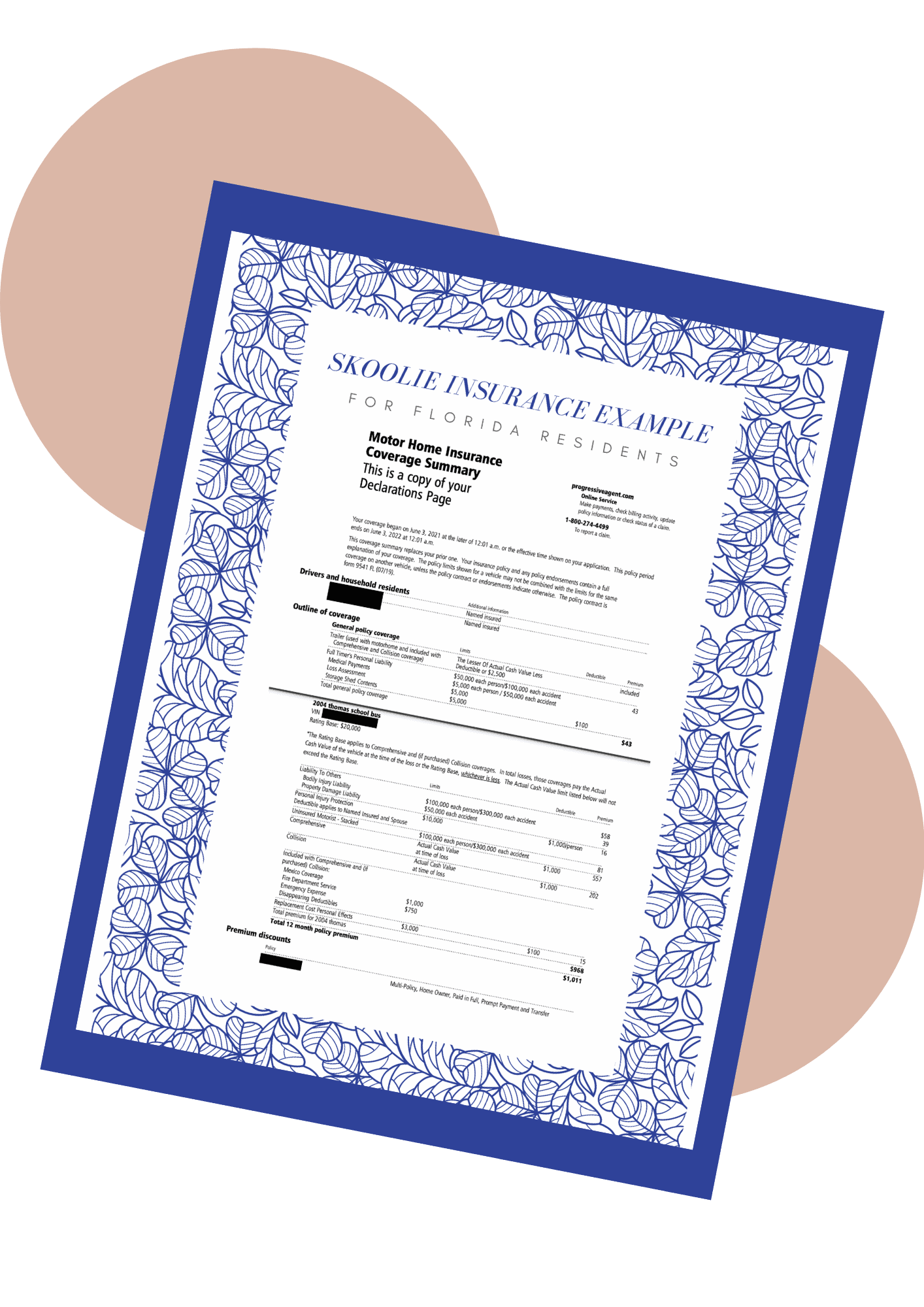
This is a breakdown of our personal school bus conversion insurance policy with Progressive.
What questions did our insurance agent ask before insuring our skoolie in Florida?
What is the cost & rating base on skoolie insurance in Florida?
Total annual policy amount: $1,011
Rating base: $20,000
We paid the annual policy up front – we didn’t have the option to split the payments into smaller periods with this provider. We went with minimum coverage on the policy.
Are you living full time or part time in your school bus conversion?
We were planning to or already living full time in our policy, and the insurance wanted to make a distinction for this on our policy.
What are the coverage & liability thresholds to insure a skoolie?
Our policy covers:
personal liability like medical payments, loss assessments and storage shed contents
What evidence did we provide our insurance agent to show we were a motorhome?
We sent our agent:
Our Florida title and registration
Provided her with our VIN number
Since we are titled as a motorhome in the state of Florida, the process to insure our skoolie was the same as insuring a “normal” motorhome.
Progressive, at the time we bound, actually had a drop down option for school bus conversion.
This may come in handy if you do modifications like a roof raise on your bus tiny home.
FAQs on Binding Insurance on a Skoolie in Florida
Can I insure my school bus conversion if I am not yet titled as a motorhome?
The short answer is yes. We purchased our decommissioned school bus in Tennessee and we received a temporary Florida insurance policy with Allstate Insurance, which allowed the insuring of a vehicle that wasn’t titled as a motorhome.
The cost to insure our school bus was reasonable though more expensive than after we completed the conversion and titled it as a motorhome.
How do you retitle a decommissioned school bus as a motorhome in Florida?
The process to update our school bus title from “bus” to a “motorhome” was really simple in Florida. Read this blog on how we did it and the forms we used to do it in about 10 minutes.
Does a skoolie insurance policy cover personal possessions?
It depends on if you elect personal property coverage on the skoolie insurance policy or purchase a separate policy for personal property in your rig.
Check your current school bus conversion insurance declaration page to determine if there is personal property coverage on your policy. If you don’t have coverage, then you can contact your insurance agent to create a policy, like a renter’s insurance policy, that will cover your belongings and personal property like appliances in case of loss.
Can I obtain a motorhome coverage on my skoolie if it isn’t titled as a motorhome?
No. To obtain motorhome or RV coverage, you must have your school bus conversion titled as a motorhome.
If your decommissioned school bus is still being converted into a motorhome, you can and should have insurance on it. Check with an independent insurance agent that is knowledgeable about RVs and skoolies. I’ve referenced a few above.
Does my school bus conversion need to be inspected before getting insurance?
It depends state-to-state, honestly. Personally, we’ve insured our skoolie twice, once before the conversion was complete and it was titled as a motorhome with Allstate and then after with Progressive, and we never had to have it inspected in Florida.
How much does school bus conversion insurance cost?
We pay just over $1,000 for an annual motorhome school bus conversion policy with Progressive in the state of Florida (2021-2022). Our skoolie is titled as a motorhome in Florida.
We were previously insured in 2020-2021 with Allstate before our decommissioned school bus was even built out. That annual policy cost was about $1,200.