Destination Unknown

Category: Features and tips

Blogs in this category include features on and tips about our skoolie as well as resources and products used.

  • Selling our Skoolie: Features & Upgrades to the HildeBus

    Selling our Skoolie: Features & Upgrades to the HildeBus

    We are selling our skoolie, lovingly called the HildeBus. This blog details out the custom features, upgrades, and service history of our tiny home on wheels.

    Additionally, you can follow the history of her build by watching the Skoolie Demolition playlist and Skoolie Finishings playlist on our vlog. We have a vlog & blog detailing the reasons why we decided to build a skoolie during the pandemic.


    Skoolie video tour

    In summer 2021, we make a vertical format skoolie video tour that is under 1 minute long. Watch it here!


    How to Buy our Skoolie

    Price

    $65,000

    Contract

    If a buyer wishes to purchase the HildeBus, the seller and buyer will sign a contract detailing the terms of the sale and transfer of the skoolie, license and registration.

    The buyer is responsible to transfer the title and registration at her own DMV, and transferring insurance to her name (or choosing a different provider). The seller will cancel insurance on the day of sale since they are no longer owners of the vehicle.

    Down-payment

    To secure interest, a non-refundable security deposit is needed of 10% of the purchase price from the buyer.

    Payment

    The buyer is responsible to obtain funding, whether that be cash or private loan. Wire payments are the preferred method of payment transfer due to simplicity.

    How to Reach Us

    If you would like to reach us about touring our skoolie for purchase or hosting us as a long-term AirBnB on your property, please email us at Hello@DestinationUnknown.life.


    History of the HildeBus

    We purchased our retired school bus at government auction from a school district in Tennessee at the end of September 2020. We started demolition of the interior in October 2020 and officially hit the road in May 2021.

    Eric (husband) did the majority of the demolition and build by himself with no construction background – we were fortunate to have help of many friends, family and neighbors who had expertise in construction, carpentry, painting, and electrical. Truly, we may not have finished this project at times without the help of others, and we appreciate that more than they may ever know.

    Build safety

    Build safety and quality were important to us since our family of five would be living on board full-time. Eric hired several professions to inspect the major systems at both the rough-in and finishing stages to ensure safety for our family.

    Eric adhered to RV build code as much as possible, since the code was set in place by industry professionals.

    The major systems that he built were:

    • Plumbing
    • Electrical
    • Solar
    • A/C
    • Liquid Propane

    Read this blog if you want to know more about buying a used school bus for a skoolie renovation.


    Features and Upgrades of our skoolie

    Her features and upgrades will be categorized according to 5 main points: plumbing, electrical & solar, propane, AC, mechanical and then a general category (framing, paint, etc).

    Any framing and products installed were done between December 2020 to May 2021, and only put into full-time service during May 2021 to October 2021. This build is lightly used.

    Plumbing

    We ran flexible CPVC (pex) piping for our cold and hot water lines. We ran white PVC flexible pipe for our waste water lines (from kitchen sink and bathroom areas, including urine diverter at toilet). Eric hired a licensed plumber to inspect this system at rough-in and final. No leaks were found or have since occured.

    We purchased two 100-gallon tanks: one for fresh water and one for gray water. The gray water tank is mounted underneath our bus (read the gray water tank blog here). The fresh water tank, pump, and accumulator is located under our bed in the rear bedroom or captains quarters (read the fresh water tank blog).

    The on-demand water heater is also installed in the rear bedroom. Read that water heater blog.

    Read about how we built out and waterproofed our shower here in this blog.

    In the cabinet holding the pump and accumulator, there is also a manual release valve for the fresh water tank, which release under the bus. To access this area, you’ll need to remove the screws to the panel.

    To fill the fresh water tank, we have inlets installed on the right rear exterior.

    We have 2 water filtration systems:

    • Before water enters the fresh water tank, with an in-line filter
    • At the kitchen sink, to filter drinking water

    Electrical and solar

    12V

    We optimized our build to run predominantly on a 30 amp 12V system for lighting and fans, since that is the power produced directly from solar energy.

    We used a marine grade wire, made for specific use in mobile or moving application.

    Items running on 12V:

    • LED puck lights in ceiling (on dimmer switches)
    • LED lights in bunks
    • 12V Retro-inspired fridge by Unique appliances (made for mobile application)
    • Two ceiling vent fans (living room and bunk cabin)

    110V

    We ran 110V wiring for those normal kitchen appliances or plugging in a computer, for example. These outlets are located primarily in the living room and kitchen. The 110V outlets are tamper resistant and two offer USB-C and USB-A charging capability.

    Solar

    We installed the following:

    • Six 205 watt mono crystalline solar panel to the roof using brackets that can be adjusted if needed
    • Victron 3000 inverter/charger
    • BMV 700
    • Alternator charger equipment (not installed but included)
    • Four 100 amp hour Battle Born batteries
    • Charge monitor (installed in bunk bed corridor on wall)

    Generators

    We purchased two 750 watt gas generators from Harbor Freight in June 2021. We run them in tandem to power our AC when we are not tied in to the grid.

    These are included in the sale.

    Liquid Propane

    In May 2021, Eric ran black pipe for our liquid propane (LP) system and tested for leaks at all connection points. The entry into the bus begins in the exterior under-mount storage bin located under the cabinets near the kitchen sink & range.

    We only have LP lines running along the right side of the bus, which is where the appliances are located that need this service.

    We carry two 20 pound propane tanks in the under-mount storage bin, and that lasts our family of five about 3 months before needing to be refilled.

    Appliances using liquid propane gas:

    1. Dickinson Marine Heater in living room
    2. Unique off-grid range (oven, convection oven & cooktop) in kitchen
    3. On-demand, ventless hot water heater (read that blog) in captain’s quarters [aka. rear bedroom]

    Air conditioning
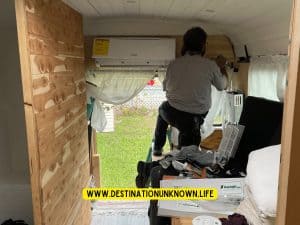
    The compressor is mounted underneath the bus with a screen to limit debris. The air handler is mounted in the rear of the bus in the captain’s quarters.

    A licensed HVAC technician in Cutler Bay, Miami connected our mini-split air condition system.


    Mechanical & Service History

    Prior to the purchase of the bus (September 2020), we had a mechanical inspection performed, and relied on the service reports from the school system. Immediately after the purchase in Tennessee, Eric took the bus to a second mechanic at the bus manufacture (Thomas Built Buses).

    In April 2021, a mobile mechanic performed an oil change and mechanical inspection.

    In June 2021, we had our rear air brakes and one new rear tire installed in Cutler Bay, Miami by a mobile mechanic.

    In August 2021, we had engine maintenance done in Worcester, Massachusetts. They fixed a radiator leak then.


    General

    Bus specifications

    • Length: 37 foot; Width: 8.5″ with side mirrors pushed in
    • Exterior Height: between 10 to 11 feet
    • Interior Height: 6.5 feet in the center
    • Engine: Cummins 5.9L
    • Transmission: Allison 2000
    • Mileage: ~215,000 miles
    • Weight: ~25,000 pounds

    Title & Insurance

    The HildeBus is titled as a motorhome in the state of Florida. As such, she is fully insured.

    Read the blog on how we insured her in Florida and her coverage limits.

    Interior floor plan

    Kitchen

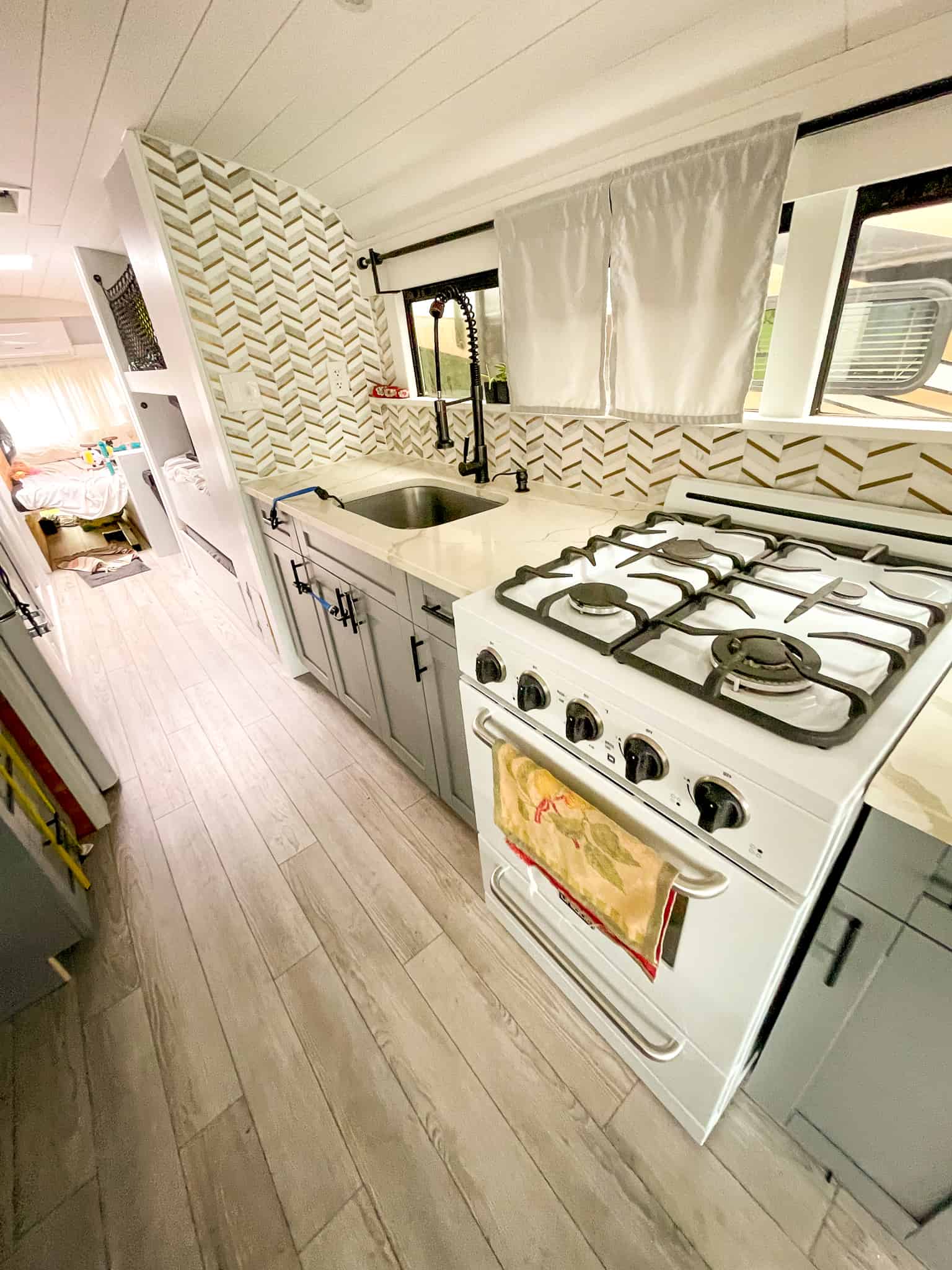
    To this day, I’m obsessed by our beautiful and functional kitchen space. I go into more detail on our skoolie kitchen in this blog here.

    Features of our kitchen:

    • Quartzite counters in light gray and white
    • Custom solid wood cabinets in gray-blue
    • Breakfast bar seating with storage
    • Vertical deep pantry storage with bread storage on top
    • Retro-looking appliances by Unique optimized for mobile dwelling
      • Fridge is powered by 12V
      • Range uses liquid propane gas
    • Single-basin stainless steel sink
    • Chef-style faucet, which doubles as an outdoor shower
    • Marble and gold tile backsplash
    • Cedar accents
    • Vinyl (not wood) window sills to limit bacteria growth

    Living room

    The couch is 7 feet long, which is great for a big family. It features deep storage underneath and can pull out to be a twin sized bed. The cushions are 4 inch upholstery grade foam. The couch has been installed with car seat mounting brackets as you can read in this blog.

    Attached to the couch (front of the bus) is a shoe storage space inlaid with antique heart of pine.

    The two captains chairs are black leather on a swivel base and can be reclined.

    We installed a liquid propane Dickinson marine heater with chimney between the two captains chairs, as a focal point.

    Above the driver’s chair (front of bus), we installed bookshelves and a horizontal cabinet for additional storage. We also built a dash board with two cupholders.

    Though the switches remain on the dash to the left of the driver’s chair, they do not work as that electrical was demolished in this vlog.

    One of two ceiling-mount vent fans are located here. This one has a rain sensor.

    Front door

    We installed a full tempered glass door from Home Depot. It includes built in shutters and provides fantastic visibility when driving.

    The door offers keyless entry with a Kwikset Smartkey Keypad. You can easily assign multiple codes, easily change the door lock, and set it up to automatically lock.

    Bunk bed cabin
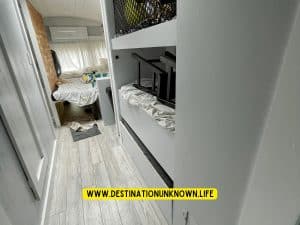
    We built 2 fixed bunk beds and 1 pull-out bunk bed over the wheel well in the middle of the bus. Additionally, we built a little nook with door to the right of the pull-out bunk. The kids love this for toy storage.

    The custom cushions are 3 inch upholstery foam.

    The bunks are built for a younger family. The stationary bunks are about 5 feet long and 3 feet wide. The lower bunk is about 4 feet long and 3 feet wide. If you had a child larger than this, we recommend they sleep on the pull-out couch in the living room.

    The fixed bunk beds have 12V lights and flexible nets, which are great when the kids are sleeping or for storage when driving. The top bunk also has a narrow shelf for storage.

    There is a manual 12V vent fan in the ceiling.

    The window is one of two emergency exit windows (the other is in the bathroom).

    Electrical Solar closet
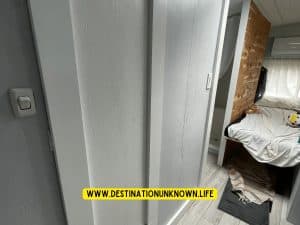
    This closet is located in the same corridor as the bunk bed cabinet, and includes all electrical and solar coming into the bus, such as electrical panel and lithium batteries.

    Captain’s Quarters (Rear bedroom)

    The bed frame houses the fresh water tank, pump and accumulator. There is storage in the rear of the bed frame and a built-in end-table above the pump house.

    When you want to change the bed from a daybed set up, it converts into a full-size bed. You’ll slide the top piece of the bed towards the cedar wall where it locks into place on a french cleat.

    The custom cushions are 4 inch upholstery foam.

    Custom cabinetry has been installed above the bed as well as in the closet located at the rear of the bus. The AC handler and ventless hot water heater are installed on this back wall.

    The rear door can be opened. It can be best secured with a padlock on the exterior.

    There is a roughly 2 foot by 2 foot skylight in this cabinet, which lets in natural light when the curtains are otherwise shuttered for privacy.

    Bathroom

    We installed a composting toilet, sink, light fixture above the sink and shower with bench seating. There is built in storage in the area next to the toilet.

    The window is one of two emergency exit windows (the other is in the bunk bed cabin).

    Composting toilet

    Our system is a 5 gallon bucket with plastic bag, coconut coir for the solids and a urine diverter to the gray tank for liquids.

    Shower
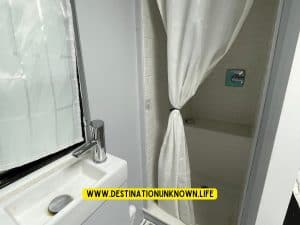
    After Eric framed the shower and bench, he installed cement board for the walls and a 2 foot by 2 foot shower pan for the base.

    Read the blog on how we built our skoolie shower here.


    Insulation Specifications

    • Closed cell spray foam throughout walls and ceiling. See vlog on that installation and this vlog on clean up.
    • Ceramic automotive insulation on framing where it comes in place with the metal frame. See vlog on that installation.
    • Rigid foam in the floor
    • We kept the original windows, but we resealed them all in 2021.

    Upgrades to limit rot and mold (reduce thermal bridge)

    • Vinyl (not wood) window sills.
    • Cedar accent walls in living room (couch), kitchen (by vertical cabinet), and captain’s quarters (feature wall).
    • Ceramic automotive insulation on framing where it comes in place with the metal frame. See vlog on that installation.

    Safety features

    • Smoke & carbon monoxide detector (installed in sleeping cabin)
    • Propane gas detector (installed in sleeping cabin)
    • Fire extinguisher (in solar cabinet)
    • Two emergency exit windows (bathroom and bunk bed cabin)
    • Rear and front doors work
    • Three Car-seat mounting brackets (read blog on car seat installation)
    • Seatbelts for the two captain’s chairs
    • Bungee cords to secure kitchen cabinets while driving
    • Bungee nets to secure items in bunks while driving

    Paint & Accents

    In February and March 2021, Ingrid spent many hours prepping the exterior of the bus for paint. We removed all vinyl decals with a rubber wheel and reflective tape with a heat gun followed by lots of goo-gone and acetone.

    Additional interior & exterior paint cans can be found in the storage bins below the bus for touch-ups as needed.

    Body Paint

    We choose a tintable oil-based product for automotive usage from Lowe’s. It’s similar to Rustoleum, but allowing for color variation.

    We further prepped the exterior for paint by sanding and washing with a heavy duty cleaner (link product on Amazon).

    After that, following the paint manufacturer guidelines, we applied a primer coat then two top coats of the colors we chose.

    We chose white for the window area and dark blue for the lower part of the body. It matched our house and car – we apparently like this color combination a lot.

    Vinyl Wrap

    In June 2021, we teamed up with Media 1 Wrap This for our custom vinyl wrap on the exterior of our tiny home. Admittedly, a new owner may not want our brand on the bus, so I would recommend speaking with them on the best ways to remove the wrap if you want to.

    Watch the wrap process by Media 1 Wrap This in vlog.

    Roof Paint

    In February 2021, the bus roof was lightly sanded then scrubbed with a heavy duty cleaner (link product- evergreen). It was caulked and painted using Tropicool products (bright white) recommended for high heat and sun conditions that we experience in Florida.

    We used this Henry’s Tropicool product on Amazon and it has a lifetime warranty; however, we do recommend servicing and cleaning your roof and panels at least once a year to assess for leaks. It costs over $500 for a 55 gallon bucket.

    The resulting finish is slightly tacky and grippy, which is nice if you have to service the panels on the roof.

    [lasso id=”4743″ link_id=”2170″ ref=”amzn-henry-he887hs073-tropicool5gal-tropicool-roof-coat-5-gallon”]
    Interior Paint

    In July 2021, we hired a professional painter to spray the interior. We used low VOC paint purchased at Lowe’s in a semi-gloss finish, to allow for easy clean up.

    We choose a limited color palette for the interior:

    • flat white for the ceiling
    • blue-gray for the walls
    • bright white white for the baseboards

    Frequently Asked Questions

    • Windows: The windows that remain are original. They were caulked and sealed in February 2021, prior to painting the exterior. See how we deleted our windows in this vlog.
    • Could a top bunk be removed? Yes, you could remove the top frame and give yourself more headroom on the bottom bunk.
    • Will the solar power the AC? No, you will need to plug into the grid in order to run the AC or use the two portable generators in tandem.
    • How much storage do you have on the exterior? We have 3 under-mounted storage bins that came from the manufacturer. One of the 3 bins goes back quite deep so it’s almost like a 4th bin.
    • Could I remove the compost toilet and replace with an all-in-one toilet like the Nature’s Head? Yes, simple pull out the frame and replace it with the toilet you want.
    • Is the bus being sold in As-Is conditions and furnished? Yes. Our intention is to sell the bus in As-Is condition with all fixtures, generators, water filters, and furnishings (curtains, shades, tableware, small appliances [InstaPot]), dry food storage containers, included.
    • Did your bus have extensive rust? No, probably because it comes from an area that doesn’t experience much snow. We treated our minor areas of rust as recommended (wire brush, Rustoleum spray paint). See that vlog here.
    • How did you frame the interior of the bus? Check out this vlog (walls) and this vlog (ceiling).
    • What size fresh water tank did you install? 100 gallons. Read this blog.
    • What size gray water tank did you install? 100 gallons. Read this blog.
    • How do you refill your propane tanks? There are securely mounted with releasable brackets in a storage bin on the right exterior of the bus (under the kitchen window). You close the valves, disconnect the hoses, and take to a center that will refill (some gas stations, RV parks, boat yards, and campgrounds offer refill stations).

    Go back to the Table of Contents!

    Conclusion

    Thanks for following our journey. – Ingrid & the HildeFam
  • The Ultimate Skoolie Guide To Buy a Used School Bus to Convert

    The Ultimate Skoolie Guide To Buy a Used School Bus to Convert

    How to buy a used school bus for a skoolie conversion

    If you are like us, when you first learned about the cool things you can do with a used school bus, your imagination was flooded with visions of a custom tiny house for epic family road trips, custom tiny spaces and maybe even music festivals!

    That’s why we made the “The Ultimate Skoolie Guide To Buy a Used School Bus to Convert.”

    Yes, you could buy a used school bus but…like…how do you know what to look for? And if you found an old school bus, how do you know if it’s a good bus for your skoolie conversion or a money pit?

    You may have already started researching online and quickly realized there are a lot of scams or misinformation out there.


    Case study: Our personal experience

    Where did we purchase our used school bus from?

    We purchased a flat nose 2002 Thomas school bus at government auction through GovDeals.com, sight unseen, for $4,500 in Sept 2020 from Sumner County School Board in Gallatin, Tennessee.

    We called a remote diesel mechanic to inspect the bus before we purchased it.

    Watch the vlog where Eric sees our own bus for the first time.

    What did we look for in our first bus?

    We are a family of five with no pets and needed a full sized school bus. We wanted a strong engine for driving up hills and mountains.

    The perfect bus for us ideally would look like:

    • Cummins diesel engine (5.9L Cummins or 8.3L Cummins)
    • limited surface rust
    • mileage under 100K preferably
    • no major mechanical issues with evidence of proper maintenance
    • no handicap access
    • 35 feet or longer
    • good tread on the school bus tires

    What we learned during our school bus conversion

    Timelines Change

    We thought we could complete our skoolie conversion in 4 months. Our skoolie life began 7 months from the time we started, and we still had a few projects left to complete when we moved in.

    How much storage space do you need?

    A key part in planning before you buy is determining how much storage space you will need, and not just on the interior.

    Don’t forget the exterior since that is where you may be mounting things.

    We got really lucky here because we had enough space underneath to mount our AC condenser and gray tank. Our bus came with 3 large storage bins already mounted, which allowed for ample storage and installation of our propane tanks.

    Engine Location

    We bought a flat nose bus, so our engine block sits next to the driver seat. A school bus engine puts off a lot of heat, like over 200 degrees Fahrenheit!

    It is brutal in the summer without AC inside the bus, even with the windows down.

    In hindsight, we would have preferred a rear mount engine or an engine mounted outside the front of the bus (also known as a “dog nose bus“).

    Case study of our budget

    Purchase budget

    • Used school bus purchase price: $4,500 in September 2020
    • Mechanical inspection with a mobile mechanic: $350

    Build-out of our school bus conversion

    • High-quality finishes, 6-panel solar array, DC fridge, professional inspections, labor: $50,000

    On-going maintenance

    • Surprise repair in May 2021 in Miami, Florida (brake line repair + new tire): $4,000
    • General maintenance and upgrades by Mechanic in Worcester, Massachusetts: $10,000
    • 5-days Hotel accommodation when we couldn’t live in the bus: $1,000

    Do you need construction experience to make a skoolie conversion?

    My husband, Eric, took on our skoolie conversion.

    He had limited to no experience in building, and relied heavily on resources online, the skoolie community, and professional recommendations.

    He tried to follow RV builder code as much as possible, and scheduled professional inspections at the rough-in and final stages for plumbing, electrical and gas.

    Eric spent about as much time researching before actually performing the activity, specifically around the electrical, gas installation and solar array set-up.

    Poor electrical decisions can lead to fire hazards. Eric studied for at least 2 weeks on how to properly install the 12V DC and AC electrical systems and consulting with several electricians prior to ordering the supplies.


    Best places to buy a used school bus for sale

    Survey responses from the skoolie community

    Sales vs. Source | Who did you buy your used school bus from? | The Ultimate Skoolie Guide To Buy a Used School Bus to Convert | Destination Unknown
    Sales vs. Source | Who did you buy your used school bus from?

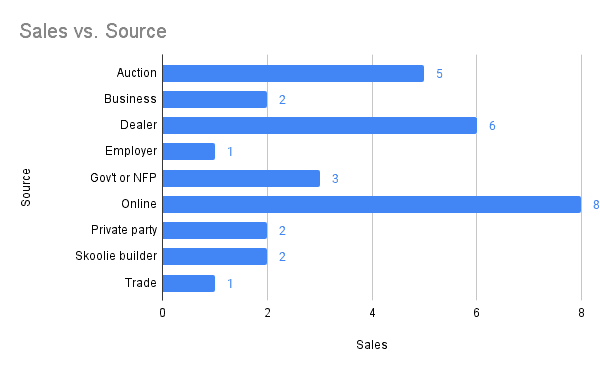
    I surveyed the skoolie community asking, “Who did you buy your used school bus from?” Honestly, I didn’t expect the results.

    Overwhelmingly, the results and discussion in the comments section showed that many of you purchased a bus locally on Facebook marketplace!

    I categorized the responses into nine source categories listed below. Within each category are seller recommendations that I will go into more detail in the next sections.


    Sources of used bus sales

    1. Auction
    2. Business
    3. Dealer
    4. Employer
    5. Government or Not-for-profit
    6. Online marketplace
    7. Private party
    8. Skoolie builder
    9. Trade

    Thank you to all the participants from the Facebook groups: Skoolie Nation and Skoolie Planet, and our Instagram stories.

    If I had surveyed a larger pool of people (more than 30), the results may have changed; however, I think the results are normal for a person polling people in the skoolie community for the purpose of seeing where they bought their bus from.

    Auction

    A benefit to using an auction site is that you may have more payment options available to you, like credit card, than a direct sale to a seller who may only take cash or certified check.

    Additionally, you may find more businesses than private sellers listing buses for sale on an auction site, since the auction staff can help them list and sell their used bus fleet quickly.

    eBay

    How to buy a school bus on eBay | The Ultimate Skoolie Guide To Buy a Used School Bus to Convert | Destination Unknown

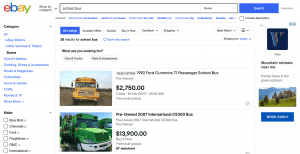
    One person surveyed purchased their bus on eBay. When I searched on “school bus” in the eBay search bar, I was pleasantly surprised by the selection of used school buses available, including fully converted school bus conversions for sale.

    eBay is a “household name” and reputable marketplace offering great buyer protection and payment options.

    Gov Deals

    This site allows government agencies to offer used goods. In fact they have tons of cheap school buses being sourced from school districts retiring their old fleets!

    This site has become the national clearing house, and you can find used school buses for sale in basically of the USA.

    An added benefit to purchasing through a middle man like this website is that you have some protection if the used school bus is in worse condition than stated.

    Furthermore, the school districts and other government agencies selling off fleets of retired school buses have no personal interest in them. They are unlikely to hide flaws and failures on purposes to mislead a new buyer.

    How to bid on buses on GovDeals.com
    How to buy a school bus on JJ Merchant | The Ultimate Skoolie Guide To Buy a Used School Bus to Convert | Destination Unknown
    1. Click “Register” in the top right corner to create an account.
    2. To find the used school buses, choose “Bus, Transits and Schools” on the home page.
    3. For a more specific search, used the Advanced Search at the top of the page. Select the “Find vehicle” tab. I recommend restricting the maximum price range between $0 to $15,000 or whatever your budget allows (the default price range is $0 to $50,000), and the location to a maximum radius from your home base. If you’re in Florida, driving to Alaska for a used school bus is pretty unreasonable.
    4. Decide on the used school bus or school buses that you want to bid on.
    5. Register a credit card when bidding. If you win the auction, they will a deposit first and then eventually the full payment due.
    6. Read the fine print since not every auction follows the same rules: we were allowed to inspect the vehicle before final purchase.
    7. Some auctions carry a reserve. That simply means that if the seller doesn’t receive a high enough price (the “reserve price”) then even if you win the bid, you may not be allowed to buy the school bus. To avoid reserve auctions, you can filter those auctions out.
    8. Expect active bidding at the end of the auction to occur, which may extend the clock. For example, if an auction is set to end at 5:00pm and bids continue coming in within 2-5 minutes of the auction’s scheduled end, then the time allowed to bid may increase by 2-5 minutes. This helps the seller receive the highest price from the most serious buyers.
    9. When bidding closes and you win your used school bus, the feeling is a mixture of happiness, relief and anticipation of what is to come.
    10. Make your deposit with the credit card on file.
    11. Schedule a mobile mechanic to inspect the school bus at the fleet yard or review the mechanical records prior to complete payment.
    12. Coordinate a time to pick up your school bus!

    To locate the bus auctions, from the home page, navigate to the left side to Categories. Click “motor pool” then “school bus.”

    JJ Merchant

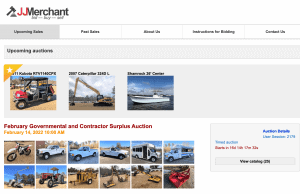
    One person surveyed got their bus here. This appears to be small auction site and there weren’t many active auctions at the time I visited. Maybe you can score a deal here if you keep checking back.

    Public Surplus

    How to buy a school bus on PublicSurplus.com | The Ultimate Skoolie Guide To Buy a Used School Bus to Convert | Destination Unknown
    How to buy a school bus on PublicSurplus.com

    This auction site is another government surplus site that has a variety of products for sale, including used school buses.

    Business

    Bus charter or bus operator

    Two people surveyed said they purchased their bus from a bus charter or bus operator. These would be companies that maybe operate tour groups and a 3rd-party operator that provides buses to business or individuals for a fee.

    Bus Dealer

    AAA Bus Sales

    Two people surveyed purchased their buses here. AAA Bus Sales in Pheonix specializes in sales, parts and services of buses.

    How to buy a school bus from Don Brown Bus Sales, Inc. | The Ultimate Skoolie Guide To Buy a Used School Bus to Convert | Destination Unknown

    Don Brown Bus Sales

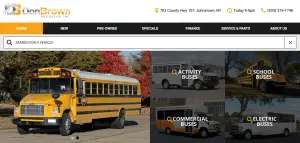
    Another two people surveyed relayed the positive experience they had working with Don Brown Bus Sales out of Johnstown, New York. There is also finance, service and parts divisions.

    Employer

    One person surveyed purchased their bus from their boss. If your employer runs buses, ask them if they plan on retiring any of the fleet soon.

    Government or Not-for-profit

    Of the people surveyed that purchased from governments or not-for-profit organizations, the responses showed bus sales from the following places:

    • Church
    • School Systems, School Districts, & School Boards
    • YMCA

    School Systems, School Districts, & School Boards

    You may find luck individually contacting a school system, school district or school board directly to purchase your used school bus.

    However, it is a lot easier to simply go to a reputable auction site that works with many school boards. We personally bought our used school bus from a school district using GovDeals.com.

    Online marketplace

    Eight people surveyed said they purchased their skoolie on an online marketplace, which was the most in our survey.

    Facebook Marketplace

    8 people surveyed purchased their old school buses on Facebook Marketplace.

    There’s no middleman so you can negotiate with the seller individually.

    Craigslist

    One person surveyed said she bought her bus on Craigslist. This community-lead forum is a great source for finding your school bus conversion, if you’re willing to look.

    Bus For Sale by Owner Classifieds

    Below are listed a number of sites specifically referencing classified ads for nearly everything related to school bus conversion sales, like school buses for sale, bus conversions for sale, skoolies for sale, and converted bus for sale.

    Private Party

    Be cautious when buying direct from the owner versus using a middle man or a business, like a school district, since that person has a greatly likelihood of deception because of financial interest.

    Make sure that they’re selling what they claim they are selling.

    Below are some helpful tips when dealing directly with a seller:

    • Use common sense. If the price seems too good to be true, ask yourself why that is.
    • Call the DMV. Check the VIN number on the bus to see if it has been reported stolen.
    • Ask for proof of ownership like a bill of sale or registration form.
    • Is it currently insured? Get a copy of the policy.
    • Is it registered with plates?
    • Is it safe to drive? Has it been in any accidents?
    • Are there any mechanical issues? Walkthrough the bus with the owner, if possible, and ask specific questions concerning common problem areas like surface rust, leaks, structural issues, engine issues and engine maintenance.
    • Has the owner recently had it serviced? Ask for records and receipts.
    • Will the owner allow you to have your mechanic take a look?
    • What method of payment do they want?

    You will pay taxes at the DMV when you register the vehicle. You’ll need to include the purchase price on the Bill of Sale.

    Facebook Groups

    We frequently see postings of school bus conversions in a number of popular Facebook Groups. Try searching within Facebook using terms like:

    • Skoolie for sale
    • School bus conversion for sale
    • Skoolie Buy Sell Trade

    I’ve compiled links to some of the Facebook bus groups specifically mentioning skoolie sales or bus sales in the description. Membership or joining the Facebook group may be required to see the posts.

    The skoolie groups are such a wonderful way to get tips, set reasonable goals during construction, find help and vibe with your tribe.

    Many share candid photos, videos, and information about conversions, offer advice and promote school bus sales.

    Skoolie Builder

    Depending on your budget and timeframe, using a reputable skoolie builder can be a lifesaver. I’ve prepared a list of skoolie builders who can manage partial and complete conversion in this blog. Some of these builders may also do sales of buses they’ve completed.

    Natural State Buses

    One person surveyed said they bought their school bus conversion from Natural State Buses builder located in Bentonville, Arkansas.

    According to their website, they specialize in:

    • Roof raises
    • Window & door installation
    • Spray foam insulation
    • Demo
    • Interior build-out

    Trade

    One person responded to the survey that they traded their old RV for their used bus, and I think that’s an awesome way to make a swap between like-minded people. This is also a cashless option.

    When all else fails, google it! Google is a powerful search engine. It knows your location and can easily pull up local bus yards in close proximity to where you live.

    Try searching on long-tail keywords like:

    • “School bus for sale near me”
    • “Old school bus sales”
    • “Used school bus auction”
    • “Retired school bus dealer”
    • “Buy school bus”
    • “Cheap school bus”
    • “Converted school bus”
    • “Used buses”
    • “Buy a school bus”

    Safe & Strong Construction

    There are a lot of things to consider when buying an old school bus. However, there is one thing you shouldn’t have to worry about, and that’s whether the bus you are looking at buying is safe or not.

    School buses are built to be extremely safe.

    School bus manufacturers must follow strict safety regulations because these vehicles transport children.

    I go into detail on why we purchased a retired school bus instead of an RV because of the quality of construction in this blog.

    What sizes do school buses come in?

    We can break the types of school buses into three sizes:

    1. Full sized school bus
    2. Mid sized school bus
    3. Short school bus

    Read this blog on how to determine what size school bus you need.

    Full sized school bus

    A full sized bus is greater than 30 feet long, with the maximum length reaching around 45 feet. These are the most common buses you see.

    Since long buses are a dime a dozen, the sales price compared to that of a short bus may be less.

    These size buses are best suited for four or more occupants, though reasonably under 6-8 people living on board.

    Mid sized school bus

    Mid sized school buses will fall somewhere between 20 feet to 30 feet. This size school bus is like Goldilock’s porridge: not too big, not too small, but just right. It provides enough interior space while not taking up too much space at say a parking lot.

    This size bus can accommodate two to four occupants living on board. Any more than that, and you may wish you had a longer bus.

    Short school bus

    A short bus is less than 20 feet. They are less common to find, but are a great option if you’re a single person or couple that don’t need as much space or wants to be more invisible in public.

    Short buses may be the perfect size for one to two people looking for something larger than a van, but smaller than a long bus.

    How wide is a school bus?

    The general width of a school bus is between 7-9 feet, including the mirrors. This is because school buses must navigate neighborhoods and city streets just like any normal vehicle would, and the government(s) place restrictions on the width.

    How heavy is a school bus?

    Most non-converted and school buses conversions weigh between 10,000 to 25,000 generally, depending on the size, finishes, and personal belongings. These are solid-built steel beasts, but you wouldn’t know it because the engine is made to pull it.

    As a reference, our large converted school bus weighs just around 22,000 to 24,000 pounds. Read about our features and upgrades in this blog.

    If you aren’t sure how much your bus weighs, you can take it to a truck weigh station. Read this blog on how to find a weigh station near you.

    What are the best used school buses to buy?

    One of the most common question asked by those looking to buy their first school bus is “what are the best buses to buy?” It depends on several factors.

    1. Your needs (are you a single person or a family of 5?)
    2. Your goals (do you have 2 months for the build or 1 year?)
    3. Living situation (will you live part time or full time in your skoolie?)
    4. Your budget (how much can you afford to spend on the school bus, repairs, build-out and on-going maintenance?)

    What to know before buying a used school bus?

    How much does a used school bus cost?

    During our search, we found the cost of an old school bus starts at around $4,000 and can go as high as $15,000, depending upon the age and condition of the bus.

    School buses are generally sold at a deep discount from their original price (over $150,000).

    They are sold either because they are too old for their intended use or because the owner has upgraded to a newer bus.

    How many miles will a school bus last?

    School buses are designed to last for well over 500,000 miles. But that doesn’t mean that a school bus will last for well over 500,000 miles in every case.

    The exact number of miles you can get out of a school bus depends on how the bus is used and maintained.

    If the bus is used for just one purpose — transporting students — and kept at a reasonable speed (no more than 65 mph), it will likely last much longer than if it’s used as a workhorse to run errands and haul cargo.

    School buses are also built with safety features to help them endure accidents. But even these safety features have their limits. If a school bus crashes at 35 mph, it may not be able to withstand the force.

    If it crashes at 15 mph or slower, its safety features and construction can help the bus survive longer.

    How do you make sure your school bus has a long life?

    There are other things you can do to keep your bus in top condition and in good working order. We’ve listed a few below:

    • Inspect it weekly for leaks (more frequently if driving regularly)
    • Treat surface rust quickly
    • Power it own to make sure the batteries have a charge and the air brakes (if any) engage
    • Check oil levels
    • Replace worn-out parts before they become hazardous.

    Should you buy a bus that has already been gutted and renovated?

    Pros for Gutted:

    • You can more easily examine the bus for rust and water intrusion during your inspection.
    • You will save a lot of time and money by eliminating the need to completely gut the inside of the bus yourself.
    • You don’t have to dispose of all the seats, wall panels, scrap metal and hardware

    Pros for Not Gutted:

    • It may cost less since no labor has been performed to demolish the interior
    • You don’t get that first experience of gutting your bus

    Before buying guide

    Decide what are key things you’re looking for like length, engine size and how far are you willing to travel to get it?

    In order to make the best decision possible, you need to know what to look for and where to look. It is also important to know what you should avoid.

    While some of these tips may not apply to every situation, they are easy enough to follow that they will help you identify a good purchase before buying.

    Skoolie Buying Guide Questionnaire

    • What’s your purchase budget?
    • How far are you willing to travel to pick it up?
    • Have you reviewed the bus’s mechanical history?
    • Will you or a mechanic inspect the bus before purchase?
    • How will you purchase the bus?
    • Will you use it for full time or part time living?
    • How will you insure it?
    • How will you register it with your DMV?
    • How much have you budgeted for maintenance and repairs?
    • What are the bus weight maximums?
    • What type or size of engine does it have?
    • Where is the engine located: inside-front, inside-rear or outside.
    • Is there a Handicap access?
    • Does it have air brakes or hydraulic brakes?

    How to inspect before buying a school bus

    Inspection by a Mechanic

    If you aren’t qualified to do an inspection before buying, find and pay a mechanic. The inspection will run you between $300-$500, depending on where the mechanic is coming from and the time it takes to perform the inspection.

    We found that where there was a large fleet or auction of buses, there was usually a mechanic shop nearby. You can search for “diesel mechanics” near the area your bus is located.

    The first thing you should do when considering buying a used school bus is to have it inspected by a mechanic. The second thing you should do is have it inspected by a mechanic. Thirdly, get another mechanic to inspect the bus. Fourthly, get two other mechanics to inspect the bus, just in case they missed something the first three times.

    Trucks of this size and age are not often bought by individuals, but rather companies that deal in used school buses. There are several reasons why buying a used school bus from one of these companies is a much safer bet than doing so from an individual.

    The most obvious reason is that they’ve been inspected by mechanics who know what they’re doing and who can answer any questions you may have about the state of the vehicle’s mechanical condition.

    The body

    You have to look at the outside of the bus for rust and in areas that may have contact with water in the interior like window sills and stairs.

    Rust is really common with buses in the north that experience snow or that are more coastal, where the salt content is higher.

    Rust can do significant structural damage to the steel frame of a school bus if left unattended.

    Check the school bus tires for dry rot or cracks. Make sure that all doors open and close properly. If there is no air conditioning system then check if there is any water damage from condensation due to not having A/C.

    Make sure that all of the lights, turn signals and other things are working properly.

    The engine

    Look at the engine of the bus for oil leaks and check for any signs of damage which would indicate that it was in a crash or flood or otherwise damaged.

    Make sure to check underneath for oil leaks coming from any parts near the bottom of the engine block.


    Conclusion

    After reading this you should have a better idea of what to expect when you buy an old school bus and the steps you have to take in order to convert it into a skoolie.

    The more time you put in upfront before you shell out cash will save you from more headaches down the road.

    If you still think that it’s worth the risk, then go ahead and give it a shot. It will be an adventure you’ll remember for the rest of your life. We did and we don’t regret it!


    Thanks for following our journey. Click here to check out more of our skoolie posts. – Ingrid & the HildeFam

  • Are skoolies allowed in fancy RV parks?

    Are skoolies allowed in fancy RV parks?

    Are skoolies allowed in fancy RV parks? Heck yes!

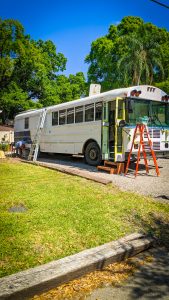
    Are skoolies allowed in RV parks? | White Skoolie | Destination Unknown
    Are skoolies allowed in RV parks?

    I list out below a few helpful questions to ask upon booking and our personal experiences, state by state, during our travels along the east coast of the United States between May to October 2021.

    When we researched how we were going to travel in our skoolie (school bus conversion), we read a lot of forums and Facebook posts stating all the trouble that they had finding places to park, getting skoolie insurance in Florida, getting titled as a motorhome, etc.

    We haven’t had difficulty in these areas so I’m creating a Skoolie series to dispel the rumors and talk about it. I hope it helps others!

    Table of Contents

    Common Reasons Why Skoolies Aren’t Allowed in RV Parks

    Unfortunately, there will always be private RV campgrounds that run their businesses as they see fit, even if it doesn’t make sense to a skoolie owner or blatantly prejudices against the community. If you’re curious what some of those reasons may be, read the Shocking Reasons Skoolies Aren’t Allowed in RV Parks.

    Which RV parks have we stayed in?

    We stayed at the Florida RV parks at the height of summer and in a popular tourist destination, the Florida Keys. We had no problem booking a reservation (other than booking last minute!).

    Questions to ask when booking

    Like I mentioned, all the parks we stayed at allowed our skoolie. The only issue we ever ran into was length restrictions – specifically, Acadia National Park in Maine restricted length to under 35 feet (I believe) and we were 37 feet.

    Though disappointing that we couldn’t park inside the park, there were a significant number of other private RV parks we could stay at (& with shuttle service!).

    We also recommend longer booking periods, rather than paying by day, because you get a discounted rate for weekly and monthly stays.

    1. What is the maximum size rig you allow?
    2. Do you have water hook-ups?
    3. Do you have electric hook-ups?
    4. Do you have laundry services?
    5. Do you offer a Good Sam discount?

    Options to staying in RV parks

    Don’t despair if you ever do get turned down. Other than the embarrassment or anxiety related to being “broken up with,” skoolies tend to be built as resilient rigs. Ours was, anyway.

    Boondocking is a solid option

    We built our “land yacht” with the intention of allowing us to be off-grid and redundancies in case one electrical or heating source failed.

    We added 6 solar panels to our roof, which allowed us to power everything except the air conditioning. We added propane as our primary heat source. We also installed 100 gallon fresh water & 100 gallon gray water tanks, so we didn’t have to refill as frequently.

    You can camp for free overnight in Wal-Mart, Lowe’s, and Home Depots. Honestly, most commercial restaurants or parking lots tend to be cool with it. You can check with security ahead of time – they don’t really mind especially if you’re nice on the front end.

    We frequently would get food at Buffalo Wild Wings and then park overnight. Thanks to the managers there!

    Harvest Hosts & Boondockers Welcome

    Harvest Hosts has now purchased Boondockers Welcome, so they are one and the same. We loved these services because they were more affordable or free with a purchase at a business (like a restaurant or bar).

    We found many of our campsites like in North Florida and in a sunflower field in South Georgia using Harvest Hosts.

    Harvest Hosts is website that brings together hosts that are RV & Skoolie-friendly to spend 1 night at their home or place of business.

    To get 15% off your membership with Harvest Hosts, use our link to register. In return, we do get $15 for referring you. Will it be worth it? We think so. 


    Thanks for following along with our journey and RVing adventures. – Ingrid & the HildeFam

  • How to easily insure a skoolie in Florida

    How to easily insure a skoolie in Florida

    We have quickly and easily insured our school bus conversion twice in Florida with no issues. The first time we insured our decommissioned school bus was the day before we bought her at auction, with all the seats and school bus markings. Next, we changed providers after we titled her as a motorhome and received better rates.

    We read many articles and forums describing the difficulty some people had getting insurance on their skoolie or school bus conversion, and that just isn’t the case if you know who to speak with.

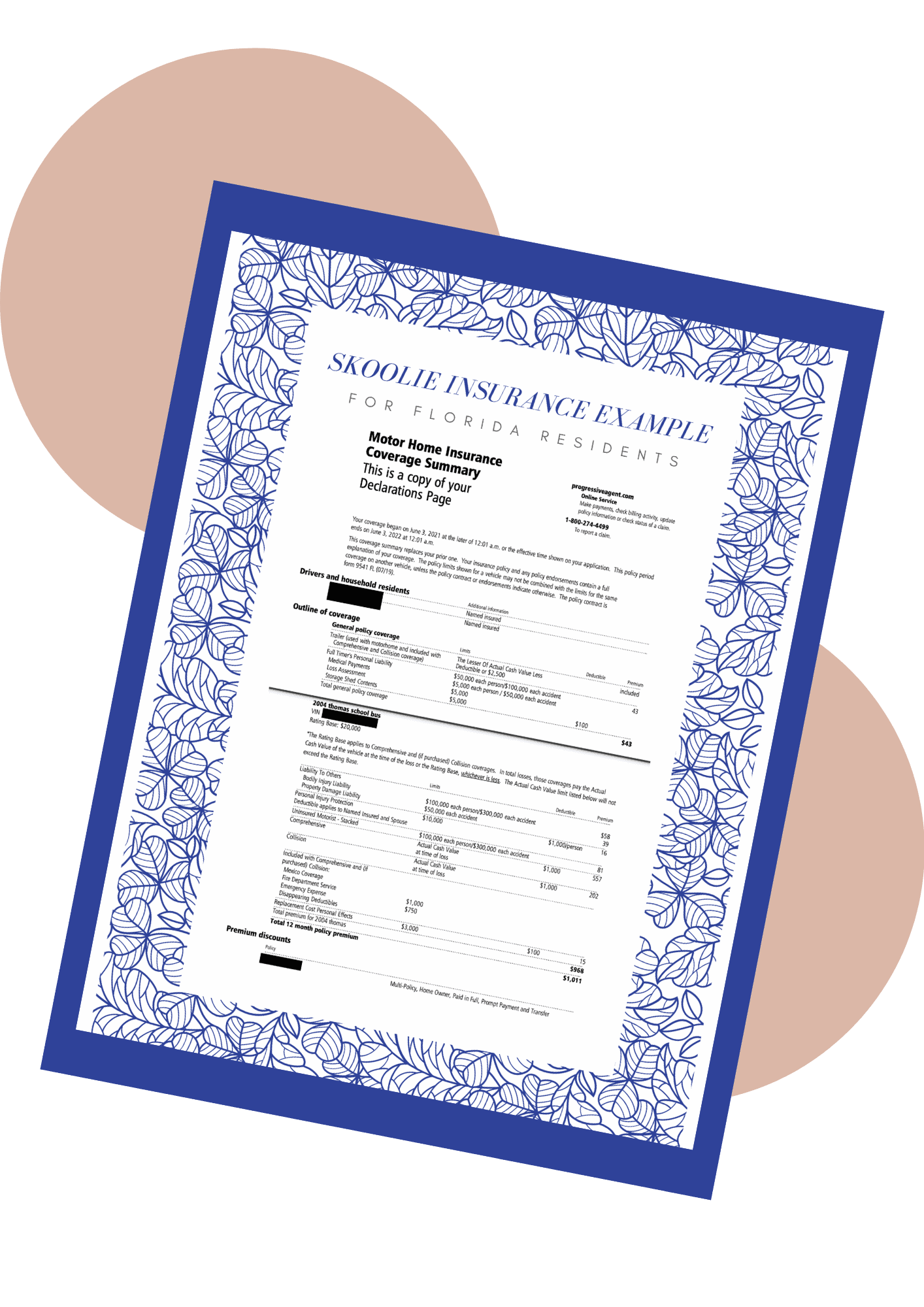
    I even include a copy of our Florida skoolie insurance policy so you can use it to help you when you quote out your skoolie insurance.

    Skoolie Insurance Example from Progressive Insurance in Florida | Destination Unknown Bus | insure a skoolie
    Free Skoolie Insurance Example

    Table of Contents

    Insure your skoolie with an independent insurance agent

    My biggest recommendation is to work with an independent insurance agent who understands school bus conversions.

    We worked with two independent insurance agents, Marie Carney & Kelly Newsome, on different occasions to find us the best rates across all the automobile insurance providers in Florida.

    The huge benefit to working with an independent insurance agent is she is not restricted to working with one insurance company. This saved us a lot of time because she did the research on which insurance providers would insure a school bus conversion, whether the conversion has not started or if it is fully complete.

    The added benefit of working with an independent agent is you may also be able to bundle your car, motorhome and home policies together. We did this with our skoolie & car, which saved us money and just the headache of paying different providers.


    Insurance agents that insure Skoolies in Florida

    • Marie Carney, Vystar Insurance Agency
      • Direct 904-594-5464; Brightway Service 888-254-5014
      • Marie.carney@brightway.com
    • Valeria Alovan, Garzo Insurance
      • Phone 321-206-8035 Ext.503
    • Kelly Newsome, Allstate
      • Phone 352-326-9300
    • Good Sam RV Insurance
      • 1-888-514-1116
    Good Sam Roadside Assistance: Built With The RVer In Mind! Plans Starting at $49.95 Shop Now!

    Insurance companies that insure school bus conversions

    What insurance providers actually insure decommissioned school bus conversions and skoolie motorhomes?

    Here are a list of insurance companies that I’ve come across that may insure a school bus conversion. These providers may vary state to state, and the list is not specific to Florida.

    • Progressive
    • Allstate
    • National General (“The General”)
    • Liberty Mutual
    • Good Sam RV Insurance
    • SafeCo
    • Geico
    • Laris Motorsports Insurance

    Progressive

    This is who we’ve insured our skoolie for the past two years. Our independent insurance agent bound a policy with Progressive Insurance. The terms were reasonable and our detailed below.


    This is a breakdown of our personal school bus conversion insurance policy with Progressive.


    What questions did our insurance agent ask before insuring our skoolie in Florida?

    What is the cost & rating base on skoolie insurance in Florida?

    • Total annual policy amount: $1,011
    • Rating base: $20,000

    We paid the annual policy up front – we didn’t have the option to split the payments into smaller periods with this provider. We went with minimum coverage on the policy.

    Are you living full time or part time in your school bus conversion?

    We were planning to or already living full time in our policy, and the insurance wanted to make a distinction for this on our policy.

    What are the coverage & liability thresholds to insure a skoolie?

    Our policy covers:

    • personal liability like medical payments, loss assessments and storage shed contents
    • liability to others
    • personal injury protection (PIP)
    • uninsured motorist (stacked)
    • comprehensive & collision (including in Mexico)
    • replacement cost of personal items ($3,000 limit)

    What evidence did we provide our insurance agent to show we were a motorhome?

    We sent our agent:

    • Our Florida title and registration
    • Provided her with our VIN number

    Since we are titled as a motorhome in the state of Florida, the process to insure our skoolie was the same as insuring a “normal” motorhome.

    Progressive, at the time we bound, actually had a drop down option for school bus conversion.

    This may come in handy if you do modifications like a roof raise on your bus tiny home.


    FAQs on Binding Insurance on a Skoolie in Florida

    Can I insure my school bus conversion if I am not yet titled as a motorhome?

    The short answer is yes. We purchased our decommissioned school bus in Tennessee and we received a temporary Florida insurance policy with Allstate Insurance, which allowed the insuring of a vehicle that wasn’t titled as a motorhome.

    The cost to insure our school bus was reasonable though more expensive than after we completed the conversion and titled it as a motorhome.


    How do you retitle a decommissioned school bus as a motorhome in Florida?

    The process to update our school bus title from “bus” to a “motorhome” was really simple in Florida. Read this blog on how we did it and the forms we used to do it in about 10 minutes.

    Does a skoolie insurance policy cover personal possessions?

    It depends on if you elect personal property coverage on the skoolie insurance policy or purchase a separate policy for personal property in your rig.

    Check your current school bus conversion insurance declaration page to determine if there is personal property coverage on your policy. If you don’t have coverage, then you can contact your insurance agent to create a policy, like a renter’s insurance policy, that will cover your belongings and personal property like appliances in case of loss.

    Can I obtain a motorhome coverage on my skoolie if it isn’t titled as a motorhome?

    No. To obtain motorhome or RV coverage, you must have your school bus conversion titled as a motorhome.

    If your decommissioned school bus is still being converted into a motorhome, you can and should have insurance on it. Check with an independent insurance agent that is knowledgeable about RVs and skoolies. I’ve referenced a few above.

    Does my school bus conversion need to be inspected before getting insurance?

    It depends state-to-state, honestly. Personally, we’ve insured our skoolie twice, once before the conversion was complete and it was titled as a motorhome with Allstate and then after with Progressive, and we never had to have it inspected in Florida.

    How much does school bus conversion insurance cost?

    We pay just over $1,000 for an annual motorhome school bus conversion policy with Progressive in the state of Florida (2021-2022). Our skoolie is titled as a motorhome in Florida.

    We were previously insured in 2020-2021 with Allstate before our decommissioned school bus was even built out. That annual policy cost was about $1,200.

    Additional Resources

    If you’re needing more information on insuring your school bus conversion, then check out the Van, Skoolie, & RV Insurance blog on the Skoolie Supply website.


    Thank you for following our journey – Ingrid & the HildeFam

  • 10 Stunning Skoolie Small Kitchen Ideas That Just Make Sense

    10 Stunning Skoolie Small Kitchen Ideas That Just Make Sense

    Designing our skoolie small kitchen was no small task. Having strong design in a tiny home kitchen is so important! I share the 10 design choices we made in our skoolie small kitchen that we’re obsessed with.

    10 Skoolie Small Kitchen Design Ideas

    1. 12V Fridge
    2. Breakfast bar seating with storage
    3. Chef-style pull-down kitchen faucet
    4. Foldable drying rack
    5. Propane range with cooktop and oven
    6. Quartzite counters
    7. Storage containers for dry goods
    8. Undermount single basin sink
    9. Vertical cabinet with soft-close drawers
    10. In-line water filtration

    12V Fridge

    We designed our skoolie to be completely off-grid with our main power source coming from solar energy. As such, we needed appliances that were as energy-efficient as possible and designed for mobile application (RV or marine).

    When performing our energy audit, we determined that most of our energy pull would be from large house-hold appliances (refrigerator) and heating & cooling sources (air-conditioning).

    We purchased a 12V 10 cubic foot refrigerator from Unique, a Canadian brand that specializes in manufacturing appliances for off-grid and mobile application. Unique also sells a 110V version at about 1/2 the price of the 12V. Both fridges will be more energy-efficient when compared to your normal household refrigerator.

    Breakfast bar seating with storage

    When you live tiny, it’s imperative that you have multi-use spaces. Our breakfast bar fits 2 wide bar stools with room for a third. Under the counter is cabinet storage for our dry goods and the kids’ snacks. We share meals around it, make art projects, complete office work, and just chill around this space.

    Adding the breakfast bar was probably the best design choice we made for our tiny home.

    Chef-style pull-down kitchen faucet

    Skoolie kitchen with quart counters, pull-down faucet and propane stove with oven

    I mentioned in our “12 Hacks for Living in a Skoolie” blog that our faucet was an amazing design choice. When we’ve just come from the beach, we can swivel the faucet around and pull the sprayer out of the kitchen window to hose off sandy items or use it as an outdoor shower. Because of it’s high arch, we can also clean tall items in the sink like pots or children!

    Foldable drying rack

    We purchased up a roll-up drying rack that goes over the kitchen sink or over a towel on the counter. It is such a space saver and folds away easily under the sink when not in use. When drying everything on a towel on the counter, mildew grows quickly because there isn’t airflow. This compact drying rack solved that issue for us.

    We purchased ours at Home Depot or Lowe’s.

    Propane range with cooktop and oven

    We purchased the white 24″ 4-burner propane gas range with oven, cooktop & broiler by Unique. We love how well it cooks food and that it was made for off-grid and mobile application. This range is from the same brand, Unique, as the fridge so they have a matching retro look that we enjoy.

    Quartzite counters

    Choosing quartz or quartzite countertops for our skoolie felt like a splurge; however, it really wasn’t that bad. Because of the small space, we were able to score a deal by purchasing a remnant from a larger job. That piece, including the kitchen sink, installation and labor, came out to about $1,400.

    We love that it is easy to clean, stands up to children and holds up well in a mobile application.

    Storage containers for dry goods

    We purchased plastic storage containers from IKEA for all dry goods in our tiny home. I mentioned in “5 Easy Steps to Live Intentionally with Less in a Skoolie” blog that we try to limit packaging coming into the bus. These containers have been a great solution to that problem and they double as food storage contains for large meals that go into the fridge.

    We recommend buying plastic or metal containers – avoid glass, even tempered glass, because items do fall out of cabinets and can break!

    Undermount single basin sink

    We love having a single basin sink for a small living space. It’s easy to fit all the dirty dishes (or kids) into one deep sink, and it also holds things like our large cast iron skillet when driving (so it doesn’t fall off the counter!).

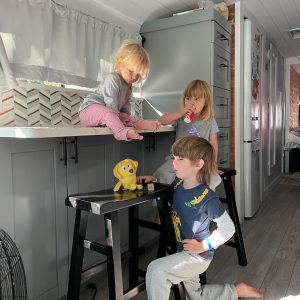
    Three children in a skoolie small kitchen
    Madeleine, Finley & Landon relaxing in our skoolie.

    Having the undermount sink is a nice feature to keep the counters clean and avoid the inevitable build-up of gunk around the rim of a kitchen sink. Everything can be pushed into the sink easily.

    Vertical cabinet with soft-close drawers

    Utilizing vertical space in a tiny home is key in a strong design. Rather than installing upper cabinets, which would have required us to lose that feeling of openness in the living space, we opted for a vertical cabinet with pull-out drawers instead. They are also soft-close, which is so lovely in a busy household.

    In-line water filtration

    We have two water filters in our skoolie. One is an in-line filter that screws on to the hose for water coming into the bus. This filters out any particles or sediment. Under the kitchen sink, we installed another filter that further purifies the water in the bus and makes it drinkable.

    We prefer the in-line water filters because they are out-of-sight and don’t require us to move them when traveling. Countertop water systems like the Berkey require regular maintenance (refilling and cleaning) and storage when driving.


    Do you have a skoolie small kitchen?

    I hope you enjoyed our 10 most-loved design choices in skoolie small kitchen. I would love to get your input in the comment section if you would put any into your tiny home on wheels.

    Thanks for following our journey. – Ingrid & the HildeFam